The Honeywell TP50WKN is the quiet pick for a basement that doubles as living space. Live Science measured it holding a steady ~61 dB next to the unit, quiet enough not to talk over, and owners give it 4.5 stars across more than 1,400 ratings. Its mirage display reads humidity from across the room, it covers up to 3,000 sq ft, and auto-defrost keeps it going in cool basements. There is no pump and the tank is small, so plan for a gravity drain.
Full review
Real-World Performance
The Honeywell TP50WKN is a dependable mid-priced 50-pint unit with an unusually strong owner consensus: 4.5 stars across more than 1,400 Amazon ratings, with buyers repeatedly praising how easy it is to set up and run. Live Science's hands-on review found it removed moisture steadily and credited it as a quiet, easy-to-live-with dehumidifier. For a basement that needs reliable, ongoing moisture control rather than the absolute fastest drying, it hits the mark.
Rated for rooms up to 3,000 sq ft, it suits typical and larger basements, and its smart digital humidistat senses room moisture and activates dehumidification automatically to hold a target level. It is not the quickest drier in this roundup, but its consistency and the breadth of positive owner feedback make it a low-risk choice.
Quiet Operation
Quiet is the TP50WKN's calling card. Live Science measured it holding a steady level that never exceeded about 61 dB right next to the unit, save for a brief spike to 74 dB at startup, and concluded you do not need to raise your TV volume or talk louder while it runs. That makes it noticeably more pleasant than the Midea Cube or GE APER50LZ on high, both of which push into the mid-60s and beyond.
For a basement that doubles as a bedroom, home office, or gym, that lower, steadier noise floor is the single best reason to choose this unit. A dehumidifier in a living space runs for hours, and the difference between a quiet hum and a loud drone is the difference between a unit you forget about and one you keep wanting to switch off.
Design and Usability
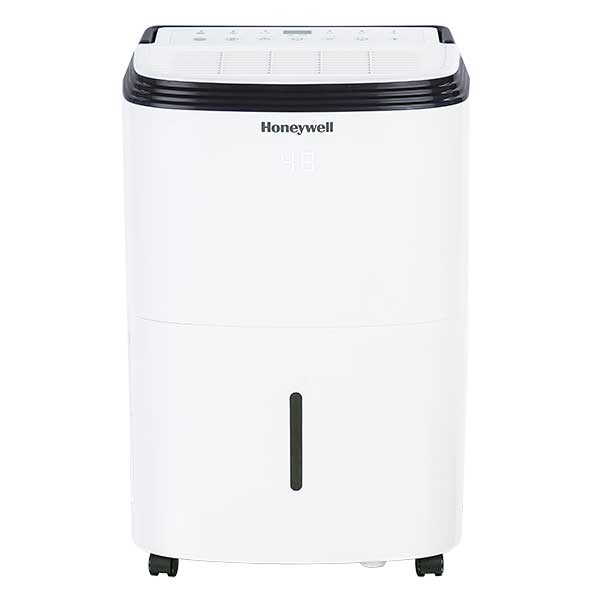
The TP50WKN's standout design touch is its front mirage display, an elegant readout that shows current room humidity from across the room so you can check conditions at a glance without bending down to the unit. Reviewers and owners alike singled out this display as a genuinely useful and attractive feature rather than a gimmick. The flat white body with a black bezel looks clean enough to live with in a finished space.
Practical usability is well thought out too: a heavy-duty flip-up handle and smooth wheels make it easy to roll between rooms, a cord winder keeps the cable tidy, and the washable filter rinses clean under a faucet with no replacement cartridges to buy. Full-tank and filter-clean alerts take the guesswork out of maintenance.
Drainage and Maintenance
The TP50WKN offers a continuous-drain option: connect the included hose and let condensate drain by gravity to a nearby floor drain for long unattended operation. Patent-pending splash guards on the tank reduce messy spills when you do empty it manually. For a basement with a drain at or below the unit, that gravity option makes for largely hands-off running.
The limitation is that, like the Frigidaire Gallery, this unit has no built-in pump, so it cannot push water uphill. And its water tank is relatively small, which means that if you rely on bucket emptying rather than a hose, you will be emptying it frequently to keep pace with a damp basement. Buyers should plan to run the continuous drain to get the most from it.
Where It Falls Short
The two practical drawbacks are the lack of a pump and the small tank. In a below-grade basement where the drain sits above the unit, you would need a pump-equipped model like the Midea Cube or GE APER50LZ instead. And without a continuous hose, the modest tank fills quickly in very humid conditions, undercutting the set-and-forget appeal.
Sourcing is also worth noting: the TP50WKN is sold primarily through Honeywell's own store rather than as a clean Amazon listing, so the buy link points to Honeywell direct. The warranty is a standard one year. None of these undercut its core strength of quiet, reliable operation, but they shape who it is right for.
Who It's Best For
Choose the Honeywell TP50WKN if your basement doubles as a living space and quiet operation is your priority, and your drainage situation allows a gravity hose or you do not mind emptying the tank. It is the best pick here for a finished basement bedroom, office, or gym, where its low noise floor, attractive mirage display, and reliable performance make it easy to live with.
Look to the Midea Cube or GE APER50LZ instead if you need a pump to lift water out, or to the Waykar 34-pint if you want to spend less for a smaller space. For the quiet-seeking finished-basement buyer with workable drainage, though, the TP50WKN is the standout.
Value at This Price
At around $230 the TP50WKN sits below the 50-pint smart units in this roundup while still covering up to 3,000 sq ft, which makes it a sensible mid-priced choice for a basement that does not need a pump. Its strongest value argument is the breadth of positive owner feedback: a 4.5-star average across more than 1,400 ratings is an unusually large and consistent sample, signaling that buyers reliably get a quiet, dependable unit for the money.
You are not paying for a pump or deep Wi-Fi app control, which keeps the price down, and the washable filter means no recurring filter costs. For a finished basement where quiet and reliability are the priorities and gravity drainage is workable, that combination of a fair price, low noise, and a proven owner track record is a strong value, even if the buy link points to Honeywell direct rather than Amazon.
Strengths
- +One of the quietest units in this roundup; Live Science measured a steady ~61 dB right beside it
- +Strong 4.5-star owner consensus across more than 1,400 Amazon ratings
- +Elegant front mirage display reads room humidity from across the room
- +Continuous-drain option plus a washable filter with no replacement cartridges
- +Covers up to 3,000 sq ft with auto-defrost for cooler basements
Watch-outs
- −No built-in pump, so it needs gravity drainage or bucket emptying
- −Water tank is on the small side, requiring frequent emptying without a hose
- −Not sold as a clean Amazon listing; buy direct from Honeywell
- −1-year limited warranty
How it compares
The quietest unit here, beating the Midea Cube and GE APER50LZ noticeably on noise, which makes it the pick for a finished basement. It trades away the pump that the Midea Cube and GE APER50LZ offer and the deep smart features of the Frigidaire Gallery FGAC5044W1, so it suits gravity-drain basements where quiet matters most.
Who this is for
At a glance: Finished basements used as a bedroom, office, or gym where quiet operation matters and a gravity drain or regular bucket emptying is workable.
Why you’d buy the Honeywell TP50WKN 50-Pint Energy Star Dehumidifier
- One of the quietest units in this roundup; Live Science measured a steady ~61 dB right beside it.
- Strong 4.5-star owner consensus across more than 1,400 Amazon ratings.
- Elegant front mirage display reads room humidity from across the room.
Why you’d skip it
- No built-in pump, so it needs gravity drainage or bucket emptying.
- Water tank is on the small side, requiring frequent emptying without a hose.
- Not sold as a clean Amazon listing; buy direct from Honeywell.
Rating sources
“It is, overall, a very quiet dehumidifier that doesn't really require you to raise the volume on your TV or talk louder while it's running.”
“Customers were happy with how easy it is to get going, and many praised the mirage front LED indicator that reads the current room humidity.”
“Removes up to 50 pints (2019 DOE Standard) of moisture daily for rooms up to 3,000 sq. ft. with a continuous drain option and auto-defrost control.”
Our 4.4 score is the average of these published ratings. Ratings marked * were derived from the reviewer’s written analysis or video transcript — the publisher didn’t print an explicit numeric score, so we inferred one from their own words. Click through to verify. More about methodology.