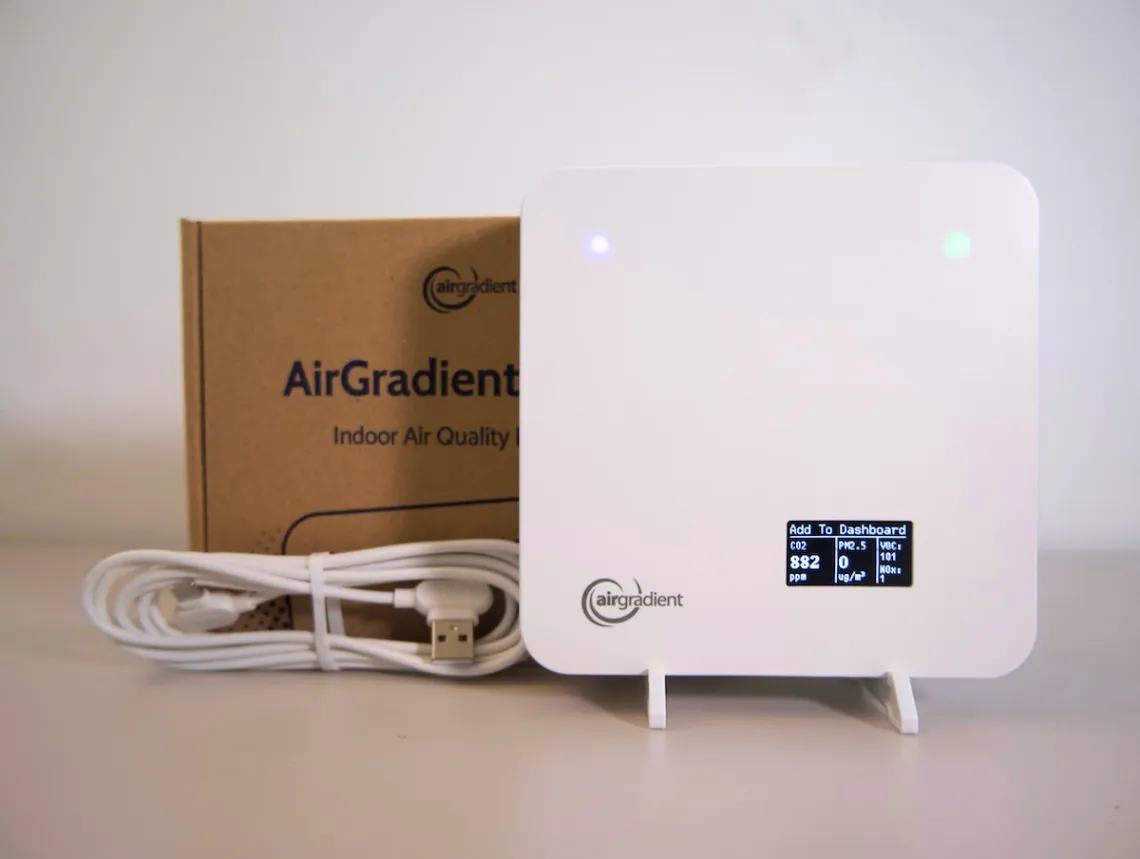
The AirGradient One measures carbon dioxide, PM2.5, VOCs and NOx on an open-source board, sold assembled for $230 or as a $138 kit. It uses better-specified sensors than most consumer monitors at the price, exposes every reading to Home Assistant and ESPHome, and keeps the data yours. What it asks in return is a tolerance for setup work: a browser-based Wi-Fi handoff, Torx screws that strip, and no radon sensor at all.
Full review
A SenseAir S8, a Plantower PMS5003 and two Sensirion parts
The sensor list is the reason to buy this rather than a sealed consumer monitor. Carbon dioxide comes from a SenseAir S8, a true NDIR part quoted at plus or minus 30 ppm and 3 percent of reading, rather than the estimate cheaper devices infer from VOC readings. Particulates come from a Plantower PMS5003, temperature and humidity from a Sensirion SHT40, and the VOC and NOx indices from a Sensirion SGP41. Every part is named, documented and replaceable, which is not true of anything else at this money.
PM2.5 is trustworthy, PM10 is not
Optical particle counters of this class size particles by how they scatter light, and that works well at the small end and poorly at the large one. Treat the PM2.5 figure as usable and the PM10 figure as indicative at best, which is a limitation of the sensor category rather than of this board. The carbon dioxide reading is the strongest number the device produces, and it is also the one most worth acting on in a bedroom or a small office.
Open firmware, Home Assistant and ESPHome
Everything on the software side is open. The firmware can be flashed straight from a browser, the board will run ESPHome instead if you prefer, and Home Assistant picks it up with every sensor exposed. The AirGradient dashboard covers firmware updates, data export, notifications and multi-location management for anyone who would rather not self-host. Assembled units ship with a test report showing the corrections applied to bring their readings in line with reference-grade monitors.
Setup over a captive hotspot, and Torx T6 screws
First setup means joining the device's own Wi-Fi hotspot and configuring it in a browser, and that step fails often enough that a reset and a second attempt is a normal part of the experience. The case closes with Torx T6 screws, which strip more easily than they should; the driver is included in the box, which tells you something. There is no radon sensor, so anyone shopping specifically for radon should look at the Airthings range instead.
$230 assembled, $138 as a kit
The kit at $138 is the same hardware without the warranty, the certifications or the factory calibration report, and The Home Assistant Blog puts assembly at about 10 minutes for anyone with some technical flair. The assembled unit at $230 is the sensible choice for anyone who wants readings rather than a project. Either way the running cost is nothing and the data stays on hardware you own, which is the real argument against the subscription-shaped alternatives in this category.
Strengths
- +Easy to assemble and configure with user-friendly instructions
- +Integrates seamlessly with Home Assistant for full control and automation, per The Home Assistant Blog
- +Provides accurate readings for CO₂, PM₂.₅, VOCs, and NOₓ sensors
- +Affordable pricing with a kit option available for 138 USD, according to The Home Assistant Blog
Watch-outs
- −The Home Assistant Blog found the initial WiFi hotspot setup problematic
- −Lacks radon sensor compared to competitors like Airthings View Plus
How it compares
The AirGradient One excels in ease of setup and Home Assistant integration, making it more user-friendly than the Airthings models, which use lower-tier sensors and lack radon detection. While it doesn't match the Qingping Gen 2's sensor accuracy, it provides a more affordable option with good performance across CO₂, PM₂.₅, VOCs, and NOₓ sensors, making it a strong alternative to the more expensive Airthings devices.
Rating sources
Our 3.0 score is the average of these published ratings. Ratings marked * were derived from the reviewer’s written analysis or video transcript — the publisher didn’t print an explicit numeric score, so we inferred one from their own words. Click through to verify. More about methodology.