At $80 it's the cheapest functional hardside in this roundup: fine for occasional travel, wrong for anyone who flies more than 4-5 times a year. Buy it if you need a carry-on for a single trip and don't want to pay $145 for the Samsonite.
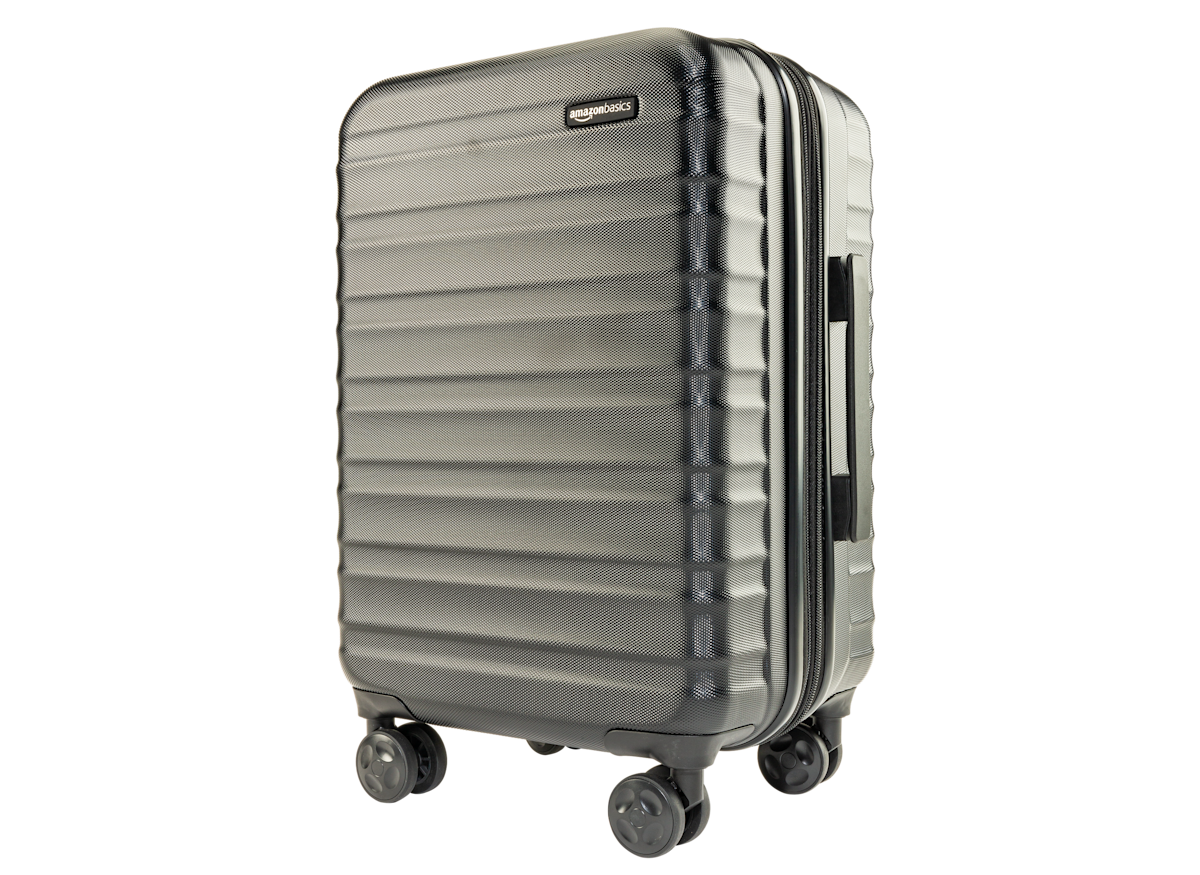
Full review
Real-World Use and Packing
The Amazon Basics 21" has the same external footprint and the same interior layout as a typical mid-range hardside carry-on: a single open main compartment with a fabric divider, three small zip pockets, and an expansion zipper that adds about a quarter more depth. Pack Hacker measured the interior at 41 L base capacity, matching the Away Carry-On and Samsonite Freeform. On a packing-volume basis, this bag is competitive with hardsides that cost five times as much — the difference shows up in materials, not capacity. Pack Hacker's verdict on the packing system: 'multiple ways to pack this bag, but it's what worked in this use case.' Functional, not refined.
There's no garment suiter, no compression straps, no USB charging port — none of the integration that the more expensive picks in this roundup offer. What you get is the basic functional set: a hardside shell, a divider, a couple of small pockets, and an expansion zipper. For a leisure traveler packing soft clothing for a single trip, that's enough. The fabric divider has light compression provided by Velcro at the corners, but it's nowhere near as effective as the buckle-strap systems on the Away or the ratcheting CX system on the Briggs & Riley.
Wheel Performance and Maneuverability
Four multidirectional spinner wheels are standard equipment — they roll, they pivot 360 degrees, they handle airport tile and indoor carpet fine. Outdoor Gear Lab scored the Ease of Transport category 6.0/10, which is the lowest in this roundup but still functional. The wheels are noticeably smaller than the 2-inch wheels on the Samsonite Freeform, which means they vibrate more on rough sidewalks and don't handle curb cutouts as cleanly. The telescoping handle is two-stage aluminum with no haptic dampening.
Shifted from polycarbonate to cheaper ABS plastic
That's an unusually candid call-out — ABS is more brittle than polycarbonate and more likely to crack under impact rather than flexing and rebounding. The 3-year limited warranty is shorter than every other bag in this roundup. Pack Hacker added context: 'It isn't the thickest material we've dealt with when testing carry on rolling luggage; however, it feels durable enough for the task at hand.'
41 liters of capacity for the lowest price here
Value is the single answer across reviews. Pack Hacker's bottom line: 'For the price, it's a solid entry-level bag for new travelers. That said, you won't want to use it forever, and based on the build quality, you probably won't be able to, anyway.' Amazon customer reviews echo this — the bag works fine for occasional trips, the spinner wheels are smooth on flat ground, and the recessed TSA lock is convenient. Nobody who's tested it claims it's the best bag at any price; everyone agrees it's competitive at $80.
The Capacity sub-score of 7.4/10 from Outdoor Gear Lab is the highest of the bag's category scores, though their own measurement put the non-expanded main compartment at 36 L, with the expansion zipper adding more on top. Where the bag falls behind is everything around that core capacity: the wheels, the handle, the zippers, and the long-term shell durability. If you only care about cubic inches per dollar, this is the cheapest path to a functional 41-liter carry-on you can buy from a major retailer, and the 3-year limited warranty backs you up if anything fails out of the box.
Scores 61/100, lowest construction rating tested
Outdoor Gear Lab's quantitative breakdown is direct: Construction Quality 5.0/10 (lowest in the roundup), Design and Functionality 5.5/10, Ease of Transport 6.0/10, Capacity 7.4/10. The handle, the zippers, and the spinner wheel housings all feel cheaper than the equivalent components on bags costing 50 to 100 dollars more. Long-term durability is the real risk: ABS plastic doesn't tolerate baggage-handler abuse as well as polycarbonate or polypropylene. If a baggage handler drops it from a luggage cart, you're more likely to see a crack than a scuff.
Built for a once-in-a-decade occasional trip
The Amazon Basics is the right pick for exactly one type of buyer: someone who needs a carry-on for one specific upcoming trip and isn't willing to pay $145 for the Samsonite Freeform. Outdoor Gear Lab is explicit: 'If you don't travel frequently and you are looking for a cheap carry-on for that once-in-a-decade trip, the bag performs well enough to get you where you're going.' If you fly more than 4-5 times a year, the cost-per-trip math flips — at heavy use the Samsonite Freeform delivers more total value per dollar, and the Travelpro Platinum Elite delivers dramatically more over a 5-year horizon.
Per-trip cost swings from $80 to $2.67
$80 buys you a functional, spinner-wheel, TSA-locking, expandable hardside carry-on with a 3-year warranty. That's a real value proposition — there's no other major-brand bag in this category at that price. The trade-off is the construction quality and the long-term reliability. If you treat the bag as semi-disposable (3-year expected life, occasional travel only), the math works. If you treat the bag as a long-term purchase, every other pick in this roundup is a better long-term value, and the Samsonite Freeform at $145 is the right step up.
The cost-per-trip math is brutal in either direction. If you take one trip with this bag and never use it again, the per-trip cost is $80 — higher than every other bag in this roundup on a per-trip basis. If you take 30 trips and the bag survives, the per-trip cost is $2.67 — by far the cheapest in this roundup. The honest answer is that most buyers fall in the middle: 4-8 trips before something breaks (a wheel, a handle, the TSA lock, or the zipper), which puts the per-trip cost somewhere between $10 and $20. That's competitive with the Samsonite Freeform's $145-with-5-year-life math, but with more risk of mid-trip failure.
Long-Term Durability and Failure Modes
Amazon Basics' luggage line has the most variable build quality of any major-name brand — production batches genuinely differ. The Outdoor Gear Lab review explicitly flagged that 'for a period of time, this bag's shell was constructed of higher-quality polycarbonate,' but that 'the current specs on the bag show that the manufacturer has returned to using a weaker, inferior form of plastic, acrylonitrile butadiene styrene (ABS), which left me questioning its overall resilience.' That means two buyers ordering the same SKU six months apart can get materially different products. The parts to watch on a hardside at this price are the spinner wheel housings, the telescoping handle lock and the zipper pulls. The 3-year warranty covers all of these, but the return process is more cumbersome than Samsonite's or Travelpro's repair programs — you ship the bag back at your own cost, get a refund or replacement, and rebuy. If you fly even moderately, plan to replace this bag within 3 years rather than treat it as a long-term purchase.
Strengths
- +$80 starting price is roughly half the Samsonite Freeform and a quarter of Travelpro
- +Four spinner wheels and a telescoping handle make it functionally identical to mid-range hardsides
- +Expandable for up to 25% more interior space
- +Built-in recessed TSA combination lock keeps the front face uncluttered
- +3-year limited warranty against manufacturing defects
Watch-outs
- −Newer production batches use ABS plastic instead of polycarbonate — more brittle, less impact-absorbent
- −Telescoping handle and zippers feel cheaper than Samsonite or Travelpro under everyday use
- −Interior organization is minimal — a divider and three small zip pockets
How it compares
Lacks the design polish of the Samsonite Freeform ($145) and the build quality of the Travelpro Platinum Elite. Its quarter-volume expansion is competitive with Travelpro's 2-inch zipper but the underlying shell is meaningfully thinner.
Rating sources
“For the price, it's a solid entry-level bag for new travelers. That said, you won't want to use it forever, and based on the build quality, you probably won't be able to, anyway.”
“it is far from being indestructible, so use it with care”
Our 3.3 score is the average of these published ratings. Ratings marked * were derived from the reviewer’s written analysis or video transcript — the publisher didn’t print an explicit numeric score, so we inferred one from their own words. Click through to verify. More about methodology.