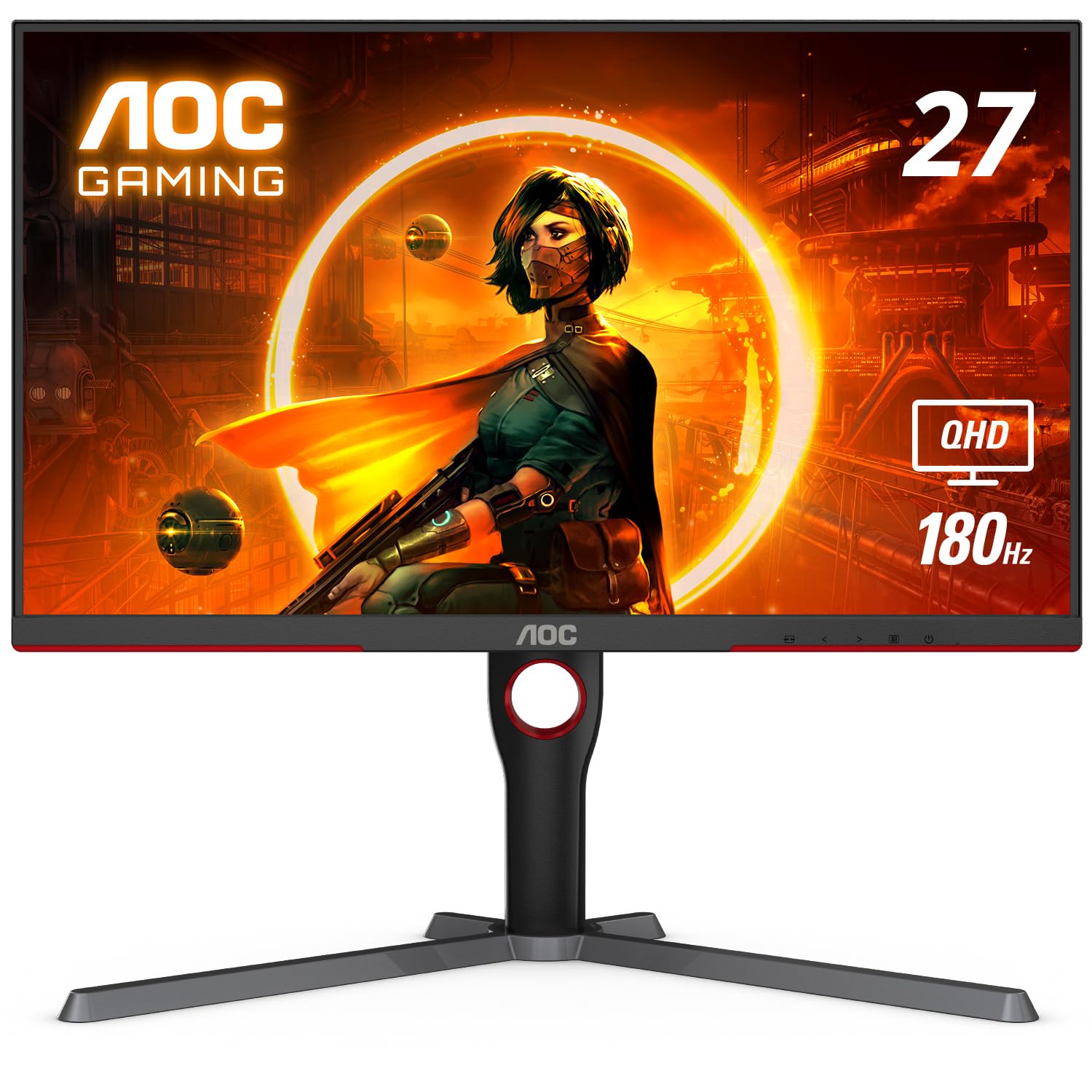
The AOC Q27G3XMN is a 27-inch 1440p VA gaming panel built around a 336-zone mini LED backlight, which is what gets it a DisplayHDR 1000 badge at a price where HDR is normally a sticker rather than a capability. TFTCentral's read is that the feature set is unusually aggressive for the money. It runs at 180Hz with FreeSync Premium Pro over a native 4,000:1 contrast ratio. The compromises are real: sRGB content oversaturates unless the emulation mode is on, local dimming blooms around small bright objects, and there is no HDMI 2.1 or USB-C.
Full review
336 dimming zones behind a VA panel
The backlight is the whole story. A 336-zone mini LED full-array system sits behind a CSOT VA panel with a native 4,000:1 contrast ratio, and the two together produce blacks that a conventional edge-lit monitor at this price cannot approach. TFTCentral found the effect strongest in scenes with large dark areas, where whole zones switch off entirely.
The panel offers four HDR presets and three local dimming strengths, and the combination that works best is the DisplayHDR mode with dimming on its strongest setting. That is worth knowing because the out-of-box configuration is not the one that shows what the display can do.
Blooming is the price of the zone count
TFTCentral is clear that the same local dimming that produces the deep blacks also haloes around small bright objects: fireworks, stars, subtitles against a dark scene. That is inherent to full-array dimming at this zone count rather than a defect in this particular monitor, but it is visible and it is the main reason to hesitate.
The other panel-level compromise is colour. Display Ninja measured broad gamut coverage at 96% DCI-P3 and 90% Adobe RGB, which is good news for HDR and bad news for everything else, because standard sRGB content oversaturates on a gamut that wide. AOC includes an sRGB emulation mode to clamp it, and desktop work needs that mode switched on.
180Hz, 1ms and a port selection that shows the price
For gaming the fundamentals are sound: 180Hz refresh, a 1ms grey-to-grey rating and FreeSync Premium Pro. VA panels are historically slower than IPS in dark transitions and there is some smearing here, but the refresh rate and adaptive sync are doing the job they are advertised to do.
Connectivity is where the budget shows. One DisplayPort 1.4 and two HDMI 2.0 inputs, and nothing else: no HDMI 2.1, no USB-C, no USB hub. TFTCentral reads this as a deliberate trade to fund the backlight, which is a fair characterisation, but it does mean current consoles cannot drive the panel at its full refresh rate over HDMI.
Sit square to it or lose the contrast
The viewing angles are the practical limitation nobody puts on the box. VA panels darken and shift off-axis, and on a screen whose entire selling point is contrast, that means the good picture only exists directly in front of the panel. Two people watching the same screen is not what this monitor is for.
TFTCentral also found the build appropriate to the price rather than impressive, with a stiff height adjustment on an otherwise fully adjustable stand, and OSD buttons that are awkward to use because there is no tactile way to tell which one you are pressing. The stand does offer tilt, height, swivel and rotation plus a quick release and 100mm VESA mounting.
Strengths
- +336-zone mini LED FALD backlight for excellent HDR performance
- +VESA DisplayHDR 1000 certification with 1300-nits peak brightness
- +180Hz refresh rate with AMD FreeSync Premium Pro support
- +High 4,000:1 static contrast ratio with VA panel technology
Watch-outs
- −sRGB emulation mode needed for accurate sRGB SDR content
- −Potential blooming/halo effect from FALD local dimming
How it compares
Mini LED backlights at this size normally cost considerably more, and the trade the Q27G3XMN makes to get there is zone count: 336 against the 576 or more that pricier full-array displays use, which is the direct cause of the blooming. Against a standard edge-lit VA panel at the same price it is a straightforward upgrade in contrast and peak brightness; against an OLED it wins on brightness and loses on microcontrast, viewing angles and VRR behaviour.
Rating sources
“Best of all, this is a really competitively priced screen considering the capabilities and specs.”
Our 4.4 score is the average of these published ratings. Ratings marked * were derived from the reviewer’s written analysis or video transcript — the publisher didn’t print an explicit numeric score, so we inferred one from their own words. Click through to verify. More about methodology.