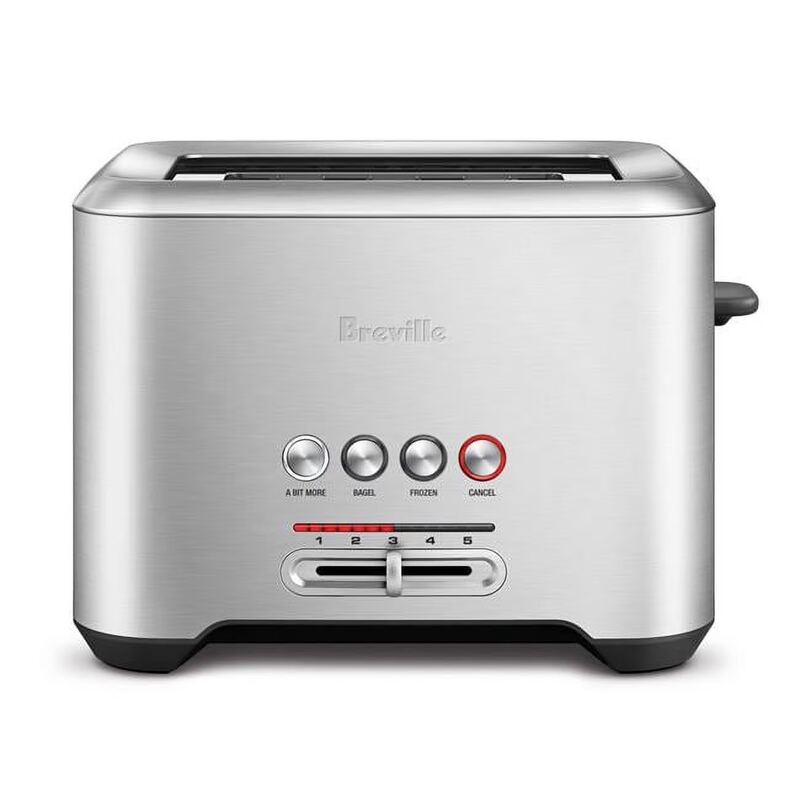
The Breville Die-Cast Smart Toaster gets consistent praise for its sleek, fingerprint-resistant design and four functional settings, among them 'lift and look' and 'a bit more.' Food & Wine's Liv Dansky rated its performance well, singling out the frozen bread feature, and noted how many owners end up buying multiple units. Not everyone agrees: some reviewers report uneven toasting and inconsistent heating. It fits buyers who want a premium, aesthetically pleasing toaster with smart features, less so anyone who demands perfect toasting consistency.
Full review
Die-cast metal body and extra-wide slots
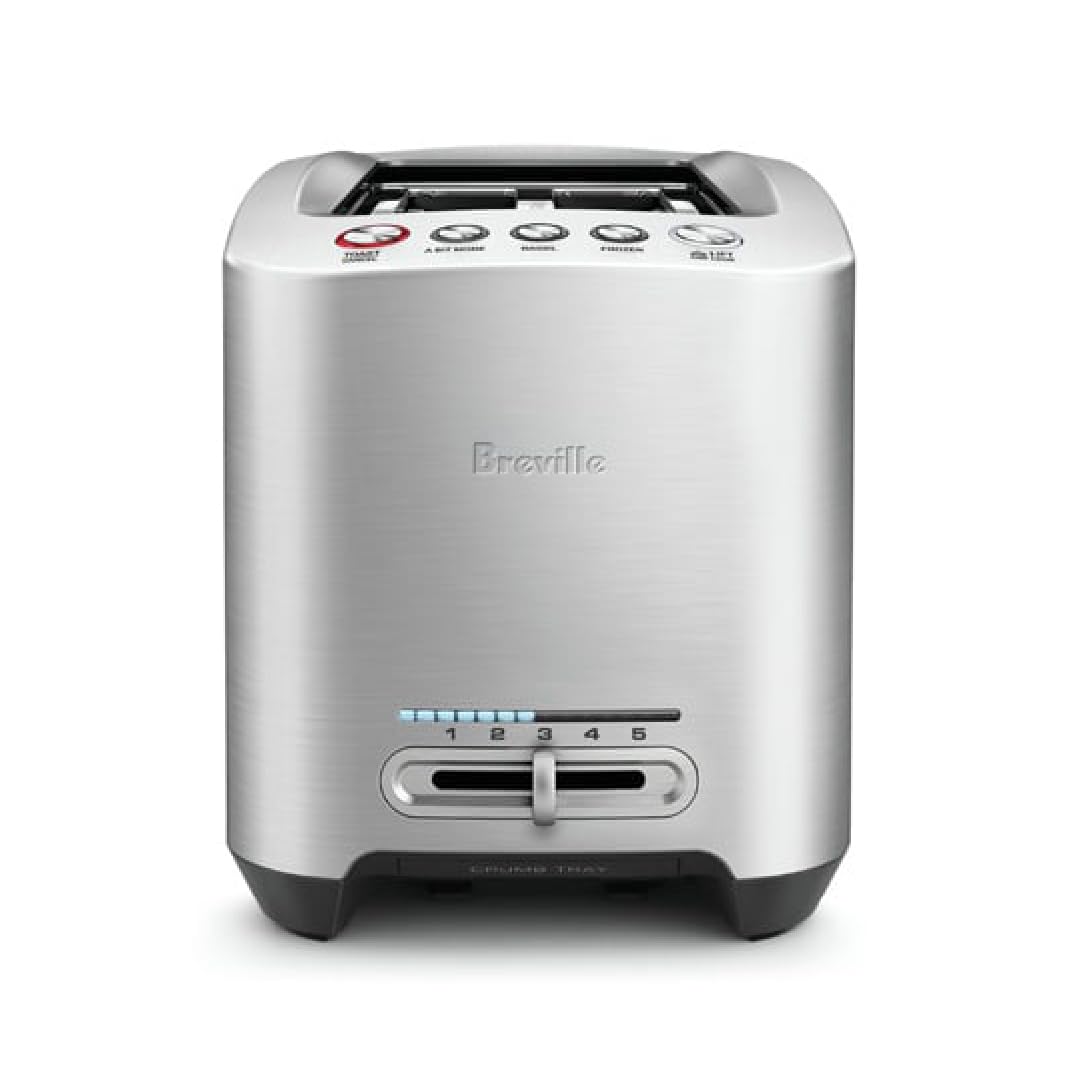
The BTA820XL is built as an object rather than an appliance: a die-cast metal shell in a brushed finish that resists fingerprints, at 11.6 by 8.6 by 7.5 inches on the counter. Food & Wine's Liv Dansky called the design both beautiful and functional, and the practical part of that is the slot width — halved bagels, thick-cut sourdough and dense pastries drop in without being forced, which is exactly where older toasters with narrow slots fail. A motorised carriage lowers the bread rather than dropping it, and the crumb tray pulls out of the front instead of requiring the whole unit to be turned over.
Four functions that earn their keep
The four settings are A Bit More, Lift and Look, Bagel and Frozen, and they are more useful than the usual button clutter. Lift and Look raises the carriage mid-cycle so you can check progress and drop it back without restarting the timer, and A Bit More adds a short top-up rather than making you guess at a whole extra cycle. Dansky singled out the frozen setting for sourdough kept in the freezer, and found A Bit More struck a reasonable balance between convenience and control. An LED bar tracks the cycle, which is a small thing that removes the guesswork from a six-position browning dial.
One side browns darker than the other
Owner reports break in a direction the editorial coverage does not. The most common complaint is uneven browning, with one face of the slice consistently darker than the other — a fault that no amount of dial adjustment corrects because it is the elements, not the setting. A related and more damning criticism is that the elements do not run hot enough on some units, so bread dries out over a long cycle instead of toasting in a short one. That is the opposite of what a die-cast premium toaster is supposed to deliver, and it is the single reason to hesitate over this one.
Failures reported after three and six years
Longevity is the second cluster of complaints. Owners report heating elements dying at around three years, and one describes the toaster starting to trip a GFCI outlet at about six — a fault serious enough that it was replaced with a different brand rather than repaired. Others report an intermittent glitch where the carriage stays down and the elements stay lit after a cycle should have ended, which is an electronics problem rather than a mechanical one. None of this is universal, and plenty of owners have had no trouble, but it is a recurring enough pattern to weigh against the metal-bodied, built-to-last impression the toaster gives out of the box.
Premium pricing against uncertain longevity
This sits at the top of the two-slice market, and what the money demonstrably buys is the shell, the slot width, the motorised carriage and the four functions. Food & Wine rated it 4.5 out of 5, and for someone toasting bagels and thick artisan slices daily the ergonomics are worth something real. What the money does not reliably buy is a toaster that outlasts a cheap one, and the browning inconsistency reported by owners is a poor look at this price. Buy it for the handling and the slots; do not buy it expecting a decade of service on the strength of the metal.
Strengths
- +Sleek design that doesn't show fingerprints
- +Four convenient functions including 'lift and look' and 'a bit more'
- +Effective heating mechanism for consistent toasting
- +Popular choice with over 3,900 Amazon shoppers recommending it
Watch-outs
- −Some users report uneven toasting with one side darker than the other
- −One reviewer noted that it dries bread more than toasting it
How it compares
The Die Cast Smart Toaster competes with the Breville 'A Bit More' in terms of smart features but lacks the consistent performance on medium settings. While both offer 'lift and look' functionality, the 'A Bit More' delivers better browning results and is more reliable overall, making it a better choice for those seeking dependable toasting.
Rating sources
Our 4.5 score is the average of these published ratings. Ratings marked * were derived from the reviewer’s written analysis or video transcript — the publisher didn’t print an explicit numeric score, so we inferred one from their own words. Click through to verify. More about methodology.