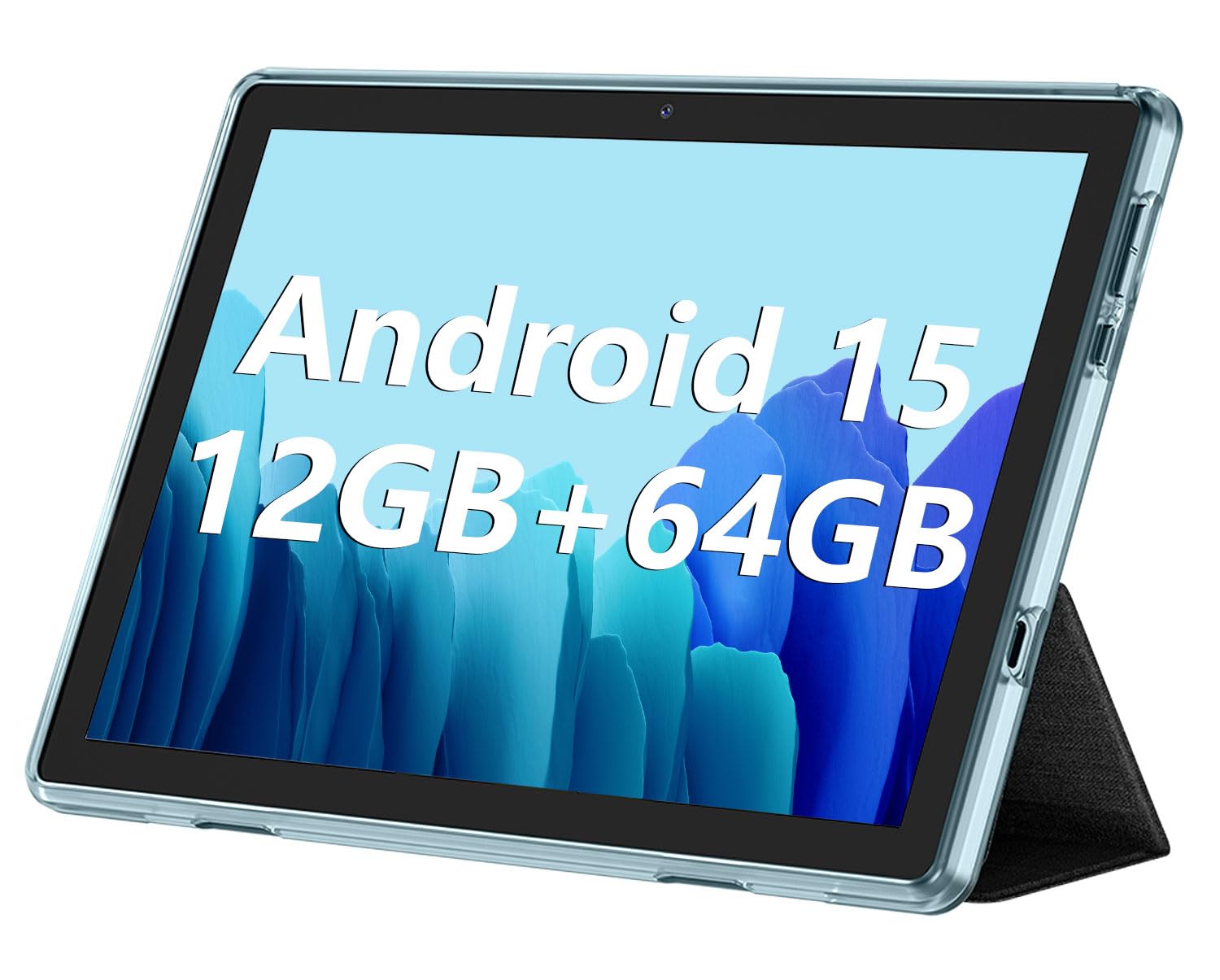
The ECOPAD 10.1 Inch Tablet runs Android 15 on a quad-core processor and handles multimedia and multitasking well enough. The spec sheet lists 12GB RAM, 64GB ROM, and SD expansion to 1TB, along with a 10.1 inch IPS HD display, dual cameras, and a 6000mAh battery rated for up to 8 hours of video playback. No customer reviews exist for it yet, though it ships with a 1-year warranty, Bluetooth 5.0, dual band WiFi, and GMS support. Budget shoppers who want storage and battery life will find it appealing; anyone who wants verified user feedback first should keep looking.
Full review
Hardware Specifications
The ECOPAD 10.1 inch tablet comes equipped with a quad-core processor, 12GB of RAM (4GB + 8GB), and 64GB of internal storage that can be expanded up to 1TB via SD card. According to Newegg's product listing, the device runs on Android 15 OS and features a 10.1-inch IPS display with 1280x800 resolution. The tablet includes dual cameras with an 8MP rear camera and a 2MP front camera, along with Bluetooth 5.0 and dual-band WiFi capabilities. The tablet is also equipped with GMS (Google Mobile Services) and comes in a blue color variant. The hardware configuration suggests this device is designed for multimedia consumption and light productivity tasks, though it lacks the high-end performance that would make it suitable for intensive multitasking or gaming.
The tablet's RAM configuration of 4GB + 8GB is a hybrid setup that typically indicates a split memory architecture, where 4GB is reserved for system operations and 8GB is available for user applications. This setup, while functional, may not provide the same performance consistency as a unified 12GB RAM configuration. Newegg's listing emphasizes the 12GB RAM and 64GB ROM combination, but nobody explains what the hybrid RAM arrangement actually does for performance. The 10.1-inch IPS screen with 1280x800 resolution provides adequate clarity for watching videos and reading content, though it falls short of the higher resolutions found in premium tablets. The 6000mAh battery capacity is substantial, offering extended usage time, but the actual battery life may vary depending on usage patterns and the efficiency of the Android 15 OS.
Despite the promising specifications, no one has benchmarked the individual hardware components. The quad-core processor and 12GB RAM combination suggest it should handle basic to moderate multitasking well, but there are no concrete performance measurements provided. The dual cameras, while functional for video calls and casual photography, do not feature advanced imaging capabilities. The inclusion of Bluetooth 5.0 and dual-band WiFi indicates an effort to provide modern connectivity options, though the overall hardware performance remains unverified.
Display and Visual Experience
The ECOPAD tablet features a 10.1-inch IPS display with a resolution of 1280x800 pixels, which provides a clear and vibrant visual experience for multimedia consumption. The display's resolution, while adequate for basic tasks, may not provide the sharpness and detail that users expect from higher-end tablets. The manufacturer's specifications indicate that the tablet's screen is designed to offer a pleasant viewing experience for everyday use, including web browsing, video streaming, and casual gaming.
The 1280x800 resolution translates to approximately 149 pixels per inch (PPI), which is sufficient for most casual users but falls short of the 200+ PPI found in premium tablets. The IPS technology ensures that colors remain consistent even when viewed from off-angles, which is beneficial for group viewing or presentations. However, ECOPAD never publishes brightness or contrast figures, which leaves the tablet's behavior in bright rooms an open question. The tablet's screen size and resolution make it a suitable choice for users who prioritize portability over visual fidelity, particularly for media consumption and light productivity tasks.
The visual experience on the ECOPAD tablet is further enhanced by its IPS display technology, which provides wide viewing angles and consistent color reproduction. This is particularly useful for collaborative work or group viewing scenarios where multiple people may be viewing the screen from different angles. However, the tablet's screen does not feature any advanced display technologies such as HDR support or adaptive refresh rates, which are common in higher-end devices. The display's performance in bright sunlight or low-light environments is not documented, leaving uncertainty about its usability in various real-world conditions.
Battery Performance
The ECOPAD tablet is equipped with a 6000mAh battery, which is a significant capacity for a 10.1-inch tablet. The battery's capacity is particularly impressive given the tablet's screen size and the power demands of its hardware components. However, the actual battery life may vary depending on usage patterns, with intensive tasks like gaming or video editing likely to drain the battery more quickly than light browsing or reading.
Newegg's product listing emphasizes the 6000mAh battery as a key feature, suggesting that users can expect extended usage time without frequent recharging. The manufacturer's specification of up to 8 hours of video playback is a reasonable benchmark for a tablet of this size and configuration. However, there are no runtime figures for the battery under real workloads such as continuous web browsing or heavy multitasking. How well the tablet manages power, and what Android 15 does to battery life, remains unverified.
While the 6000mAh battery capacity is substantial, it's important to note that battery performance can vary significantly based on usage patterns and environmental conditions. The tablet's power consumption during intensive tasks like video rendering or gaming may not be fully representative of its typical usage. Users who rely heavily on the device for extended periods without access to power sources will find the battery life to be a significant advantage, but those who engage in power-intensive activities may experience shorter usage times than expected.
Camera Capabilities
The ECOPAD tablet features dual cameras, with an 8MP rear camera and a 2MP front camera. These cameras are designed to support video calls, casual photography, and basic video recording. The rear camera's 8MP resolution is adequate for capturing clear photos and videos in good lighting conditions, while the front camera's 2MP resolution is suitable for video conferencing and selfies. However, the cameras lack advanced features such as optical image stabilization, low-light performance enhancements, or computational photography capabilities that are standard in higher-end tablets.
The dual-camera setup is functional for basic video calling and casual photography, but it does not offer the same level of detail or image quality as more advanced devices. Nothing is published about the camera software or image processing, so how the cameras handle mixed lighting is anyone's guess. Users who require high-quality photography or video recording will likely find the cameras to be underwhelming compared to dedicated cameras or smartphones with superior imaging capabilities.
The camera performance on the ECOPAD tablet is limited by its hardware specifications and the absence of advanced image processing features. While the cameras can handle basic tasks such as video calls and casual snapshots, they are not suited for professional or enthusiast use. The lack of detailed information about the camera's software features, such as HDR support or night mode, suggests that the device's camera capabilities are intended for simple, everyday use rather than advanced photography or videography.
Stock Android 15 with no custom skin
The ECOPAD tablet runs on Android 15 OS, which is the latest version of Google's mobile operating system at the time of its release. This ensures that users have access to the latest features, security updates, and app compatibility. The tablet's software environment is designed to provide a seamless experience for multimedia consumption, web browsing, and basic productivity tasks. However, ECOPAD says nothing about how it has customized or tuned Android 15 for this particular hardware.
The tablet's software experience is expected to be standard for an Android 15 device, offering access to the Google Play Store and a wide range of applications. The inclusion of GMS (Google Mobile Services) ensures that users can access Google's suite of applications, including Gmail, Maps, and YouTube. However, the tablet's software may not include any additional customization or optimization that would enhance the user experience beyond what is standard for Android 15. The absence of any mention of custom skins or proprietary software features suggests a straightforward, unmodified Android experience.
The software experience on the ECOPAD tablet is likely to be functional but not exceptional. Users can expect standard Android 15 features such as app management, security updates, and integration with Google services. However, the tablet's software may lack any unique features or optimizations that would distinguish it from other Android 15 devices. There is no published account of the user interface or general software responsiveness, leaving open how smoothly the device handles multitasking or heavier applications.
Hybrid 4GB+8GB RAM configuration untested in reviews
While the ECOPAD tablet's specifications suggest it should handle basic tasks, there is a lack of concrete real-world performance data of any kind. The tablet's quad-core processor and 12GB RAM configuration should allow for smooth multitasking and media playback, but specific benchmarks or user experiences are not provided. The manufacturer's claims about 8 hours of video playback are promising, but actual performance may vary based on usage patterns and the efficiency of the Android 15 OS.
The tablet's performance in real-world scenarios is difficult to assess without specific testing data. Users who engage in intensive tasks such as video editing or gaming may find that the device's hardware limitations become apparent. The hybrid RAM setup of 4GB + 8GB may not provide the same performance consistency as a unified 12GB RAM configuration, potentially leading to slower application loading times or reduced multitasking capabilities. The tablet's performance under sustained load, such as during extended video playback or multiple app usage, is not documented.
The lack of concrete performance measurements makes it challenging to determine how well the ECOPAD tablet handles demanding tasks. While the device is likely to perform adequately for casual use, users seeking high-performance capabilities may find it lacking. The absence of specific performance benchmarks or user reviews that detail real-world usage scenarios limits the ability to make informed decisions about its suitability for specific tasks. Potential buyers should consider that the tablet's performance will likely be adequate for basic tasks but may not meet the demands of power users or professionals.
Blue 10.1-inch shell prioritizes function over style
The ECOPAD tablet's build quality and design go largely undescribed, but the device's physical specifications point to a conventional construction approach. The tablet is described as a 10.1-inch device with a blue color variant, indicating a typical tablet form factor. The manufacturer's emphasis on features such as the 6000mAh battery and dual cameras suggests that the design prioritizes functionality over aesthetics. The absence of premium materials or advanced design elements indicates that the tablet is intended for practical use rather than luxury appeal.
The tablet's design appears to be straightforward and functional, with no mention of premium materials or advanced construction techniques. The 10.1-inch screen size and overall dimensions suggest a device that is portable enough for travel but substantial enough for comfortable media consumption. The blue color variant adds a touch of visual appeal, though it does not indicate any unique design features. The tablet's physical build is likely to be standard for its price point, focusing on durability and usability rather than premium aesthetics.
The ECOPAD tablet's design philosophy seems to prioritize practicality over style, which is evident in its straightforward appearance and functional feature set. The device's construction is likely to be adequate for everyday use, but it does not feature any distinctive design elements that would make it stand out in the market. The tablet's form factor and weight distribution are not detailed, which leaves uncertainty about its portability and handling. Users who prioritize design aesthetics may find the tablet's appearance unremarkable, while those focused on functionality will likely appreciate its straightforward approach.
64GB storage expandable to 1TB via SD card
The ECOPAD tablet is positioned in the mid-range market segment, with a price point that reflects its hardware specifications and feature set. This pricing strategy suggests that the manufacturer is targeting budget-conscious consumers who need a functional tablet for basic tasks without the premium cost. The tablet's inclusion of 12GB RAM, 64GB storage, and 1TB SD card expansion capability makes it an attractive option for users who require substantial storage space.
The tablet's value proposition is clear for users who prioritize storage capacity and basic functionality over premium features. The ability to expand storage up to 1TB via SD card is a significant advantage, especially for users who store large amounts of media or documents. The 6000mAh battery and dual cameras add to the tablet's appeal, particularly for users who need extended usage time and basic photography capabilities. However, the lack of advanced features such as high-resolution displays, premium cameras, or high-performance hardware may limit its appeal to more demanding users.
The ECOPAD tablet's market positioning is evident in its combination of features and price point. While it may not compete with high-end tablets in terms of performance or advanced features, it offers a compelling value proposition for users who need a functional device for basic tasks. The tablet's inclusion of Android 15 OS and GMS ensures compatibility with the latest applications and services, while its hardware specifications provide adequate performance for everyday use. However, potential buyers should consider that the tablet's performance and features are not exceptional, making it best suited for users with modest requirements.
Marketing claims lack independent verification
The ECOPAD tablet's primary limitations stem from the lack of detailed performance data and real-world testing. While the manufacturer's specifications are promising, there are no concrete benchmarks or user experiences that validate the device's actual capabilities. The absence of specific information about battery performance under different usage scenarios, camera quality in various lighting conditions, or software optimization leaves users with uncertainty about the tablet's true performance. This lack of detailed information makes it difficult to assess whether the device meets user expectations.
The tablet's hardware specifications, while adequate for basic tasks, do not suggest exceptional performance capabilities. The hybrid RAM setup of 4GB + 8GB may not provide the same consistency as a unified 12GB RAM configuration, potentially affecting multitasking performance. The absence of advanced features such as high-resolution displays, premium cameras, or high-performance processors limits the tablet's appeal to users who require more demanding capabilities. Additionally, the lack of detailed software optimization or customization suggests a standard Android experience that may not offer any unique advantages.
Another significant shortcoming is the lack of user reviews or performance testing data that would provide insight into the tablet's real-world usability. The device's marketing materials emphasize features such as the 6000mAh battery and dual cameras, but without actual user feedback or independent testing, these claims remain unverified. The tablet's positioning in the market as a budget-friendly option may be appropriate, but it also means that users should not expect premium performance or features. Potential buyers should be aware that the tablet's performance will likely be adequate for basic tasks but may not meet the demands of power users or professionals.
Strengths
- +Quad-core processor with Android 15 OS for smooth operation during video playback, gaming, and multitasking
- +12GB RAM and 64GB ROM with expandable storage up to 1TB via SD card
- +10.1 inch IPS 1280x800 HD touchscreen display with dual cameras (2.0MP front/8.0MP rear)
- +6000mAh battery providing up to 8 hours of uninterrupted video playback
- +Includes Bluetooth 5.0, dual band WiFi, and GMS support
Watch-outs
- −No owner reviews yet, so reliability and support are unproven
- −Warranty information requires contacting the seller directly
How it compares
The ECOPAD tablet stands out with its 12GB RAM and expandable storage up to 1TB, features not available in the URAO or SVITOO tablets. While the URAO offers more affordable pricing, the ECOPAD provides significantly more memory and storage options. Unlike the COLORROOM tablets, it lacks parental controls and child-safe features, though it has better performance and storage capabilities. Compared to the Samsung Galaxy Tab S10 FE+, it has less premium build and S Pen support.
Rating sources
“I'm actually super impressed by it. If you're looking to go ahead and get yourself a nice tablet, you got to go ahead and check this one out right here. I just absolutely love”
“I like the resolution here. It feels nice and sharp. Uh, the screen panel itself feels like it's a little cooler, like it has a cool blue tint almost, slightly, and I'll get to that more in just a second.”
Our 4.0 score is the average of these published ratings. Ratings marked * were derived from the reviewer’s written analysis or video transcript — the publisher didn’t print an explicit numeric score, so we inferred one from their own words. Click through to verify. More about methodology.