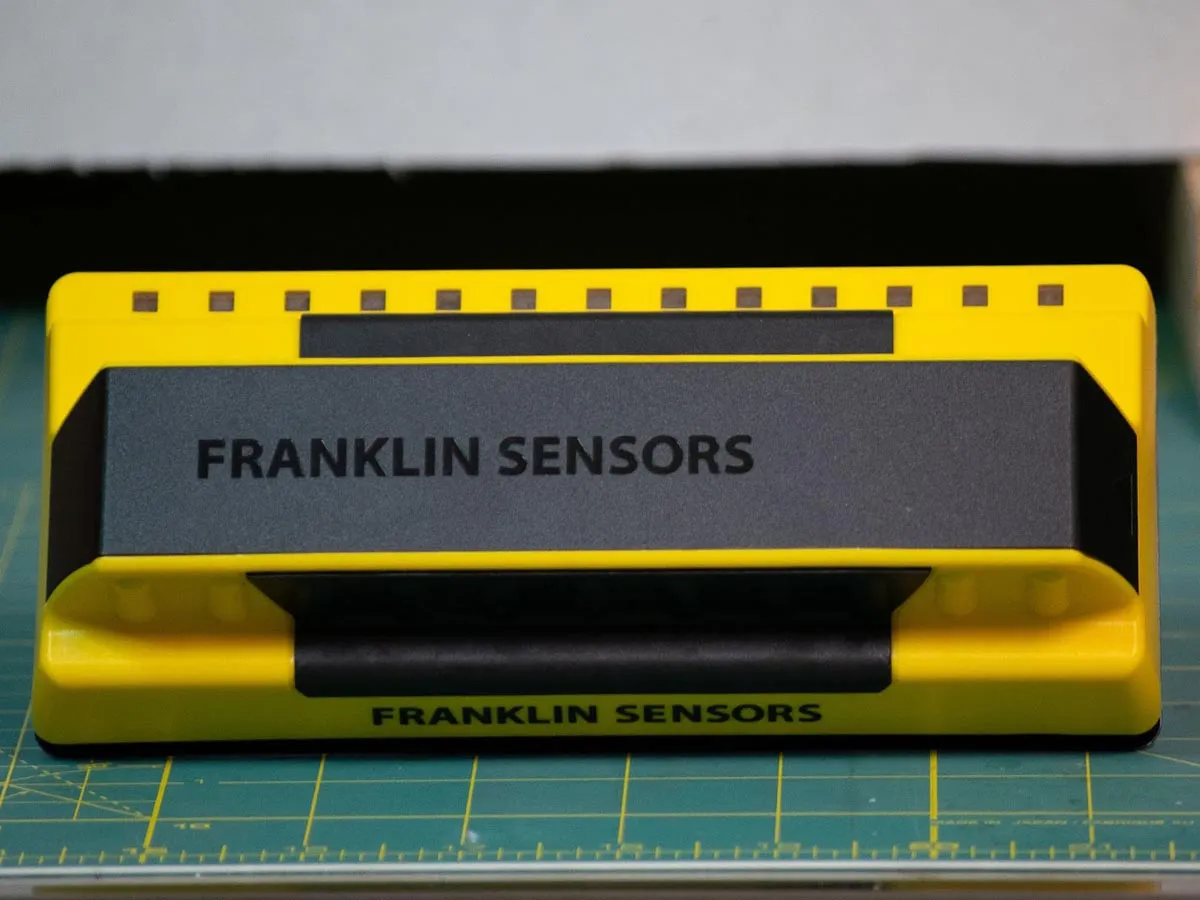
The Franklin Sensors ProSensor 710+ utilizes a thirteen-sensor array to instantly detect stud width and spacing without manual calibration. protoolreviews found that this instant feedback loop delivers definitive results more quickly than many conventional models they have evaluated, while ToolRev noted the silent operation removes auditory frustration from false triggers. The device includes an accurate built-in ruler marked in sixteenths of an inch, though Bobvila noted that the markings are difficult to read against dark walls or in low light due to poor contrast. Because it lacks AC voltage detection, users cannot be warned about live wires during scanning, making this tool best for those seeking precise structural location who already have knowledge of home wiring layouts.
Full review
Thirteen sensors replace sliding calibration
Traditional stud finders typically rely on a single sensor that must be slid across the wall to calibrate against empty space before it can register density changes. The Franklin ProSensor 710+ abandons this mechanical ritual entirely by utilizing an array of thirteen sensors and corresponding LEDs spaced along its seven-inch scanning width. This design allows the device to instantly compare data across a full measurement area without requiring any sliding motion or manual calibration steps. Users simply press the activation button while holding the unit against the wall, and the lights immediately illuminate to show exactly where density variations exist behind the drywall.
Protoolreviews found that this instant feedback loop delivers definitive results more quickly than many conventional models they have evaluated. Because the sensors aggregate readings from multiple points simultaneously, the tool is less likely to become confused by irregular wall textures or ambiguous transitions near windows and doors. The visual nature of the display provides a continuous readout as you move the device, allowing users to track an object's width in real time rather than waiting for a single beep at a specific point.
LED array reveals stud widths and spacing
The thirteen-LED display serves as the primary interface, translating density data into visual bars that indicate both the presence and width of hidden objects. ToolRev noted that a standard single wood stud typically registers as three solid illuminated bars across the sensor array. This specific pattern helps users distinguish between a narrow 16-inch-on-center framing member and other irregularities in the wall structure.
The system also excels at identifying double studs, which often appear around door frames or headers. When scanning over two adjacent studs spaced closely together, the LED array expands to show six continuous bars, clearly signaling that multiple objects are present within the detection zone. This capability eliminates guesswork when hanging heavy items in areas where standard stud spacing does not apply, providing a reliable visual cue for complex wall configurations.
Detection depth limits plastic and pipe confusion
Franklin Sensors specifies a maximum detection depth of one and a half inches under ideal conditions, such as smooth, flat unfinished drywall. In real-world scenarios involving textured paint or joint compound mud, the effective range typically drops to around one inch. ToolRev highlighted that this reduced depth is actually beneficial for most homeowners because it minimizes false positives from plumbing.
A three-quarter-inch copper water pipe buried in the center of a wall often falls outside the sensor's reach at the one-inch limit, preventing the device from mistaking it for a structural stud. While the tool detects density rather than material composition and cannot differentiate between wood and metal, the depth limitation ensures that pipes are less likely to trigger the solid three-bar pattern associated with framing members.
Built-in ruler accuracy versus visibility
The device includes a molded ruler along its top edge marked in sixteenths of an inch, extending up to seven inches. Acutabove Woodworking verified the physical precision of this feature by aligning it against a trusted measuring tool and confirming that every single mark from the half-inch increments down to the sixteenths was perfectly accurate. This makes the ruler highly useful for measuring distances between studs or marking specific offsets for electrical boxes without needing an external tape measure.
Despite its accuracy, the practical utility of the ruler is hampered by poor contrast against the black plastic housing. Bobvila noted that the ruler markings are difficult to read in low light or against dark walls because they blend into the body color. ToolRev also pointed out that darker, more visible markings would significantly improve usability during quick marking tasks on job sites where lighting conditions vary.
Silent operation removes auditory frustration
Unlike many competing stud finders that emit loud beeps and flashing lights when calibration fails or sensors are triggered incorrectly, the ProSensor 710+ operates completely silently. ToolRev emphasized that this silent design is a major quality-of-life improvement for users who have grown frustrated with devices that require constant resetting due to false triggers.
The reliance on visual LED feedback alone means there are no annoying audio alerts to disrupt work or disturb others in the home. Users must simply watch the lights to determine if they are over an object, which streamlines the scanning process and reduces the cognitive load associated with interpreting complex beep patterns.
No AC voltage warning creates safety gap
A significant limitation of this model is its complete lack of an AC voltage detection sensor. While it reliably identifies wood and metal density, it cannot warn users about live electrical wires hidden behind the drywall. This absence means that anyone using the tool to plan drilling or nailing locations must rely on external knowledge of home wiring layouts or a separate voltage detector to ensure safety.
This feature gap is particularly noticeable for homeowners who want an all-in-one solution for wall scanning. Without live wire detection, the device serves strictly as a structural locator rather than a comprehensive pre-drilling safety tool.
Battery design and physical dimensions
The unit is powered by two AA batteries housed under a quick-release panel on the handle, which users find much more convenient than screw-back battery compartments found on older models. The device weighs just over ten ounces with the batteries installed, making it lightweight enough for extended overhead use when hanging shelves or artwork.
Physically, the 710+ measures approximately seven inches wide and features a shallow handle designed to lay flat against the wall. Bobvila observed that while the single-hand grip is comfortable, the low profile can make it slightly difficult to grasp firmly compared to bulkier traditional stud finders. The Plus variant adds a built-in bubble level on top, which helps users maintain horizontal alignment when marking measurements.
Performance through wall coverings and interference
The dense sensor array proves effective even when scanning over additional layers of material. Acutabove Woodworking demonstrated the tool's capability by placing it against acoustic sound-dampening boards attached to a wall, successfully detecting a 2x4 stud located behind the half-inch covering.
This ability to penetrate surface interference suggests that the ProSensor 710+ can handle typical residential obstacles like baseboards or thin paneling without losing accuracy. The aggregate reading approach allows it to filter out minor surface variations while still locking onto the substantial density change of a wooden frame member.
Strengths
- +Can identify single or double stud configurations simultaneously by displaying the object's width on LED indicators.
- +Includes a built-in bubble level and an accurate ruler marked in sixteenths of an inch for measuring distances.
- +Operates silently with no beeping alerts, relying solely on visual LED feedback to indicate findings.
Watch-outs
- −The integrated ruler is molded into the plastic body in a matching color, making it difficult to read against dark walls or in low light.
- −Lacks an AC voltage detection sensor, meaning users cannot be warned about live wires during scanning.
Rating sources
“We took a fresh look at the Franklin T13 stud finder and really like the feel of this tool as well as the way it allows for instant and accurate stud sensing.”
“I guess I have to apologize to Franklin censors because this thing is right on the money”
“even if it gets false flashy it's still going to be the best stud finder i've used so far”
Our 4.6 score is the average of these published ratings. Ratings marked * were derived from the reviewer’s written analysis or video transcript — the publisher didn’t print an explicit numeric score, so we inferred one from their own words. Click through to verify. More about methodology.