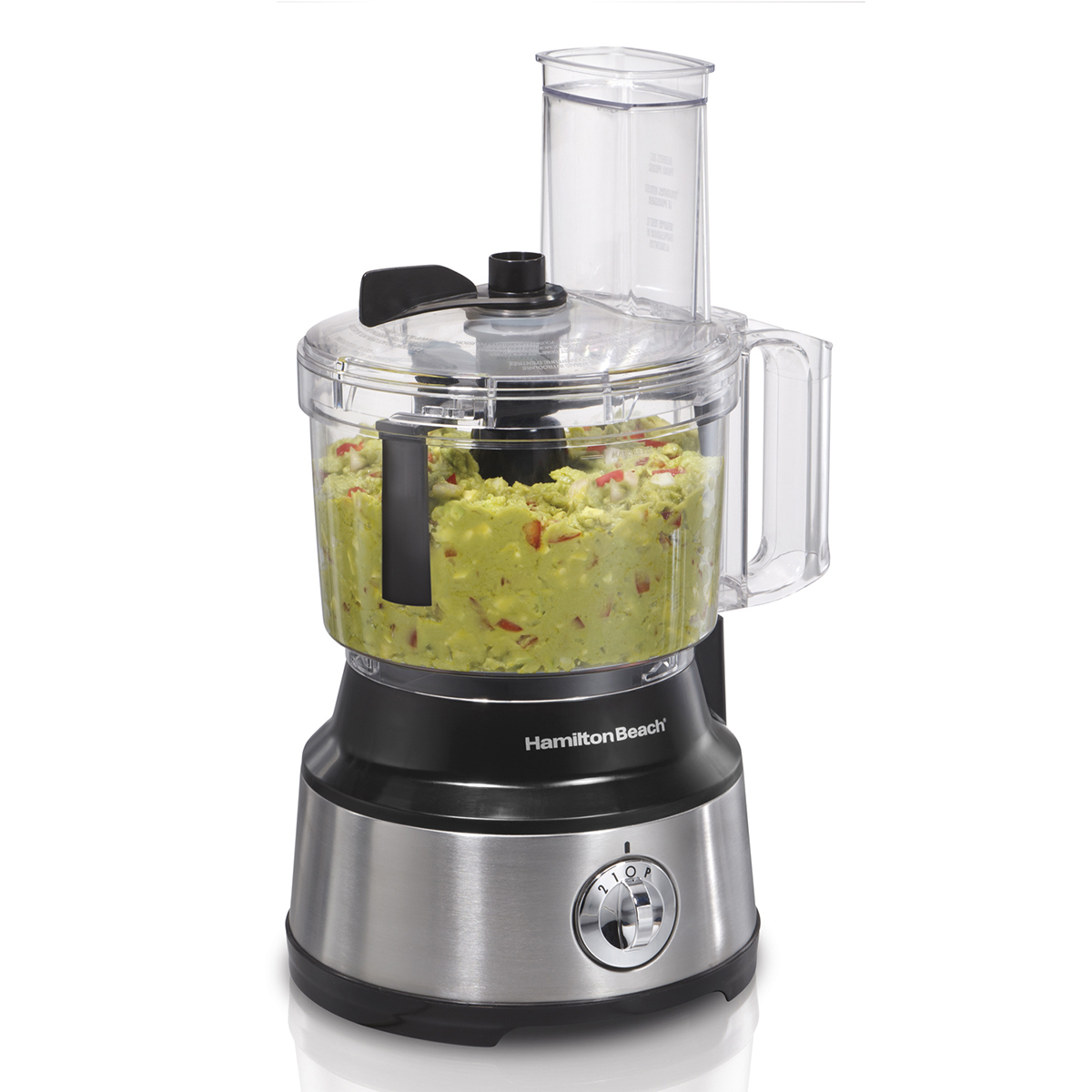
The Hamilton Beach 70730 is the best budget food processor: around $70, with surprisingly strong chopping and pureeing. TechGearLab found its chopping "on par with some of our higher scoring models" and said it made the best hummus of anything they tested, helped by a clever manual bowl scraper. Slicing is the weak point (it "destroyed our tomatoes"), and the machine is heavy and loud. For the price, the chopping and pureeing are a steal.
Full review
Real-World Processing Performance
The Hamilton Beach 70730 is the budget surprise of this category, punching well above its ~$70 price on the jobs that matter most for everyday cooking. TechGearLab scored it 64 out of 100 and noted its chopping "performed on par with some of our higher scoring models, which is notable." Its pureeing was even better: it "made some of the best hummus of any food processor we tested, with a unanimous decision by our panel of tasters." For chopping onions, carrots, and almonds and making smooth dips, it competes with machines costing two to three times as much.
Consumer Reports, which tested it in their program, found solid chopping and shredding for the price, and shoppers consistently praise its value. The 10-cup bowl and extra-large feed chute mean it handles real batches, not just token amounts, despite the budget positioning.
The Bowl Scraper Feature
The 70730's cleverest feature is a manual bowl scraper — a lever you turn while the machine runs to sweep food stuck on the bowl walls back down into the blades. Owners single this out as a genuine time-saver: instead of stopping, opening the lid, and scraping down the sides repeatedly, you just turn the scraper, which keeps processing moving and improves consistency on sticky mixes like hummus and pesto.
Controls are deliberately simple — on, off, and pulse — with an S-blade and a reversible slice/shred disc. There are no presets or adjustable slicing, which is in keeping with the budget brief.
Build and Value
At around $70 the 70730 is the cheapest full-size processor in this lineup, and the value proposition is clear: class-leading chopping and pureeing for budget money. The build is basic plastic and the unit is on the heavy side, but the bowl, lid, and blades are dishwasher-safe and the whole thing is easy to operate. It's the kind of appliance that over-delivers for its price as long as you know its one real weakness.
Destroyed tomatoes instead of slicing them
That weakness is slicing. TechGearLab was blunt: it "basically destroyed our tomatoes rather than slicing them." If clean, uniform slices are important to you, this is not the machine — the KitchenAid KFP1318's adjustable slicing is in a different league, and even the sibling Stack & Snap slices more cleanly. It's also heavy to move and noisy in operation, which can bother those in quiet households, and it has no presets or adjustable slice control. The single shred/slice disc covers only one thickness, so versatility is limited. For chopping and pureeing it's excellent; for precision slicing it's poor, and that split is the whole story of this machine.
Chops better than its Stack and Snap sibling
Against the KitchenAid KFP1318 and Ninja BN601, the 70730 is far cheaper and chops/purees nearly as well, but it can't slice cleanly or match their power and build. Against the Hamilton Beach Stack & Snap — its closest sibling at a similar price — the 70730 chops and purees better while the Stack & Snap slices and shreds better, so the two trade strengths cleanly. Against the Cuisinart FP-8SV, the 70730 is cheaper with more capacity but a bit louder and rougher at slicing. For a buyer whose budget is the hard constraint and whose prep is chopping-and-pureeing heavy, it's the most sensible pick in the lineup.
Built for dips, soups, and hummus on a budget
Buy the 70730 if you're on a tight budget and your prep is mostly chopping vegetables and nuts and making dips, soups, and hummus — it's outstanding at those for the money, and the bowl scraper is a real convenience. Skip it if you need clean, uniform slices (the KitchenAid KFP1318), if you want preset programs and more power (the Ninja BN601), or if you'd rather have better slicing/shredding at a similar price (the Hamilton Beach Stack & Snap).
Strengths
- +Best budget pick — TechGearLab found chopping "on par with some of our higher scoring models"
- +Made the best hummus of any processor TechGearLab tested
- +Manual bowl scraper pulls stuck food back into the mix without stopping
- +10-cup capacity and extra-large feed chute for around $70
- +Bowl, lid, and blades are dishwasher-safe
Watch-outs
- −Slicing is weak — TechGearLab said it "destroyed our tomatoes"
- −Heavy and noisy in operation
- −No preset programs or adjustable slicing
- −Build is basic plastic
How it compares
The budget chopping-and-pureeing champ: out-purees its price class and chops nearly as well as pricier machines, but its slicing trails the KitchenAid KFP1318 and Ninja BN601 badly. Similar price and capacity to the Hamilton Beach Stack & Snap, which slices better but chops worse; cheaper and bigger than the Cuisinart FP-8SV.
Rating sources
“It performed on par with some of our higher scoring models, which is notable. It made some of the best hummus of any food processor we tested, with a unanimous decision by our panel of tasters.”
“An affordable food processor tested in Consumer Reports' program, with solid chopping and shredding for the price.”
“Customers admire the 10-cup processor's ease of use and convenient size, frequently praising its performance and value for the price.”
Our 3.7 score is the average of these published ratings. Ratings marked * were derived from the reviewer’s written analysis or video transcript — the publisher didn’t print an explicit numeric score, so we inferred one from their own words. Click through to verify. More about methodology.