The Klipsch ProMedia 2.1 THX is the best-sounding 2.1 desktop speaker system for the money, leading with big, room-filling bass and horn-loaded satellites that stay crisp and clear even at very high volume. THX certification and a measured 95 dB output with no distortion make it a powerhouse for gaming, movies and music. The trade-offs are its lack of Bluetooth and its dated, space-hungry design, but on pure sound-per-dollar it's a long-running classic.
Full review
The subwoofer
The ProMedia 2.1 is a sound-first system, and reviewers are near-unanimous about its strengths. Tom's Guide found it "will impress in almost every way when it comes to sound," noting that "the system leads with its big bass, but the satellites also do a good job with voices and instruments" and produces "a wide soundscape." The MicroTractrix horn tweeters give it the crisp, detailed highs Klipsch is known for.
HiFiReport detailed the bass capability: the system's published frequency response runs from 31Hz to 20kHz, paired with Klipsch's horn-loaded satellites. The result is a balanced-but-punchy presentation that excels with games and movies and holds up well with music, as long as you don't mind a forward, energetic tuning. The horn-loaded tweeters in particular give the system a crispness and projection that the soft-dome tweeters on most budget rivals can't match.
Hits 95 decibels without distorting
The headline performance number is volume. Tom's Guide measured the ProMedia 2.1 hitting "about 95 decibels" at max volume and was impressed that "they maintained that volume without distorting — something few speakers can manage." That clean headroom means the system fills a room for a movie night or a gaming session without the harshness or compression that afflicts cheaper speakers pushed hard.
AudioReputation positioned it bluntly as a value standout: "if your budget is set at $150 or $200, Klipsch ProMedia 2.1 speaker system is one of the best options," delivering "punchy bass, clear and detailed mids, and crisp highs." In practice it's the system here that most convincingly replaces a small home-theater setup on a desk.
Connectivity and Setup
Setup is straightforward but resolutely old-school. The subwoofer houses the amplifier and connects to the two satellites via included speaker wire, and AudioReputation noted it "features 4 speaker wire inputs (spring clips), one preamp input, and AC cable." An inline control pod with a volume knob and a headphone jack handles day-to-day adjustment.
The crucial thing to understand is that everything is analog – you feed it from a 3.5mm or RCA source, and there is no Bluetooth, USB, app or remote. That keeps the signal path simple and clean, which contributes to the sound quality, but it also means pairing a phone wirelessly isn't an option. You'll route audio from your computer or a DAC over a cable, and there are no tone controls beyond the volume pod, so the (excellent) tuning is fixed rather than adjustable like the Edifier R1280T's bass and treble knobs.
Unchanged design since its 2001 debut
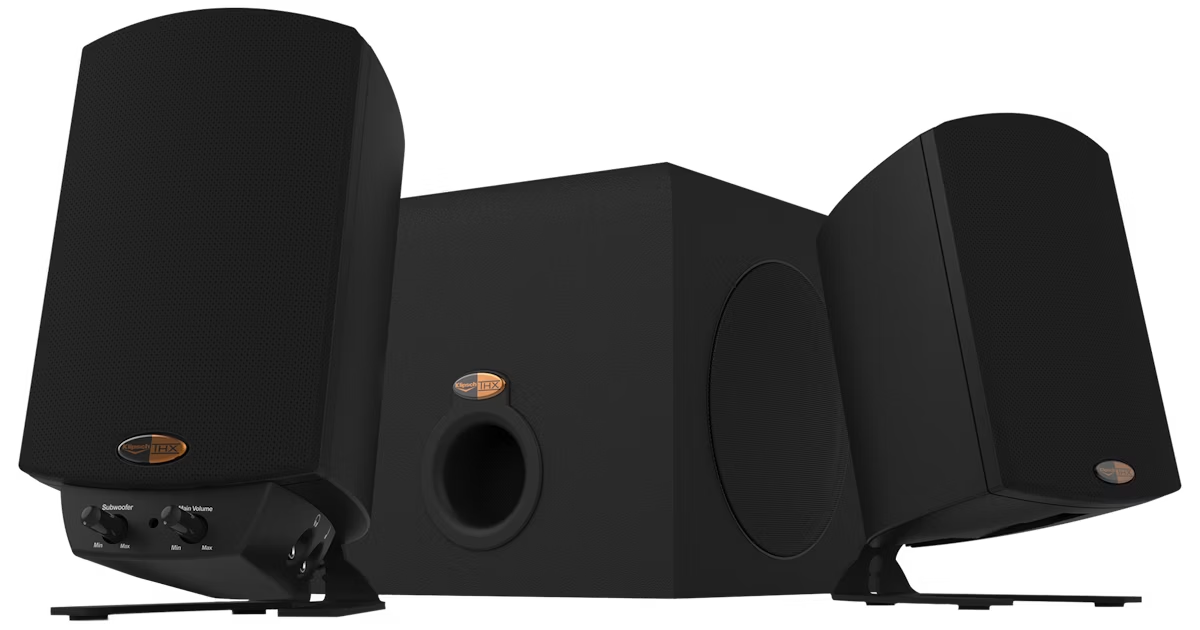
The ProMedia 2.1 has barely changed since its debut, and Tom's Guide noted the design philosophy directly: the speakers "have been available since 2001" and "you don't need to mess with a good thing." The satellites are larger than the dinky drivers on Creative or Logitech systems, and the subwoofer is a substantial ported MDF box that needs real floor space, so it's worth measuring your desk and under-desk area before buying.
The build is sturdy and the horn-loaded satellites are a recognizable, no-frills design. Controls are handled by an inline pod with a volume knob and headphone jack rather than a remote or app. It's utilitarian and undeniably dated-looking, but it's also durable – this is a system people keep running for a decade or more, and that longevity is part of the value: you're unlikely to be replacing it any time soon.
4.4-star average across a thousand reviews
The recurring praise is the sound-per-dollar. Reviewers love the big, clean bass, the loud-without-distortion ceiling, the THX certification and the horn-tweeter clarity. AudioReputation said it "delivers a great sound quality with punchy bass, clear and detailed mids, and crisp highs," and customer ratings back it up – it holds a 4.4-star average from over a thousand Walmart reviewers.
Its longevity is itself a kind of endorsement: a design that's stayed on best-of lists for over two decades has clearly nailed something fundamental. For listeners who care about how a desktop system sounds more than how it looks or connects, the ProMedia 2.1 keeps earning recommendations. HiFiReport highlighted the engineering behind that reputation – a ported subwoofer reaching down to 31 Hz and Klipsch's signature horn tweeters – which explains why it still outperforms much newer rivals on raw sound.
No Bluetooth, app, or remote at all
The biggest omission is connectivity. As Tom's Guide put it, the ProMedia 2.1 is great "if you've got the space for a subwoofer and don't need Bluetooth" – it's analog-only, with no wireless, no app and no remote. In a world where the Logitech Z407 and Audioengine A2+ Wireless add Bluetooth, that's a real convenience gap.
It also asks for space: the subwoofer is large and the satellites are bigger than rivals', so it suits a roomy desk or floor more than a cramped one. And beyond the inline volume pod there are no tone controls or EQ, so you take the (very good) tuning as it comes. For minimalist or wireless-first setups, it's the wrong fit.
Louder and bassier than the Z407, less convenient
Within this guide the ProMedia 2.1 is the bass-and-volume specialist. It comfortably out-muscles the Logitech Z407 and Creative Pebble X Plus, whose smaller subwoofers can't match its 130W low-end or 95 dB ceiling, and it goes far deeper and louder than the sub-less Audioengine A2+ Wireless and Edifier R1280T. What those rivals offer in return is convenience – Bluetooth, remotes, compact size – that the Klipsch lacks.
Against the Audioengine A2+ specifically, it's a different philosophy: the Klipsch is louder and bassier for less money, while the Audioengine is more refined, better built and wireless. For a buyer who ranks raw sound and value above features, the ProMedia 2.1 is the pick; for a quality-and-convenience buyer, the Audioengine edges ahead.
150 dollars for a 95-decibel ceiling
At around $150 the ProMedia 2.1 offers some of the best sound-per-dollar in desktop audio, a reputation it's held for over two decades. AudioReputation put it squarely in context: at a "$150 or $200" budget it's "one of the best options" for a 2.1 system, and Tom's Guide's measured 95 dB no-distortion ceiling backs up the claim that you're getting performance well beyond the price.
The value math is simple: very little else at this price gets this loud, this clean, with this much bass and THX-certified clarity. What you sacrifice for that – Bluetooth, a remote, a modern look, a compact footprint – are conveniences rather than sound, so if your money should go toward audio rather than features, the ProMedia 2.1 is one of the strongest buys here.
Built for loud rooms, not tidy wireless setups
The ProMedia 2.1 is for gamers, movie watchers and music fans who want the most impactful, loudest desktop sound they can get for around $150 and don't care about wireless. Its big bass, clean high-volume output and THX-certified clarity make it a genuine small-home-theater alternative on a desk.
Skip it if you need Bluetooth, want a tidy minimalist setup, or have a cramped desk with no room for a subwoofer – the Logitech Z407 or Creative Pebble X Plus suit those cases better. But for pure sound-per-dollar, the ProMedia 2.1 remains one of the best buys in desktop audio, two decades on. It's also a smart pick for a budget gaming or movie corner where you want genuine impact and volume without stepping up to a full home-theater receiver and bookshelf setup.
Strengths
- +Big, room-filling bass from a powerful 130W-rated subwoofer
- +Gets extremely loud – around 95 dB measured – with no distortion
- +THX certification and a wide, detailed soundstage from horn-loaded satellites
- +Crisp, clear highs and capable midrange for voices and instruments
- +A proven, long-lived design that's been a favorite since 2001
Watch-outs
- −No Bluetooth or wireless connectivity, analog inputs only
- −Dated design and no remote or app control
- −The subwoofer needs floor space and the satellites are large
- −No tone controls beyond the inline volume pod
How it compares
The Klipsch ProMedia 2.1 is the bass and volume king of this group, with a far more powerful subwoofer and higher output than the Logitech Z407, Creative Pebble X Plus or the sub-less Audioengine A2+ Wireless and Edifier R1280T. The trade-off is connectivity: where the Logitech Z407 and Audioengine A2+ Wireless add Bluetooth, the Klipsch is analog-only, betting everything on sound rather than convenience.
Rating sources
“The Klipsch ProMedia 2.1 THX will impress in almost every way when it comes to sound. The system leads with its big bass, but the satellites also do a good job with voices and instruments.”
“If you are looking for a 2.1 speaker system and if your budget is set at $150 or $200, Klipsch ProMedia 2.1 speaker system is one of the best options. It delivers a great sound quality with punchy bass, clear and detailed mids, and crisp highs.”
Our 4.3 score is the average of these published ratings. Ratings marked * were derived from the reviewer’s written analysis or video transcript — the publisher didn’t print an explicit numeric score, so we inferred one from their own words. Click through to verify. More about methodology.