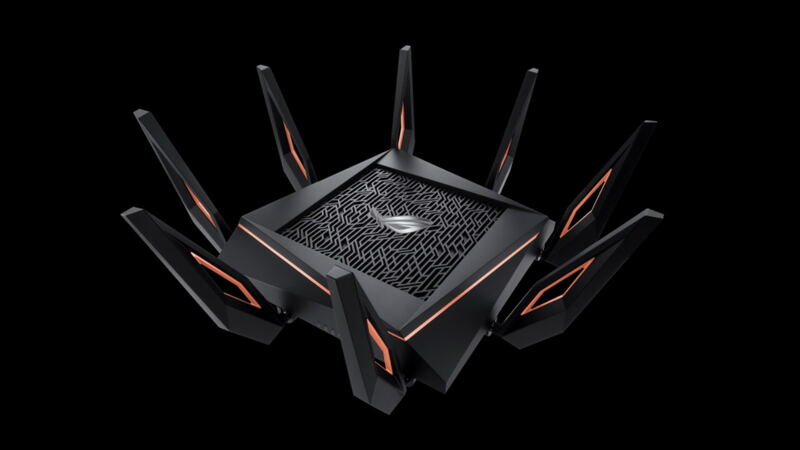
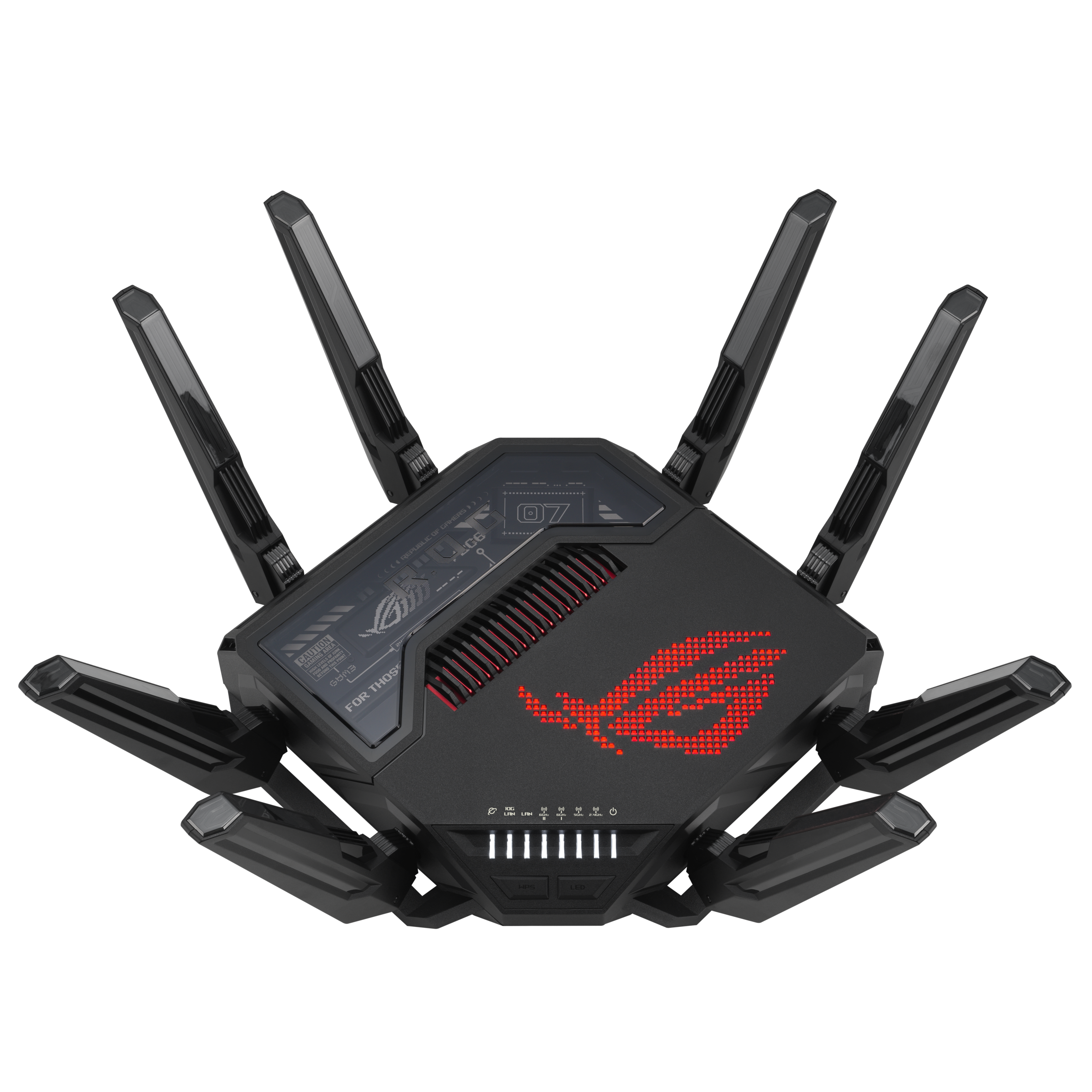
The GT-BE98 Pro is ASUS's no-compromise flagship: quad-band Wi-Fi 7, two 10GbE ports, a quad-core processor and eight external antennas, wrapped in the deepest gaming software anyone ships. Tom's Hardware scored it 4.25 out of 5 for fast, consistent 6GHz performance and a wall of LAN ports, and Dong Ngo of DongKnows went to 4.3 out of 5. It is the most expensive router here, 6GHz range is short, and none of it is reachable without Wi-Fi 7 clients.
Full review
Quad-band Wi-Fi 7 on a quad-core CPU
The GT-BE98 Pro runs four radio bands off a quad-core processor and eight external antennas, and the point of that hardware is headroom rather than a single peak number. Tom's Hardware described performance on the 6GHz band as fast and consistent, which is the more useful property for gaming: a link that does not sag when a dozen other devices are streaming, syncing and backing up matters more than a best-case throughput figure taken in an empty room. On a device-dense network the router itself never becomes the bottleneck, which is what the quad-core silicon is actually buying. Tom's Hardware's overall read, at 4.25 out of 5, was that the performance and feature set genuinely suit hardcore gamers.
Two 10GbE ports and a dedicated game port
Wired connectivity is the clearest separation from the rest of the field. Tom's Hardware called out the plethora of LAN ports including two 10G connections, and dual 10GbE is rare even at flagship prices, where most rivals stop at one. Several 2.5GbE ports sit beneath them, enough for a NAS, a wired desktop and a couple of access points without adding a switch. There is also a dedicated game port that automatically prioritises traffic from whatever console or PC is plugged into it, so the prioritisation happens without anyone opening a QoS page. For a household on multi-gig internet, or one moving large files locally, this is the part of the router that will still matter in five years.
Open NAT, adaptive QoS and game acceleration
ASUS's software is the other half of the argument. Adaptive QoS pushes game packets ahead of background traffic, Open NAT reduces per-title port forwarding to a preset, game-server acceleration picks routes, and a mobile game mode extends the same treatment to phones on the network. AiMesh lets the router adopt other ASUS units to cover a larger house, and AiProtection Pro is included for the life of the router rather than sold as a subscription, which is a real running-cost difference over several years. Dong Ngo of DongKnows scored it 4.3 out of 5, the highest mark in its citation list, and firmware depth is the usual reason ASUS earns that kind of number from him.
6GHz range stays short by design
The standing limitation is 6GHz range. The band that supplies the fastest links also propagates worst through walls and floors, so the throughput that makes this router impressive is largely a same-room or adjacent-room property. Further out, clients fall back to 5GHz and the advantage narrows toward what a good Wi-Fi 6 router already does. That is physics rather than an ASUS defect and every Wi-Fi 7 router in this category shares it, but it changes where the thing should sit: near the gaming machines, not in a utility closet at the far end of the house. The chassis is large and antenna-heavy, which limits the shelves it will fit on anyway.
Overkill unless the clients are Wi-Fi 7
At $679.99 this is the most expensive router in the ranking, and the honest framing is Tom's Hardware's: expensive first, then the performance and features that justify it for a particular buyer. That buyer owns Wi-Fi 7 clients and will actually use the dual 10GbE backbone. Without Wi-Fi 7 devices none of the headline capability is reachable, and the older Wi-Fi 6 ASUS ROG Rapture GT-AX11000 delivers the same ROG software experience for a fraction of the outlay. The TP-Link Archer BE800 is the sensible middle, giving up the second 10GbE port and some of the gaming tooling for a considerably lower price.
Strengths
- +Quad-band Wi-Fi 7 with eight external antennas and a quad-core processor
- +Two 10GbE ports plus multiple 2.5GbE LAN ports
- +Dedicated game port that prioritises wired console or PC traffic automatically
- +Deep ROG software: adaptive QoS, Open NAT, game acceleration, mobile game mode
- +AiProtection Pro included for the life of the router, with no subscription
Watch-outs
- −At $679.99 it is the most expensive router in this ranking
- −6GHz range is short, so the fastest band is effectively same-room
- −Large chassis with eight protruding antennas needs real shelf space
- −None of the headline capability is reachable without Wi-Fi 7 client devices
How it compares
The top-tier pick, beating the TP-Link Archer BE800, Netgear Nighthawk RS700S and TP-Link Archer BE900 on raw 6GHz throughput and gaming-specific software, with dual 10GbE versus the single 10GbE on most rivals. It is far pricier and more powerful than the older Wi-Fi 6 ASUS ROG Rapture GT-AX11000, which remains the value alternative below it.
Rating sources
“While expensive, the Asus ROG Rapture GT-BE98 Pro has the performance and features to appeal to hardcore gamers.”
Our 4.4 score is the average of these published ratings. More about methodology.