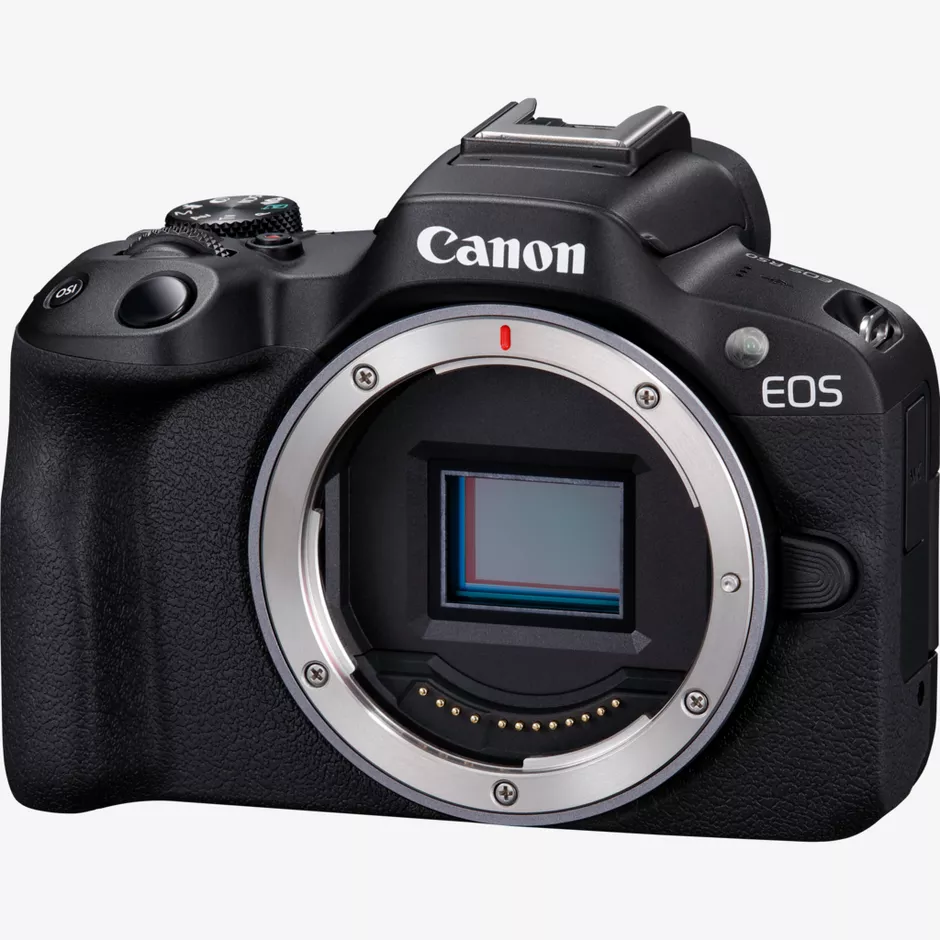
The Canon EOS R50 is a compact APS-C mirrorless camera priced at $680 body-only, and its 24.2MP sensor and advanced autofocus system make it strong value. Reviewers praised the burst shooting and subject tracking, calling the AF system the best at this price point. Third-party lens support is limited, and there is no AV mode in video. The Phoblographer also noted higher ISO penalties than expected. The R50 still holds up as a solid entry-level route into the RF mount without the premium price tag.
Full review
Flagship subject tracking in an entry-level body
The autofocus is what lifts the R50 above its price bracket. DPReview describes a system that pairs subject recognition with tenacious tracking, recognising people, animals including dogs, cats, birds and horses, and vehicles from cars to aircraft. Eye detection locks on for portraits without any menu diving, and the whole thing is descended from the technology in Canon's far more expensive bodies.
There is a mode aimed squarely at self-recording, which biases focus toward whatever is closest to the camera and falls back on face detection for wider framing. It works as advertised, with one caveat worth planning for: stabilisation is disabled in that mode, so a tripod or gimbal is effectively required.
Fast bursts that run out of buffer quickly
DPReview calls the R50 surprisingly adept at burst shooting, and the numbers back it up: 15 frames per second with the fully electronic shutter and 12 with electronic first curtain. For a camera at this price that is a real capability rather than a spec-sheet flourish.
The buffer is where it stops. Roughly seven raw frames or forty-two JPEGs is all you get before the camera slows, which is under half a second of shooting at the top rate. It is enough to catch a moment and not enough to cover a sequence, so the burst mode rewards timing rather than spray-and-pray.
4K oversampled from 6K, but no aperture priority
Video records up to 4K at 30p with no crop, oversampled from a 6K readout, and there is 10-bit HDR capture alongside HEIF stills. Vertical and close-up modes are built in, and the camera works as a webcam without extra software, which matters for the streaming audience Canon clearly had in mind.
The omission that irritates more experienced users is the lack of an aperture priority mode in video, which forces manual or full auto exposure with nothing in between. Combined with the absence of in-body stabilisation, the R50 asks for a stabilised lens and some planning before it will produce clean handheld footage.
The RF-S lens shelf is nearly bare
This is the R50's structural problem rather than a flaw in the camera itself. The native crop-sensor lens range is short, and Canon's approach to third-party lenses on this mount means the usual budget alternatives are not available to fill the gap. Buyers are effectively choosing between the kit zoom, the longer travel zoom, and adapting full-frame glass that undoes the size advantage.
There is also a ceiling on the sensor. High ISO output holds together for casual use, but the penalty climbs faster than some reviewers expected, and the sensor uses neither stacked nor backside-illuminated technology. For a camera bought to replace a phone in low light, that is worth knowing before purchase.
A family and travel camera first
PhotoBohemian's Jan Rybar frames it well: an extremely compact mirrorless body that could be mistaken for a fixed-lens compact, and one that makes the most sense as a portable family and travel camera. Between the guided auto mode with its plain-language brightness and colour controls, the fully articulating touchscreen and the tracking autofocus, it is genuinely approachable for a first interchangeable-lens camera. Anyone who needs a deep lens catalogue or reliable low-light performance should be looking at a different mount.
Strengths
- +Responsive touchscreen with good resolution
- +Very useful burst rate with either EFC or Electronic shutters
- +Autofocus system is the best out there at this price point
- +The Phoblographer found tracking impressively good for a budget camera
Watch-outs
- −Very few RF-S lenses available
- −No AV mode in video
How it compares
The Canon EOS R50 delivers better autofocus performance than the Sony α6400, but lacks the 4K/60p recording and 10-bit color depth of the Sony α6700. Compared to the Fujifilm X-S20, it offers a more affordable price point and better lens support, though the X-S20 provides superior video capabilities and dedicated vlog mode.
Rating sources
“The EOS R50 is Canon's second-cheapest RF-mount camera, sitting above the EOS R100 and below the EOS R10.”
Our 3.8 score is the average of these published ratings. More about methodology.