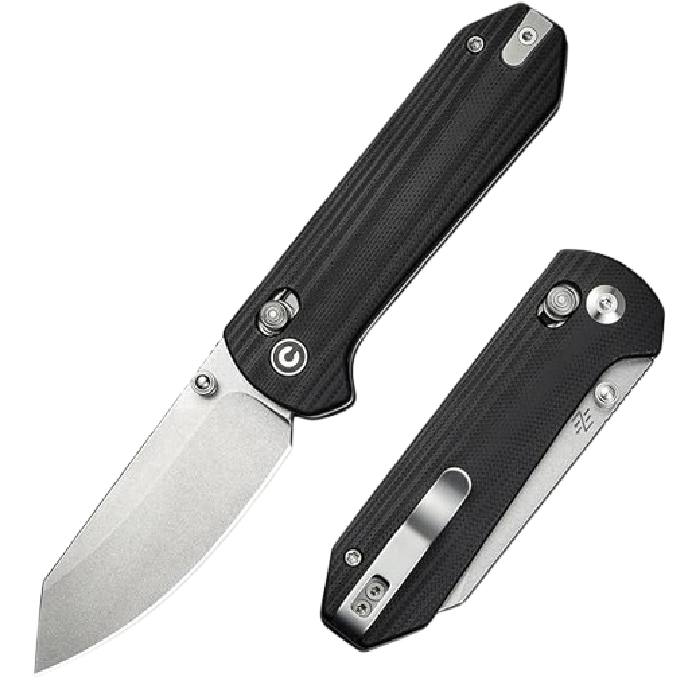
The CIVIVI Yonder is the value pick of this group, a Zac Whitmore design that took Blade Show 2024 Best Buy of the Year. Its sub-3-inch 14C28N spey-point blade rides a smooth crossbar lock at around 2.6 oz, a capable EDC that sits between a gentleman's folder and a hard-use knife. GearJunkie scored it 7.9/10 and CleverHiker 4.6/5, and Outdoor Life's reviewer called it the knife under $100 they like more than anything else in a 200-piece collection. The honest knocks are average edge retention and a crossbar that can rub a hot spot during heavy cutting. At roughly $60, it punches far above its price.
Full review
2.88-inch blade weighs just 2.6 ounces
The Yonder is the budget standout that reviewers keep saying outperforms its price. Designed by EDC personality Zac Whitmore, it won Blade Show 2024's Best Buy of the Year, and Outdoor Life's reviewer went further, writing that in an over-200-piece knife collection, there is no knife under $100 they like more. GearJunkie scored it 7.9 out of 10 and CleverHiker 4.6 out of 5, a strong consensus for a knife that streets around $60.
Cutting is where the Yonder earns its keep. The thin flat grind on the spey-point blade produces what Nothing But Knives called a thin, slice-y experience, and the reviewer praised how clean and light it feels, noting it even performed well at wood carving despite initial doubts. With a 2.88-inch blade and roughly 2.6 oz of weight, it carries like a small knife but cuts like a bigger one. CleverHiker, which scored it 4.6 out of 5, observed that the thin spey-point blade makes quick work of food prep and utility tasks while the grippy G10 handle feels secure and neutral in hand, and GearJunkie's category testers ranked its cutting just behind knives costing several times as much. That kind of performance from a sub-$70 folder is precisely why it keeps showing up on best-of lists alongside premium competition.
The Crossbar Lock
The Yonder is CIVIVI's first crossbar-lock knife, and reviewers were impressed it landed so well on the first try. GearJunkie noted most companies need a few models to dial in a crossbar system, but this one felt complete out of the gate, and that the lock was smooth and never failed in testing. The crossbar design is fully ambidextrous and lets you close the knife without fingers in the blade path.
It is not flawless. Nothing But Knives and GearJunkie both observed the crossbar notch is shorter than the standard length, which creates more resistance and a slightly stiffer pull when opening or unlocking. It is a minor quirk rather than a functional problem, but enthusiasts used to buttery aftermarket crossbar knives will notice it. GearJunkie was nonetheless impressed that the lock felt complete right out of the gate when most companies need a few iterations to dial one in, which speaks to how quickly CIVIVI has matured as a manufacturer.
Steel and Edge Maintenance
The Yonder runs Sandvik 14C28N, a steel Outdoor Life's reviewer, citing Knife Steel Nerds testing, called the best among budget steels for its combination of high toughness, above-average corrosion resistance and decent edge retention. That makes it forgiving and easy to live with, especially for a first knife: it resists rust, takes a keen edge and is hard to chip.
The honest trade-off is edge retention. Nothing But Knives was candid that no one is going to be impressed by the edge retention; it's 14C28N, and it wears like it. The flip side is that the steel loves a strop and comes back to sharp quickly with minimal effort. For an EDC knife at this price, frequent easy touch-ups are a reasonable bargain.
In practical terms, the maintenance burden is modest and the corrosion resistance is genuinely useful. Because 14C28N resists rust well, the Yonder is a sensible choice for humid climates, kitchen-adjacent tasks or anyone who tends to neglect oiling their knives. The easy sharpening also makes it a good knife to learn on; a beginner can practice on the Yonder without fear of ruining an expensive blade, and a few passes on a strop restore a working edge in seconds. That forgiving, low-stress ownership experience is as much a part of the Yonder's value proposition as the low purchase price.
Crossbar notch creates a hot spot under load
The Yonder's limitations are the expected ones for a sub-$70 knife. Edge retention from 14C28N is merely average, so owners who cut a lot of abrasive material will be sharpening more often than they would with the Bugout's S30V or the Lander 2's S35VN. The shorter crossbar notch gives the lock a stiffer pull than premium crossbar knives.
There is also an ergonomic quirk under load. Nothing But Knives found that when cutting anything large or difficult, the crook of the hand keeps snagging on the lock, creating a hot spot. For everyday slicing this rarely comes up, but during extended heavy cutting it can become uncomfortable. And as a budget build on a bearing pivot, the overall finish, while excellent for the money, is a step below the premium folders in this group.
Half the price of the Knafs Lander 2
The Yonder is unambiguously the value pick. It costs roughly a quarter of the Benchmade Bugout 535 or Spyderco Para Military 2 while delivering a similarly thin, slicy grind that punches above its price. Its 14C28N steel is the softest in this group and needs more frequent sharpening than the Bugout's CPM-S30V, the Lander 2's S35VN or the Para Military 2's CPM-S45VN, but it is also the easiest to maintain.
Like the Knafs Lander 2, the Yonder uses a crossbar-style lock rather than the Para Military 2's Compression Lock or the Bugout's AXIS lock. Against the Lander 2 specifically, the Yonder is half the price with a similar lock style but lesser steel and finish, making it the better entry point and the Lander 2 the better upgrade. The Yonder also gives buyers a low-stakes way to discover whether they even like a crossbar lock and a thin slicing grind before committing premium money; if they love it, the Lander 2 and Bugout are natural step-ups, and if they decide they want a beefier hard-use tool instead, the Para Military 2 is waiting. As a first knife it teaches you what you actually want from an EDC blade, which is part of why reviewers recommend it so freely to newcomers.
Blade Show 2024's Best Buy of the Year
Value is the entire story of the Yonder, and the reviews are nearly unanimous that it overdelivers. GearJunkie framed the brand's rise around finding a way to develop quality knives from solid materials for under $100, and the Yonder is the poster child: a bearing pivot, full liners, real G-10 scales, a crossbar lock and a respected Sandvik steel for a street price around $60. CleverHiker said it impresses with craftsmanship that feels far above its price class.
What you give up at this price is the last increment of refinement and steel performance, not core function. The Yonder cuts cleanly, locks securely and carries comfortably, which is everything most everyday users need. The Blade Show 2024 Best Buy of the Year award reflects the industry's agreement that no knife near this price does the fundamentals better, making it the rare budget pick that enthusiasts and first-timers both recommend without an asterisk beyond the expected edge-retention caveat.
A forgiving first knife for new EDC buyers
The Yonder is the knife to buy first. For someone new to EDC, or anyone who wants a genuinely good slicer without spending premium money, it delivers most of what the expensive knives do for a fraction of the cost. The forgiving 14C28N steel, smooth crossbar lock and light carry make it easy to recommend as a daily carry or a no-worry beater.
Step up from it if you want better edge retention and a more refined build, where the Knafs Lander 2 and Benchmade Bugout 535 lead, or if you need a true hard-use tool, where the Spyderco Para Military 2 is the answer. But as a first knife or a high-value everyday carry, the Yonder is the smart-money choice in this lineup.
Strengths
- +Won Blade Show 2024 Best Buy of the Year for value under $100
- +Thin flat grind on the spey-point blade slices cleanly and even carves wood well
- +Crossbar lock is smooth, never failed, and is fully ambidextrous
- +At roughly 2.6 oz it carries light with a confident four-finger grip
- +14C28N steel is tough, corrosion-resistant and takes an edge back quickly on a strop
Watch-outs
- −Edge retention from 14C28N is only average and needs regular touch-ups
- −Crossbar notch is shorter than standard, giving the lock a stiffer pull
- −Hand can snag the crossbar and form a hot spot during big cutting jobs
- −Bearing-pivot budget build is less refined than the premium folders here
How it compares
The CIVIVI Yonder is the budget choice here, costing roughly a quarter of the Benchmade Bugout 535 or Spyderco Para Military 2 while delivering a similarly thin, slicy grind. Its budget blade steel is the softest in this group and needs more frequent sharpening than the Bugout or the Knafs Lander 2. Like the Lander 2 it uses a crossbar-style lock rather than the Para Military 2's Compression Lock.
Rating sources
“Brands like CIVIVI have gained ground in the market because they found a way to develop quality knives from solid materials for under $100.”
“The thin spey-point blade makes quick work of food prep and utility tasks, while the grippy G10 handle feels secure and neutral in hand.”
“In my over 200 piece knife collection, I don't have a knife under $100 that I like more than the Yonder.”
Our 4.4 score is the average of these published ratings. Ratings marked * were derived from the reviewer’s written analysis or video transcript — the publisher didn’t print an explicit numeric score, so we inferred one from their own words. Click through to verify. More about methodology.