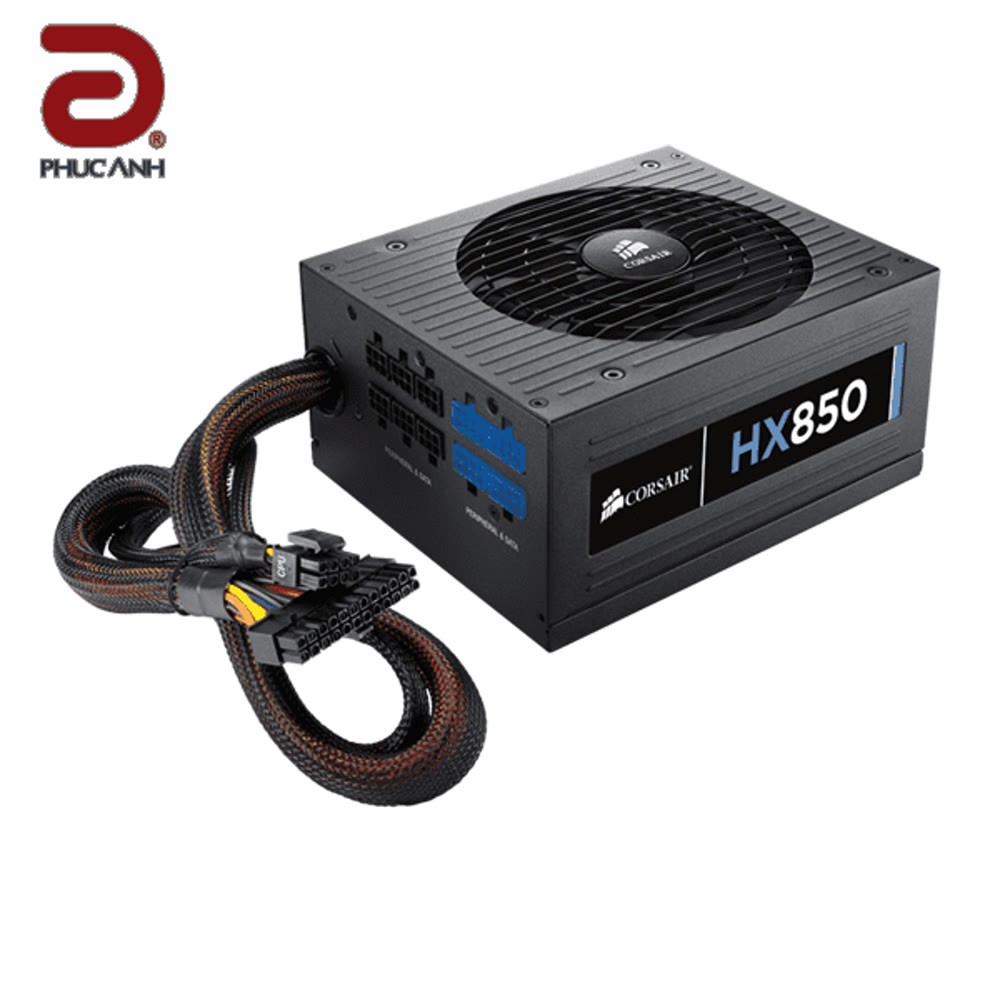
The Corsair HX850 is an 80 Plus Platinum, fully modular 850W unit whose defining trait is silence: ZeroRPM keeps the 135mm fan stopped until load demands it. KitGuru points to the Japanese 105°C capacitors and the build quality behind the ten-year warranty, and PC Perspective's bench work found voltage regulation on the main rails inside tight tolerances. The complaints are practical rather than electrical — thick ATX, EPS and PCIe cables that fight small cases, and over-current protection behaviour on the 5VSB rail. It suits a quiet high-end build where cable room is not the constraint.
Full review
ZeroRPM keeps the fan stopped at idle
The 135mm fluid dynamic bearing fan does not spin at all below a load threshold, which makes the supply silent for desktop work, browsing and light gaming — the states a PC spends most of its life in. KitGuru's assessment is that the fan only turns up as it is needed, and PC Perspective measured low noise even at full load. In a build where the CPU cooler and GPU have already been chosen for quiet, the power supply is often the last audible component, and this one removes itself from that list.
Regulation inside two percent on the main rails
PC Perspective's DC load testing found all three main outputs holding within 2% of the recommended guidelines, including the +12V rail under maximum load, and AC ripple staying low enough not to trouble sensitive components. Active power factor correction measures 0.99. This is the unspectacular part of a good power supply: nothing moves when it should not, and a graphics card that spikes hard does not drag the rest of the system with it.
Platinum efficiency and a switchable rail mode
80 PLUS Platinum certification puts real-world efficiency around 90%, which matters less for the electricity bill than for the heat that never enters the case in the first place. A switch selects between a single +12V rail and multiple rails, so the same unit suits a single large graphics card or a multi-component workstation. KitGuru highlights the 105°C-rated Japanese capacitors as the reason to believe the ten-year warranty is more than marketing.
Fully modular, with cables that fight small cases
Every cable detaches, and the Type 4 set adds sense wires that help regulation at the connector rather than at the unit. The cables themselves are the problem: the sleeved ATX, EPS and PCIe runs are thick and stiff, and in a compact case they resist routing behind the tray. The unit's own 150mm depth compounds it. In a full tower none of this registers; in anything smaller, budget time for cable management or choose a supply with softer runs.
Over-current protection on the 5VSB rail
The one electrical criticism reviewers raise is the over-current protection behaviour on the 5VSB standby rail, which is the rail that keeps USB charging and wake circuitry alive with the system off. It affects a narrow set of use cases rather than general gaming loads, but it is a real finding on an otherwise clean sheet, and it belongs in the decision for anyone loading standby power heavily. Conducted EMI is also higher than some rivals in the class.
Three reviews, all at the same score
KitGuru rates it 8.5 out of 10, with TweakTown and PC Perspective in close agreement, an unusually tight consensus that reflects a unit with no serious weakness and no headline surprise either. The case for it over a cheaper Gold-rated supply rests on the silence, the regulation and the warranty rather than on any single number.
Strengths
- +Full power at 46°C ambient temperature
- +90% efficiency at real-world load conditions
- +ZeroRPM mode for fanless operation at low loads
- +Fully modular design with clean installation
- +10-year warranty
Watch-outs
- −OCP at 5VSB
- −Bulky ATX, EPS and PCIe cables
Rating sources
“Corsair gives the HX850 PSU an overhaul and sets a new benchmark for DC output quality in the process.”
“The Corsair HX850 Platinum power supply was evaluated on both features and performance. A full range of equipment was used to test the power supply under controlled load conditions.”
Our 4.6 score is the average of these published ratings. Ratings marked * were derived from the reviewer’s written analysis or video transcript — the publisher didn’t print an explicit numeric score, so we inferred one from their own words. Click through to verify. More about methodology.