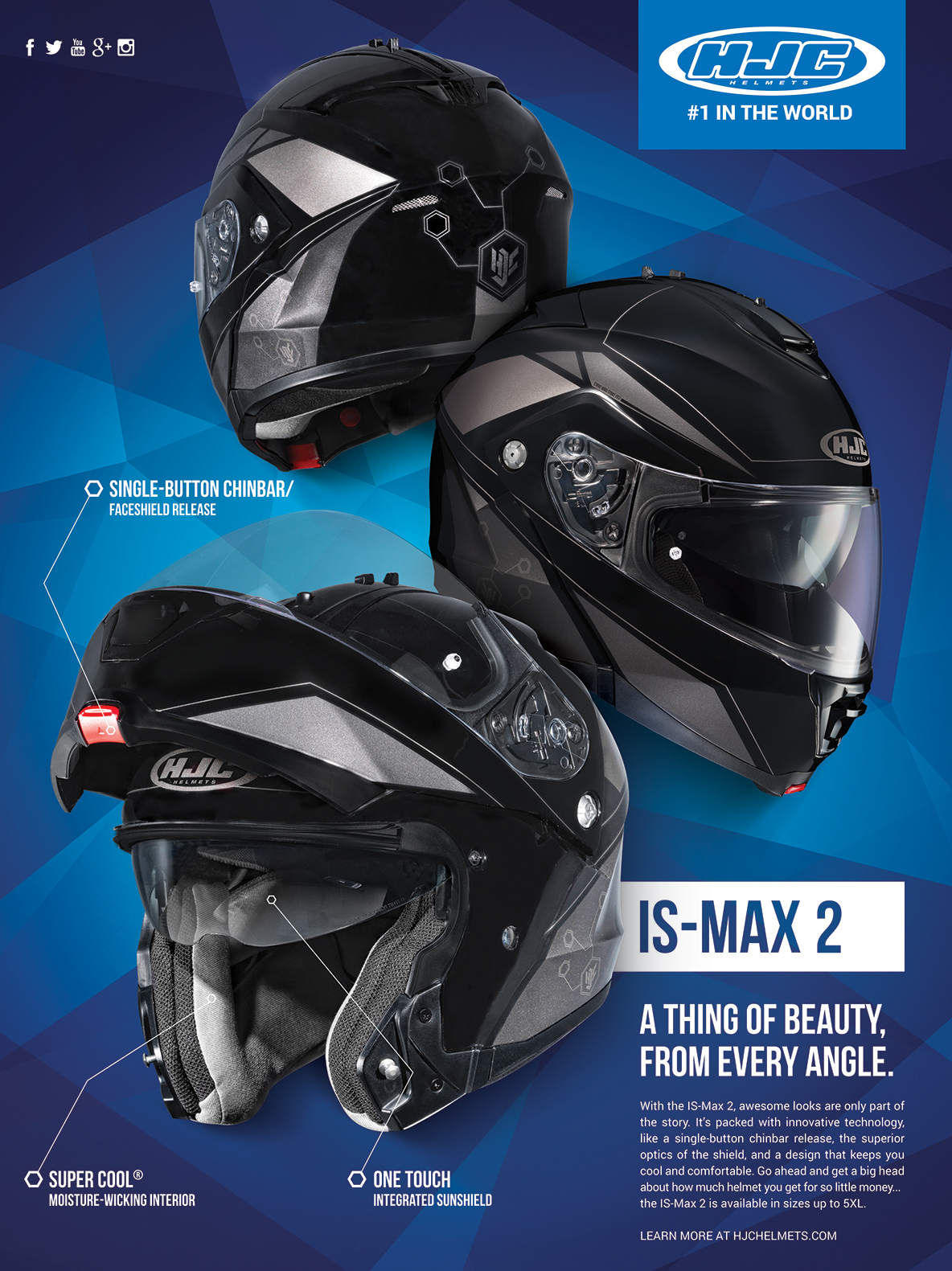
Around $200 bought the HJC IS-MAX II (now discontinued, per Billys Crash Helmets, though leftover stock may still turn up), the best modular (flip-up) helmet in this group, with a smooth-opening chin bar, an integrated drop-down sun visor and a Pinlock-ready shield. webBikeWorld rated it 4/5 A Good Buy and Motorcycle.com scored it 87.5/100, both noting it offers more than almost any modular at the price and comes surprisingly close to lids costing three times as much. webBikeWorld counts it as lightweight, though Billys Crash Helmets calls its weight about average for a modular, and it is convenient for touring and commuting. The sun-visor spring feels flimsy and it is not the quietest flip-up, but for an affordable flip-up that covers several jobs, the IS-MAX II is the pick.
Full review
Scored 87.5 out of 100 by Motorcycle.com
The IS-MAX II is HJC's value modular, and reviewers consistently rank it among the best flip-up helmets you can buy at its price. webBikeWorld gave it a 4 out of 5 A Good Buy rating, concluding that at the roughly $200 mark there are a lot of helmets but few offer quite as much as the IS-MAX II. Motorcycle.com scored it 87.5 out of 100 and noted that, if money matters, it is surprisingly close to modulars that cost three times as much.
On the road the IS-MAX II delivers the core appeal of a modular: the ability to flip up the chin bar at stops, fuel stations or to talk without removing the helmet. Reviewers found it quite stable at speed and reasonably quiet, though not the quietest modular, and the updated aerodynamic shell makes it more composed at highway speed than the original model. For touring and commuting, that flip-up convenience is a genuine daily benefit.
The flip-up format fundamentally changes the daily ownership experience compared with a fixed full-face. Riders who wear glasses, who stop frequently, or who simply want to grab a drink or talk to a fuel-station attendant without unstrapping appreciate being able to open the chin bar in a second. For tourers logging long days with many stops, that convenience compounds, and it is the single biggest reason a rider chooses a modular like the IS-MAX II over the otherwise-similar fixed full-faces in this list.
The Modular Design and Sun Visor
The IS-MAX II's chin bar opens and closes smoothly and, as webBikeWorld noted, features a bump engineered to keep it open during riding, operable easily with a gloved hand. The advanced polycarbonate composite shell with adjustable polycarbonate chin bar keeps the modular mechanism light and functional, and the whole helmet looks far more modern than the original, with sleek, flowing lines.
The integrated drop-down sun visor is a standout convenience. Motorcycle.com called it the next best thing to having a Transitions shield, maybe even better, since you can leave the main face shield open for air and still have eye protection from the internal sun visor. That feature, combined with the Pinlock-ready main shield offering 95 percent UV protection, gives the IS-MAX II versatile eye protection that fixed-shield helmets in this list cannot match.
Build Quality and Value
For a modular at around $200, the IS-MAX II is impressively well-built. webBikeWorld described it as a well-built modular helmet with a strong list of desirable features for the money, and HJC kept the weight to roughly 3.8 lb (1,728 g), which webBikeWorld lists as lightweight and Billys Crash Helmets calls about average for a modular. According to Billys Crash Helmets, it even scored fifth place in German magazine Motorrad's test of 16 modular helmets, holding its own against far pricier competition.
The value story is the IS-MAX II's strongest selling point. Reviewers repeatedly note that it delivers most of what a premium modular like the Shoei Neotec offers at a fraction of the cost. For a rider who wants modular convenience without spending $500 or more, the IS-MAX II is the obvious choice, and its blend of features, weight and finish at the price is hard to beat. Billy's Crash Helmets, while scoring it a more measured 3.6 out of 5, still confirmed that owners widely report it is a comfortable helmet.
Sun-visor spring feels weaker than expected
The IS-MAX II's clearest weak point is the sun-visor mechanism. webBikeWorld observed that while the spring system works well, the spring does not feel that strong, raising questions about how long it will last. It is a minor concern but worth noting on a feature that gets used constantly. Reviewers also reported some minor fogging in humid conditions despite the venting, which the optional Pinlock insert would help address.
It is also not the quietest modular at this price, an inherent trade-off of the flip-up design with its chin-bar seams. And on safety, the IS-MAX II is DOT-rated only, lacking the MIPS of the two Bell helmets in this list or the Snell certification of the Scorpion EXO-R420. None of these undermine its value as a budget modular, but they define it as a convenience-and-value pick rather than the safety or refinement leader. Modular helmets in general carry a small inherent weight and noise penalty for the hinge mechanism, and the IS-MAX II is no exception; buyers choosing it are explicitly trading a little of both for the flip-up convenience, which for the touring riders it targets is usually a trade worth making.
Flip-up chin bar with an integrated sun visor
The IS-MAX II is the only modular helmet in this group, offering flip-up convenience the fixed-chin Bell Qualifier DLX MIPS, Scorpion EXO-R420 and HJC C10 cannot. Its integrated drop-down sun visor is a feature only it and, indirectly via the Transitions shield, the Qualifier offer, making it especially convenient for riders who frequently move between bright and shaded conditions.
Against the rest of the lineup, the IS-MAX II is more road-focused than the adventure-oriented Bell MX-9 Adventure MIPS and more versatile than the fixed full-faces, but it is DOT-rated only, lacking the MIPS of the two Bell helmets and the Snell of the Scorpion. The choice comes down to whether flip-up convenience and a built-in sun visor matter more to you than additional safety certifications, which for many touring riders, they do. It is worth noting that all helmets here meet the mandatory DOT standard, so the IS-MAX II is by no means unsafe; it simply does not add the extra MIPS or Snell layer that some rivals do. For a rider who values the practical, everyday convenience of a flip-up above all, that is a reasonable trade, and few modulars offer this much for around $200.
Touring Convenience and Value
The IS-MAX II is built around touring convenience, and its feature set reflects that. Beyond the flip-up chin bar and drop-down sun visor, it offers a Pinlock-ready shield for fog-free riding in damp conditions and a removable, washable liner for long-term cleanliness. The updated aerodynamic shell makes it more stable and quieter at speed than the original, addressing a common modular complaint, and the one-button chin-bar release is easy to operate with gloves on.
On value, the IS-MAX II is one of the strongest arguments in the modular segment. webBikeWorld and Motorcycle.com both stress how close it comes to modulars costing three times as much, and its fifth-place finish among 16 flip-ups in Motorrad's test shows it competes well above its price class. For a rider who wants the genuine convenience of a modular, the ability to flip up at stops, eat, drink or talk without removing the helmet, the IS-MAX II delivers that experience for around $200, which is exceptional.
Best for riders who stop often to talk or refuel
The IS-MAX II is for the touring or commuting rider who values the convenience of a flip-up chin bar and a built-in sun visor, and wants it at a budget price. Riders who frequently stop to talk, refuel or check directions, and who appreciate being able to drop a sun visor instead of swapping shields, will find it the most convenient helmet in this group.
Look elsewhere if you want maximum safety certification, where the Scorpion EXO-R420's Snell rating or the Bell helmets' MIPS lead, or if you ride adventure, where the Bell MX-9 Adventure MIPS is purpose-built. Budget buyers who do not need a modular should consider the HJC C10. But for affordable flip-up versatility, the IS-MAX II is the pick.
Strengths
- +Smooth-operating modular chin bar that flips up easily with a gloved hand
- +Integrated drop-down sun visor doubles as eye protection without swapping shields
- +Lightweight per webBikeWorld at around 3.8 lb (Billys Crash Helmets rates it about average for a modular)
- +Pinlock-ready face shield with 95 percent UV protection, per webBikeWorld
- +Excellent value, scoring close to modulars costing three times as much
Watch-outs
- −Drop-down sun visor spring feels weak and may not last long-term
- −webBikeWorld found some minor fogging in humid conditions despite venting
- −Not the quietest modular at this price point, per Billys Crash Helmets
- −DOT-rated only, without the MIPS or Snell of some rivals
How it compares
The HJC IS-MAX II is the only modular (flip-up) helmet in this group, offering convenience the fixed-chin Bell Qualifier DLX MIPS, Scorpion EXO-R420 and HJC C10 cannot, and a more road-focused design than the adventure-oriented Bell MX-9 Adventure MIPS. Its integrated sun visor is a feature only it and, indirectly via Transitions, the Qualifier offer. It is DOT-rated only, lacking the MIPS of the two Bell helmets and the Snell of the Scorpion.
Rating sources
“At the roughly $200 mark, there are a lot of helmets, but few of them offer quite as much as the IS-MAX II.”
“Owners widely report that the IS-Max 2 is a comfortable helmet.”
Our 3.8 score is the average of these published ratings. Ratings marked * were derived from the reviewer’s written analysis or video transcript — the publisher didn’t print an explicit numeric score, so we inferred one from their own words. Click through to verify. More about methodology.