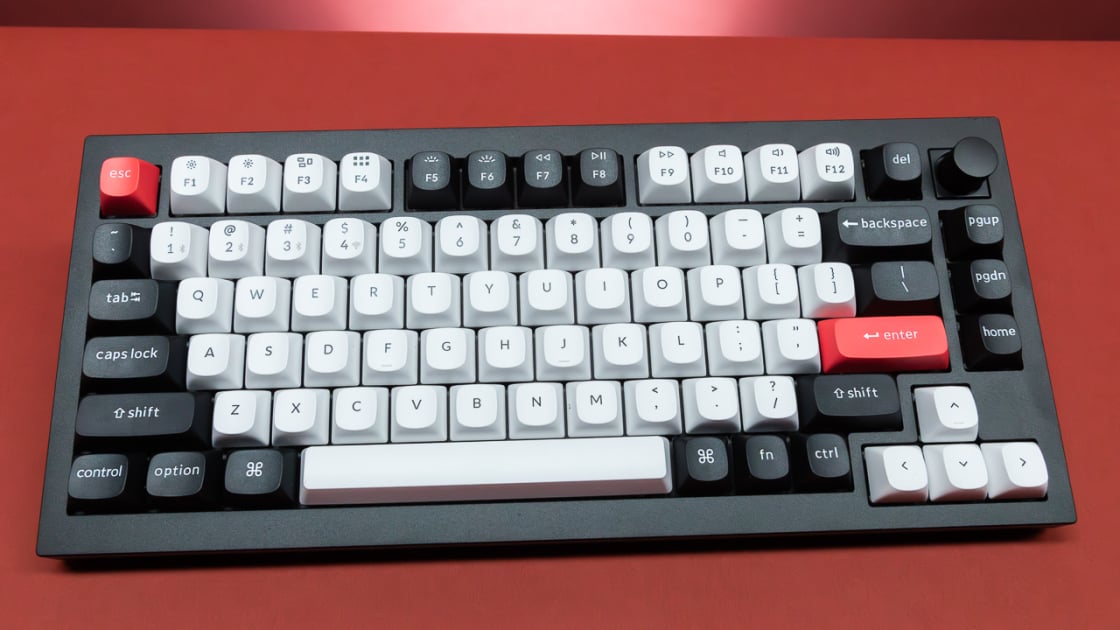
The Keychron Q1 HE brings Hall Effect magnetic switches to a compact 75% layout with per-key RGB and hot-swap sockets. PCMag praised its build quality and tactile feedback, Tom's Guide highlighted the wireless performance and battery life measured competitive response times for gaming. The rapid-trigger capability and adjustable actuation points make it a strong pick for gamers who want Hall Effect without committing to Wooting's ecosystem.
Full review
Hall effect switches in hot-swap sockets
The Q1 HE reads keypresses magnetically rather than through a metal contact, which turns the actuation point into a software setting rather than a physical property. Set it shallow for gaming, deeper to stop typos, or enable rapid trigger so a key re-fires the instant it starts rising. Keychron's addition to the idea is the sockets: the Gateron Nebula magnetic switches pull out and push in without soldering, which almost no other Hall effect board allowed at launch.
Wired's Henri Robbins, who scored it nine out of ten, is honest about the feel — smooth and consistent, but without the crispness of a good tactile mechanical switch. Tom's Hardware notes the contactless design should outlast a conventional switch, though Gateron has not published a figure for these.
An aluminum case on a gasket mount
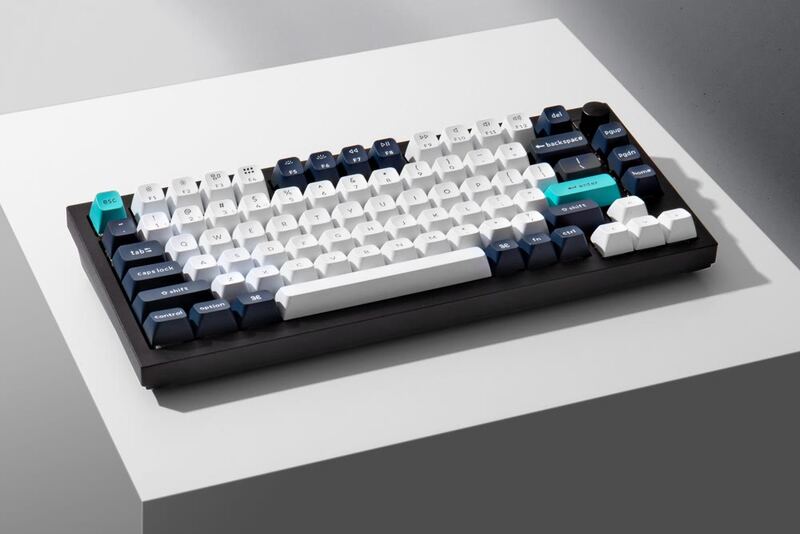
The body is CNC aluminum on a gasket mount with PBT double-shot keycaps, at 2.1 kilograms in a 75% layout. It is heavy in the way enthusiasts mean as a compliment: it does not slide, and the case absorbs sound rather than amplifying it. PCWorld's Michael Crider praises the manufacturing quality even while scoring the keyboard low overall, and PCMag's four-star review makes the same distinction between the object and the software wrapped around it.
Tri-mode wireless with an unreliable wake
Connectivity covers Bluetooth 5.1, a 2.4GHz dongle at 1000Hz polling, and USB-C. The wireless behaves well in use with one recurring exception several reviewers hit: waking a sleeping computer from the keyboard is inconsistent, so you end up reaching for the mouse anyway. Battery life is long enough that charging is a monthly thought rather than a weekly one, and considerably shorter if the per-key lighting runs bright.
One switch family and no per-game profiles
The limitations are all about choice. Only the Gateron Nebula magnetic switches fit, and they are all linear — there is no tactile or clicky option, and third-party magnetic switches are not interchangeable the way conventional ones are. PCWorld's Michael Crider identifies the bigger gap for gamers: no per-game profiles, so running different actuation settings for different titles means changing them by hand each time.
QMK and VIA cover remapping and macros, which is deeper than most gaming software manages, but the Hall effect settings live in Keychron's own launcher and the two halves do not yet feel like one product.
$229.99 buys the metal, not the ecosystem
At $229.99 this is priced against boards with a more mature software stack and a wider switch selection, and against ordinary mechanical keyboards that cost half as much and type just as well. What the Q1 HE has that neither offers is the combination of a milled aluminum 75% case, hot-swap magnetic sockets and wireless, and Wired's review recommends it specifically as the low-risk way to find out whether Hall effect suits you.
Strengths
- +Hall Effect magnetic switches with rapid trigger and adjustable actuation points
- +CNC-machined aluminum body with gasket-mounted design for a premium typing feel
- +Per-key RGB backlighting with full customization via QMK/VIA
- +Hot-swap sockets for easy switch swapping without soldering
- +Tri-mode connectivity: Bluetooth 5.1, 2.4GHz wireless at 1000Hz polling rate, and USB-C wired
Watch-outs
- −Limited to Gateron Nebula magnetic switches only — no tactile or clicky options
- −Proprietary switch design restricts third-party compatibility
- −Price point around $240 is steep compared to standard mechanical alternatives
How it compares
The Keychron Q1 HE brings Hall Effect rapid-trigger to a 75% layout with per-key RGB and hot-swap sockets, unlike the Wooting 60HE+ which is limited to 60%. Compared to the Keychron Q1 Max (similar aluminum build but standard mechanical switches), the HE wins on gaming performance with adjustable actuation. The NuPhy Air75 V2 offers a lower profile and lighter weight but lacks Hall Effect technology. The Royal Kludge RK84 is much cheaper but uses conventional mechanical switches with far less build quality.
Rating sources
Our 4.0 score is the average of these published ratings. More about methodology.