The NETGEAR PLP2000 is Tom's Guide's top powerline pick, thanks to throughput that often more than doubled every competitor in testing plus class-leading range. It pairs AV2000-class speed with two Gigabit ports, a pass-through outlet, and an extra AC socket. Working against it: a high price, only 90 days of support, and no configuration interface.
Full review
Still delivers 81.9 Mbps at 100 feet
The NETGEAR PLP2000 is the throughput champion of powerline networking, and Tom's Guide's testing is unambiguous about why it tops the rankings. The reviewer found that 'The Netgear extender led the way in terms of performance with the ability to move a maximum of 101.0Mbps out of my home’s 200Mbps connection.' He added: 'In many cases, the Netgear's throughput was more than twice any of its competitors, putting it in a class by itself.' Crucially, it held its lead at distance — at the 100-foot mark its throughput only dropped to 81.9 Mbps, still 'overwhelmingly the leader.' For filling a far-flung room or garage with usable bandwidth, nothing else here comes close.
That real-world advantage is the whole case for the PLP2000. Tom's Guide named it the best powerline extender precisely because it 'outperformed the crowd and filled a previously unconnected garage with more than enough data to watch videos, play games and live online.' Powerline performance is notoriously dependent on a home's wiring, but across testing the Netgear consistently extracted more usable throughput than any rival, which is exactly what you want from a kit that exists to bridge dead zones.
Ports and Connectivity
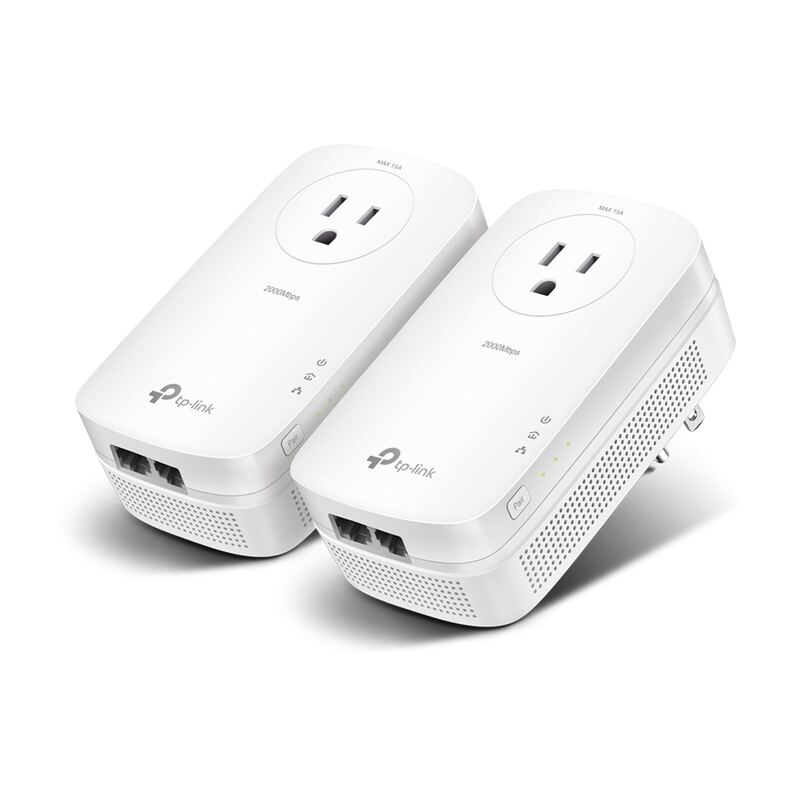
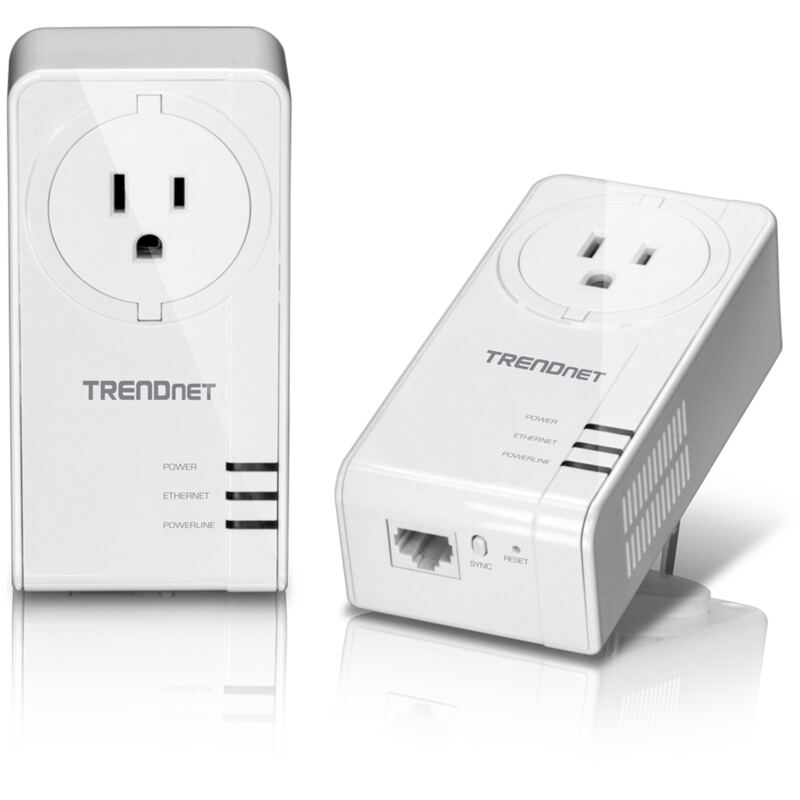
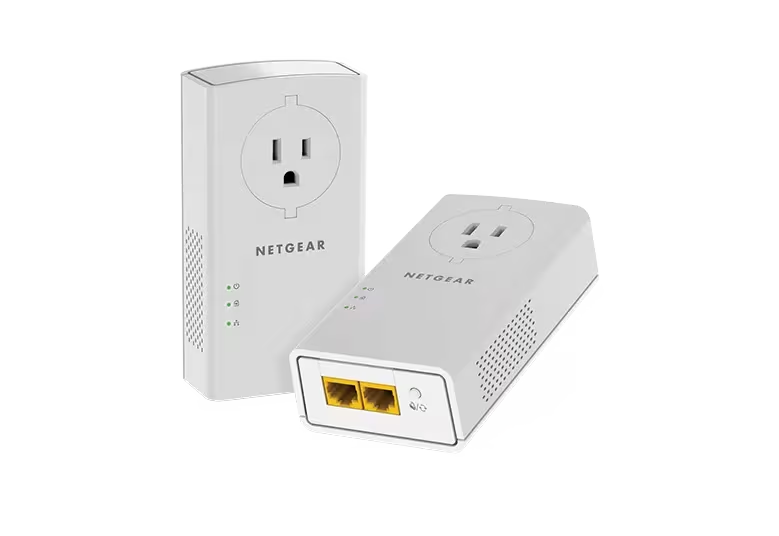
The PLP2000 is well-equipped on the hardware side. Each adapter carries two Gigabit Ethernet ports — double the single port on the budget TP-Link TL-PA7017P and TRENDnet TPL-423E2K — so you can hardwire two devices (a console and a TV, say) at the remote end without adding a switch. B&H summarizes the kit as 'Powerline 2000 with two Gigabit Ethernet ports and an AC pass-through to make up for the outlet it uses.'
The pass-through outlet means you don't sacrifice the wall socket the adapter occupies, and NETGEAR includes an extra outlet on the kit. It runs on HomePlug AV2 with MIMO for the higher AV2000-class throughput, and 128-bit AES encryption secures the link. This is a genuinely capable kit for a multi-device remote setup, not just a single-link bridge.
No app and no way to monitor link speed
Setup is true plug-and-play: plug the first adapter near your router, connect it via Ethernet, plug the second wherever you need a connection, and they pair automatically. There's no app to download and no configuration to wrestle with, which makes it about as approachable as networking gear gets. For most buyers, that simplicity is a feature, not a limitation.
The flip side is that there's no software interface at all. As Tom's Guide noted, the PLP2000 'lacks any way to monitor and configure the equipment,' so you can't check link speed, run diagnostics, or tweak settings the way you can with some app-managed powerline kits. If something underperforms, your only real lever is moving the adapter to a different outlet. For a set-and-forget bridge that's fine; for tinkerers it's a gap.
Only a 90-day support window despite the premium price
Price is the headline drawback. Tom's Guide flagged that the PLP2000 'suffers from being among the most expensive powerline kits you can get' — it costs well more than the AV1000 TP-Link options and the budget TRENDnet. If your home's wiring can't fully exploit its AV2000 ceiling, you may be paying for headroom you won't see.
The 90-day support window is short for a premium product, and the lack of any monitoring or configuration interface means you're flying blind on link quality. The adapters are also physically bulky, dominating the wall plate. None of these undercut its performance crown, but they're the reasons it's the splurge pick rather than the value pick.
Edges out the TP-Link AV2000 on throughput and range
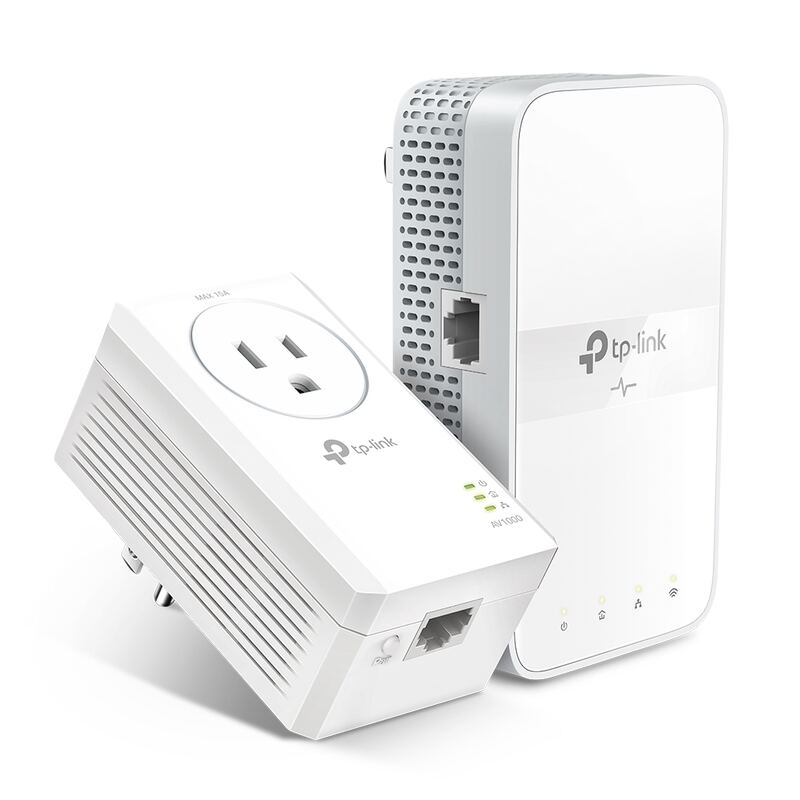
Against the TP-Link AV2000 (TL-PA9020P), the PLP2000 shares the same AV2000 speed class and two-Gigabit-port layout but edged ahead on measured throughput and range in Tom's Guide testing — though the TP-Link is typically cheaper. Against the AV1000-class TP-Link TL-PA7017P and TL-WPA7617, it's meaningfully faster and longer-range but costs considerably more. Against the value-focused TRENDnet TPL-423E2K, it's in a different league on performance, while the TRENDnet wins decisively on price and warranty.
The decision comes down to how much throughput and range you need versus what you're willing to spend. If you have a stubborn dead zone and want the best chance of beating it, the PLP2000 is the kit. If your needs are modest or your budget is tight, one of the cheaper options will likely suffice.
Two Gigabit ports for hardwiring multiple devices
The NETGEAR PLP2000 is for buyers who want the maximum powerline throughput and range available and are willing to pay a premium for it — anyone trying to bring a reliable, high-bandwidth wired connection to a distant room, garage, or outbuilding where Wi-Fi and lesser powerline kits have failed. Its two Gigabit ports also make it ideal for hardwiring multiple devices at the remote end.
Skip it if your distances are short and your bandwidth needs modest — the cheaper TP-Link TL-PA7017P or TRENDnet TPL-423E2K will likely do the job — or if you want built-in Wi-Fi at the remote end, in which case the TP-Link TL-WPA7617 is the better fit.
Strengths
- +Highest measured throughput in head-to-head testing
- +Superb range — still leads competitors at 100 feet
- +Two Gigabit Ethernet ports per adapter
- +Pass-through outlet plus an extra AC socket on the kit
- +Plug-and-play setup with no configuration needed
Watch-outs
- −Among the most expensive powerline kits available
- −Only 90 days of included support
- −No app or web interface to monitor or configure
- −Bulky adapters that dominate the wall plate
How it compares
The performance leader. It matches the AV2000-class speed of the TP-Link AV2000 (TL-PA9020P) but, per Tom's Guide testing, posts higher real-world throughput and better range than any competitor — well ahead of the AV1000 TP-Link TL-PA7017P and TL-WPA7617 and the value-focused TRENDnet TPL-423E2K. The trade is that it's the priciest kit here.
Rating sources
Our 4.5 score is the average of these published ratings. Ratings marked * were derived from the reviewer’s written analysis or video transcript — the publisher didn’t print an explicit numeric score, so we inferred one from their own words. Click through to verify. More about methodology.