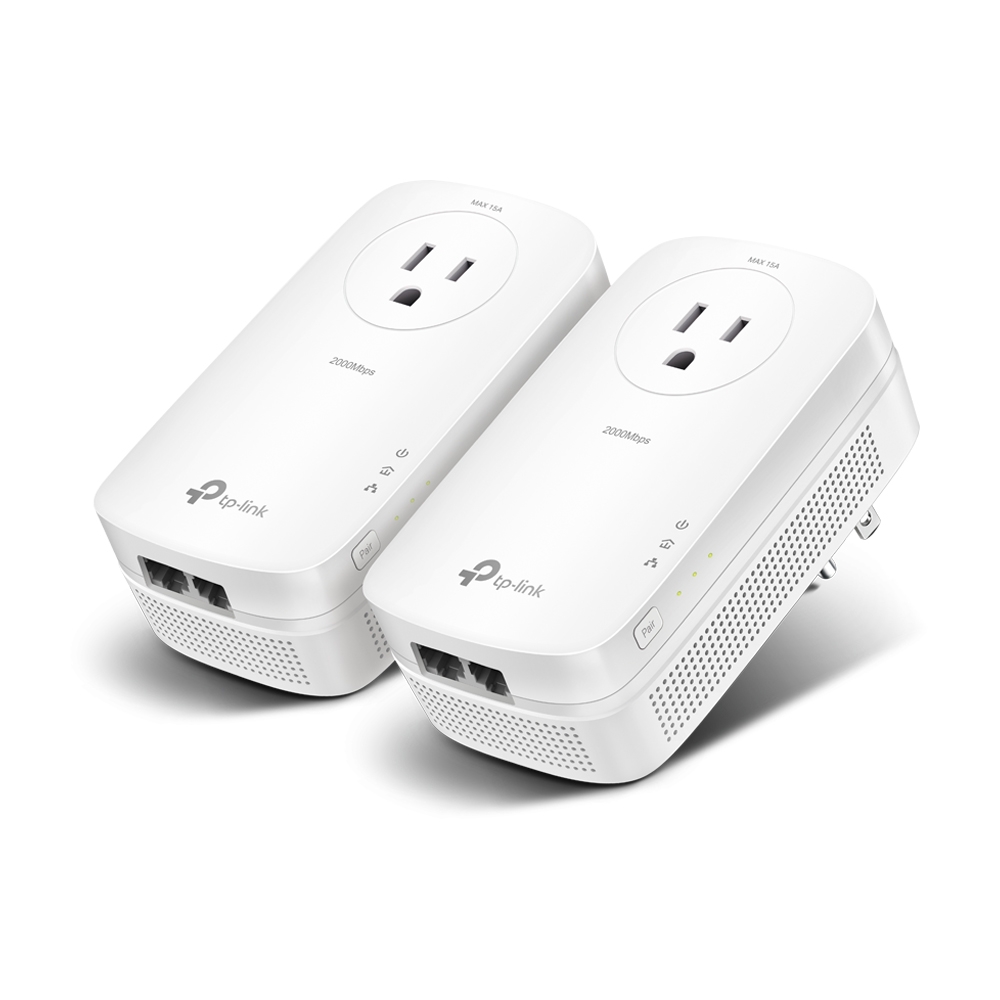
The TP-Link AV2000 (TL-PA9020P) is the value pick in the fastest powerline class, carrying the AV2000 rating and two Gigabit ports per adapter. TechRadar calls it the fastest powerline adapter at up to 2000 Mbps.
Full review
Rated the fastest powerline adapter at 2000 Mbps
TechRadar calls it "the fastest powerline adaptor, with a maximum speed of 2000Mbps, great for gamers." That headroom is what matters for low-latency game traffic and multiple 4K streams.
The AV2000 figure is a theoretical ceiling, as it is on every powerline product, and what you actually get depends on wiring quality, circuit layout and distance. HighSpeedInternet still places the kit at the top of its powerline list, and in ordinary use it is hard to tell apart from the pricier Netgear.
Two Gigabit ports per adapter, 128-bit AES
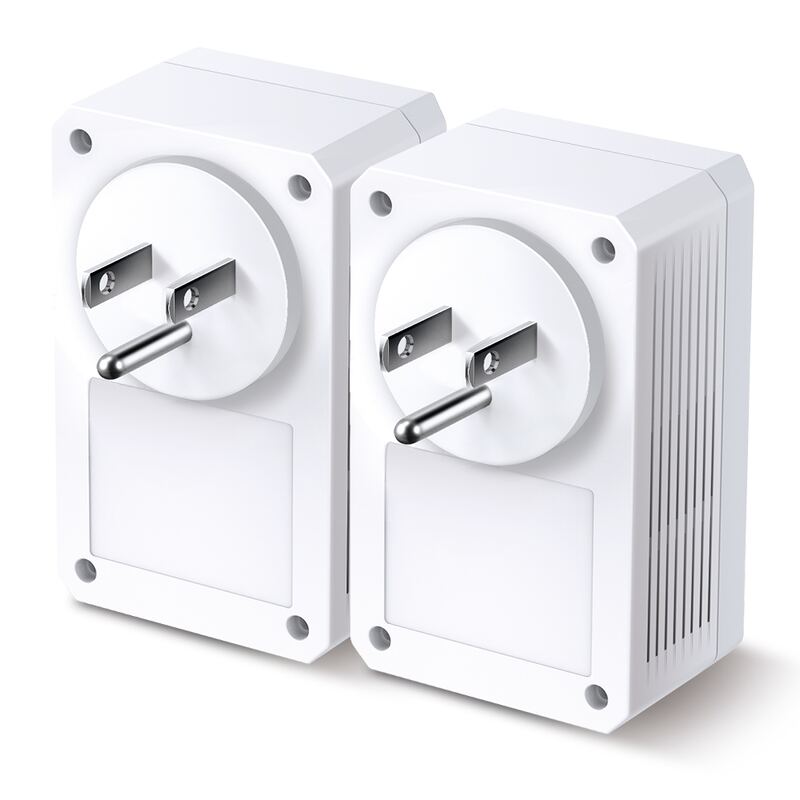
Each adapter carries two Gigabit Ethernet ports, a feature HighSpeedInternet.com singles out, so the remote end can feed a console and a smart TV, or a desktop and a NAS, without adding a switch. Single-port budget kits like the TL-PA7017P and the TRENDnet TPL-423E2K make you choose.
The link runs HomePlug AV2 with MIMO and is secured with 128-bit AES. Pairing is automatic, with a sync button for manual pairing, and TP-Link's optional tpPLC utility lets you check link speeds while you experiment with outlet placement.
Bulky adapters, and no built-in Wi-Fi
The clearest drawback is bulk: the units are large even by AV2000 standards, which is awkward on a two-outlet plate, though each adapter has a pass-through outlet so the socket it covers is not lost.
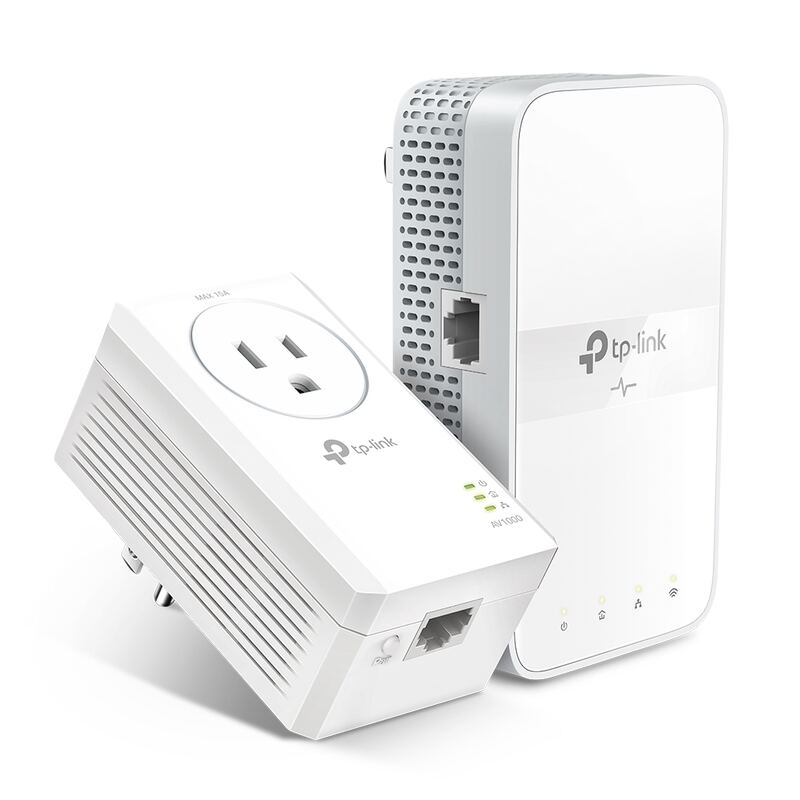
There is no built-in Wi-Fi either, so this only extends a wired connection. If the point is to project a Wi-Fi network into a far room, the TL-WPA7617 is the kit to buy instead, and on older or electrically noisy circuits nothing here will approach the rated ceiling.
Matches the PLP2000's speed class for less money
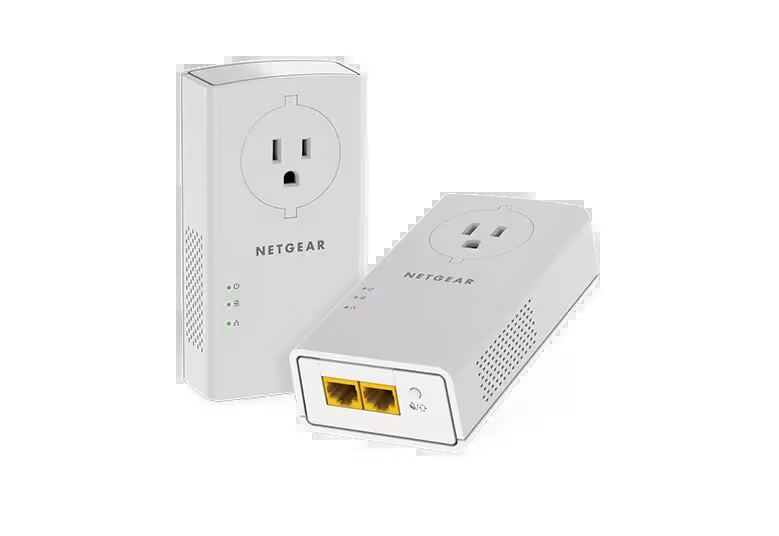
Against the NETGEAR PLP2000 the TL-PA9020P matches the AV2000 speed class and the dual Gigabit ports at a lower price. Against the AV1000-class TL-PA7017P and TL-WPA7617 it is plainly faster with more ports.
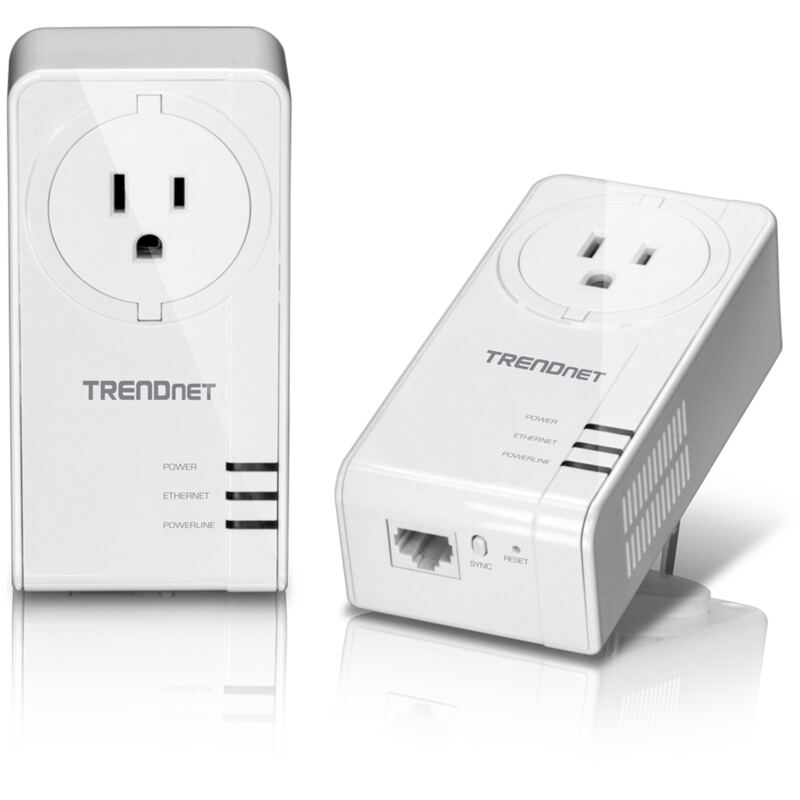
Against the TRENDnet TPL-423E2K it is much quicker but costs more and gives up the TRENDnet's longer warranty. The sweet spot is a buyer who wants top-class throughput and two ports.
Strengths
- +AV2000 speed class, rated up to 2000 Mbps
- +Two Gigabit Ethernet ports on each adapter
- +128-bit AES encryption with plug-and-play pairing and a sync button
- +Optional tpPLC utility for checking link status, which the Netgear has no equivalent for
- +Costs less than the similarly fast NETGEAR PLP2000
Watch-outs
- −Bulky adapters that crowd a two-outlet plate
- −Real-world speed depends heavily on the quality of the house wiring, HighSpeedInternet.com cautions
- −No built-in Wi-Fi, so it is a wired-only solution, as Tech Advisor notes
How it compares
The fast-and-cheap alternative to the NETGEAR PLP2000: it matches that kit's AV2000 speed class and dual Gigabit ports for less money. It is clearly faster than the AV1000-class TL-PA7017P and TL-WPA7617 and the TRENDnet TPL-423E2K.
Rating sources
“Awarded the fastest powerline adaptor, with a maximum speed of 2000Mbps, great for gamers.”
“Dual Gigabit Ethernet ports, especially on the router side, so you don't lose a LAN port — our best overall pick.”
Our 4.5 score is the average of these published ratings. Ratings marked * were derived from the reviewer’s written analysis or video transcript — the publisher didn’t print an explicit numeric score, so we inferred one from their own words. Click through to verify. More about methodology.