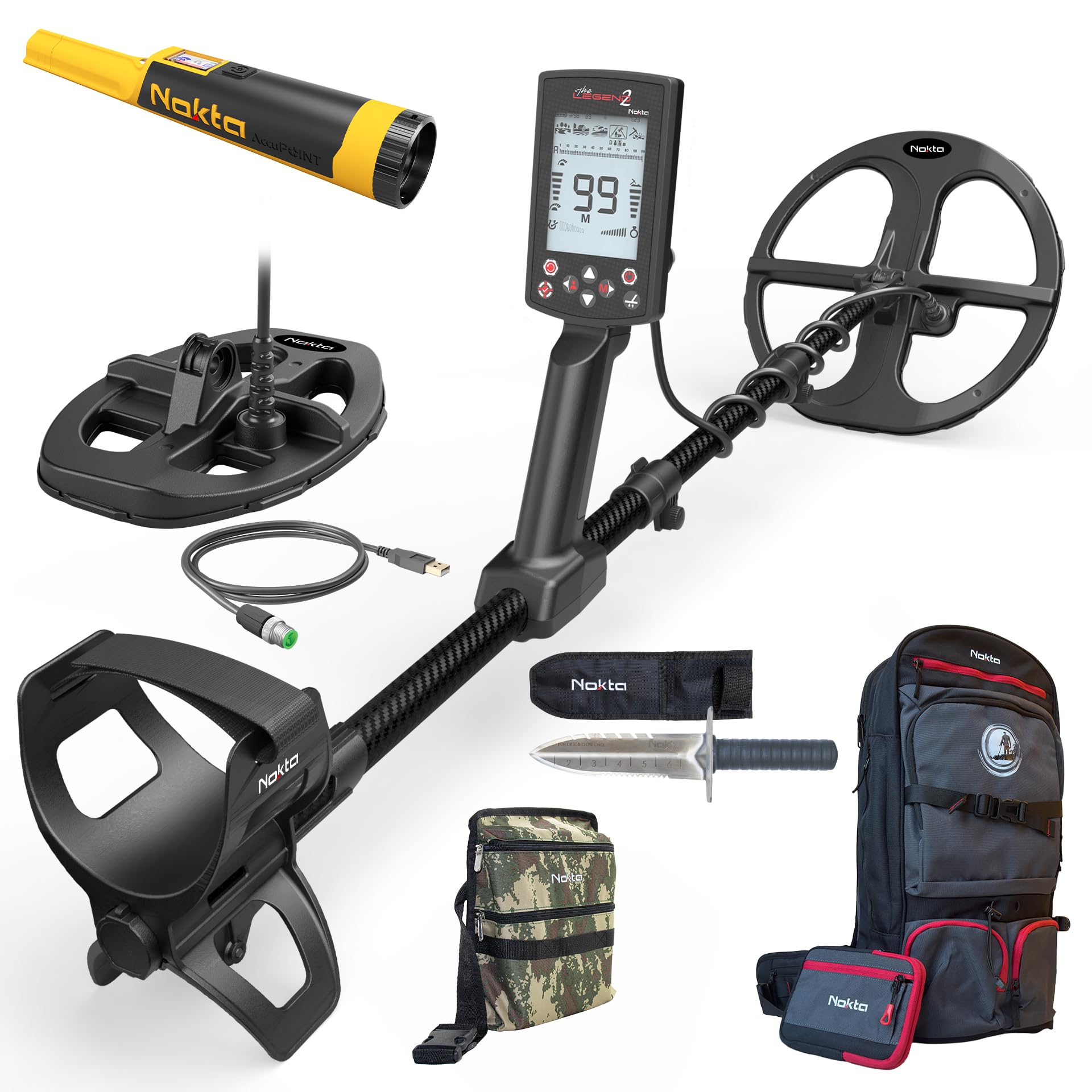
The Nokta The Legend 2 improves upon its predecessor by offering simultaneous multi-frequency operation and an expanded 99-point Target ID scale, which seriousdetecting notes enhances depth and target separation across varied terrains. bigboyshobbies.net confirms that this finer granularity allows for more precise metal identification in trash-heavy environments, while the upgraded 6700 mAh battery eliminates the need for external power packs during long sessions. However, the device suffers from ergonomic compromises; joanallen found the arm cuff feels thin and plasticky compared to the rugged main body, and seriousdetecting reported that the telescopic shaft locking cams can be stiff and difficult to adjust with cold or wet hands. This detector fits experienced hobbyists who value versatility and waterproof performance for beach or relic hunting but may overwhelm beginners seeking extreme simplicity.
Full review
Weight reduction and ergonomic trade-offs
This lighter build is designed to reduce fatigue during long detecting sessions on pasture or beach permissions where swinging a heavier unit slowly ruins concentration. The carbon fiber shaft sections click together quickly without tools, and joanallen notes the tactile feel is modern and light in hand. However, this reduction in weight comes with specific ergonomic compromises that detectorists must navigate. The arm cuff feels thin and plasticky compared to the rest of the rugged build quality, leaving some users waiting for it to crack on a cold day despite not having done so yet.
The telescopic shaft design introduces another physical quirk that affects field usability. While the folding feature makes the detector more portable for car boot storage, seriousdetecting points out that the locking cams can be stiff and difficult to adjust with cold or wet hands. If these cam locks are not properly tightened, the head of the unit will wiggle during operation, which undermines the stability required for precise target identification. Users must ensure they apply enough muscle to secure the shafts tightly, a friction point that contrasts with the otherwise smooth assembly process. The handle grip also feels less rubberized than the original Legend's design, though it does offer slightly more room for the thumb.
The control box angle has been shifted on the Legend 2, and while the screen is larger, some users find the advanced menu icons too small to read comfortably in bright sunlight. The quick menu provides easy access to common settings like discrimination patterns and recovery speed without diving deep into menus, which helps beginners get started quickly. However, for experienced detectorists who enjoy fine-tuning audio profiles or ground suppression levels, the interface requires more deliberate navigation than some competitors offer. Despite these minor friction points, the overall ergonomics remain comfortable enough for all-day use, provided users accept the trade-offs in build material feel and shaft locking mechanisms.
99-point target ID scale expansion
The most significant software upgrade on the Legend 2 is the expansion of its target identification scale from 60 points to 99 points. bigboyshobbies.net confirms this expanded granularity allows for more precise separation between similar metal types, which is critical in iron-laced pasture or modern parks where trash signals are frequent. The original Legend provided a solid 1-60 scale, but the new 99-point system gives detectorists finer control over discrimination patterns and target IDs. This means that when hunting relic sites or colonial ruins, users can better distinguish between shallow gold jewelry and deep iron nails without missing potential finds due to broad categorization.
Target ID stability during pinpointing has also been improved on the Legend 2. The original model did not display target IDs while using the AccuPoint pinpointer, forcing users to rely solely on audio cues or visual estimates from the main unit. The Legend 2 now shows the specific numeric ID in pinpoint mode, reducing guesswork and increasing confidence before digging a hole. This feature is particularly useful when dealing with small targets that might have shifted slightly in the soil or when multiple close-proximity signals are present. The enriched audio options, including seven distinct tone choices, further complement this visual data by providing different auditory cues for various target depths and sizes.
Despite these improvements, some advanced users note that the Legend 2 still lacks certain niche features found on higher-end competitors like the Minelab Manticore, which offers richer visual target information. The 99-point scale is a substantial step forward from the original Legend's 60 points, but it does not reach the level of detail available in flagship machines costing significantly more. For most detectorists hunting mixed terrain, however, this expanded scale provides ample information to make informed decisions about whether to dig or leave a target alone. The combination of visual IDs and stable audio feedback makes the Legend 2 a versatile tool for both beginners learning to identify metals and experienced hunters refining their search strategies.
Battery capacity and wireless connectivity
The internal battery on the Legend 2 has been upgraded from a 5050 mAh lithium-polymer unit to a larger 6700 mAh lithium-ion pack. This increase in capacity translates directly into longer run times between charges, eliminating the need for an external battery pack that was sometimes required during extended field sessions with the original model. metaldetectingshop highlights this enhanced power as a key feature for users who want one tool capable of handling all terrains without worrying about mid-day recharges. The larger battery also supports the detector's wireless firmware update capability, allowing users to download and install new software directly via Bluetooth rather than plugging into a computer.
Wireless connectivity extends beyond just firmware updates. The Legend 2 supports bone-conduction headphones, a feature absent on the original Legend that allows users to stay aware of their surroundings while still receiving clear audio signals from the detector. This is particularly useful for safety in remote areas or when hunting with children nearby. The included APX low-latency Bluetooth headphones pair easily and provide strong, clear audio without noticeable delay, which is crucial for accurate target identification. Users who prefer wired headphones can still use them, but those opting for wireless options must ensure they are compatible with the APX standard to avoid latency issues that could confuse signal interpretation.
The removal of the external battery port on the Legend 2 has been a point of discussion among some users who valued the ability to swap batteries in the field. However, the increased internal capacity largely mitigates this concern for most hunting scenarios. The charging LED indicator provides clear feedback on power status, and the built-in clock with time tracking helps users monitor session duration without needing external devices. For detectorists who frequently hunt long permissions or beach sites where recharging opportunities are limited, the 6700 mAh battery offers a significant advantage over previous models and many competitors in its price range.
LD-series coil compatibility and performance
The Legend 2 introduces a new line of LD-series search coils that are not compatible with the original Legend's LG-series coils. The package includes two distinct DD coils: the LD28, an 11-inch general-purpose coil for open ground, and the compact LD21, measuring 21 cm by 14 cm for tighter spaces or ironier areas. bigboyshobbies.net notes that these new coils are designed to work specifically with the Legend 2's enhanced multi-frequency processing, offering better target separation and depth performance than their predecessors. The round 9-inch LD22 and larger 15x12 inch LD38 are available as optional upgrades for users who want to specialize in park hunting or wide-area field coverage respectively.
The new coil system allows for more tailored detection strategies depending on the terrain. In moderately trashy sites like parks or yards, the LD22 provides easier control without sacrificing too much ground coverage, while the LD38 excels at covering open fields and beaches efficiently with its broad footprint. However, these larger coils are less suited to tight spaces or locations containing closely packed trash where precision is paramount. The compact LD21 remains the go-to choice for relic hunting in confined areas or when dealing with heavy iron interference from modern debris.
Compatibility limitations mean that users upgrading from the original Legend cannot simply reuse their existing LG-series coils, which adds to the initial cost of entry. This hardware change represents a ground-up rework rather than a cosmetic refresh, as kellycodetectors emphasizes in their analysis of the Legend 2's differences. The new LD coils are built with waterproofing up to 5 meters, matching the detector body's IP68 rating and allowing for full submersion without worry. This makes the Legend 2 suitable for shallow water hunting on beaches or riverbeds, provided users adhere to the manufacturer's depth guidelines.
FerroCheck feature and trash filtering
The FerroCheck feature on the Legend 2 helps reduce detection of modern ferrous trash by filtering out iron interference, a capability that metaldetectingshop highlights as particularly useful for hunters dealing with junky ground. This function allows users to distinguish between non-ferrous targets like gold or silver and common iron nails or bottle caps without having to dig every single signal. In environments with high levels of modern debris, such as urban parks or former dump sites, FerroCheck can significantly improve efficiency by allowing detectorists to ignore obvious trash signals and focus on more promising finds.
The effectiveness of FerroCheck varies depending on the search mode and ground conditions. In Park mode, which is designed for general hunting, the feature works in tandem with the expanded 99-point target ID scale to provide clear discrimination between valuable metals and common iron. Field mode users may find it less critical due to lower levels of modern trash, but relic hunters operating on historical sites will appreciate the ability to filter out contemporary debris that often accompanies older artifacts. The adjustable recovery speed settings further enhance performance in these scenarios by allowing quick signal processing when targets are close together.
While FerroCheck is a valuable tool for reducing unnecessary digging, it does not replace the need for careful discrimination tuning and audio monitoring. Some users note that in extremely mineralized ground or areas with high iron content, the feature may occasionally mask weak signals from small gold pieces or deep coins. As such, it should be used as part of a broader strategy that includes proper ground balancing and frequency selection. The Legend 2's simultaneous multi-frequency operation helps mitigate some of these challenges by running multiple frequencies together for better depth and target separation, but users must still exercise judgment when interpreting signals in complex environments.
Suitability for different hunting styles
The Legend 2 is best suited for detectorists who want one serious unit capable of handling most UK permissions without feeling like a compromise. joanallen describes it as ideal for the beach hunter, relic seeker, and experienced hobbyist who values depth, target resolution, and battery life in a single package. Its IP68 waterproofing to 5 meters makes it exactly the class of detector needed near wet sand and surf edges, while its lightweight build reduces fatigue during long sessions on pasture or large permissions. The expanded settings and refined interface reward users who enjoy learning audio profiles, recovery speeds, and iron filtering techniques.
However, the Legend 2 may not be the right choice for everyone. Beginners seeking extreme simplicity might find the array of settings overwhelming on day one, as the detector offers more customization options than a basic two-knob starter unit provides. Those only interested in casual weekend hunting or testing whether the hobby will stick before committing to expensive gear might prefer cheaper entry-level models like the original Legend or Triple Score if budget is their primary constraint. The Legend 2 shines when users are willing to invest time in learning its features and tailoring them to specific hunt sites.
For advanced detectorists tired of modern trash interference, the combination of FerroCheck, stable target IDs during pinpointing, and enriched audio options makes the Legend 2 a strong fit. It bridges the gap between accessible multi-frequency performance and professional-grade versatility without requiring users to carry multiple specialized machines. The ability to save up to fifteen custom user profiles across different search modes allows hunters to quickly switch between settings for park, field, beach, relic, or gold hunting. This flexibility ensures that the Legend 2 remains relevant across a wide range of detecting scenarios, provided users are prepared to engage with its deeper feature set.
Strengths
- +Simultaneous multi-frequency operation provides enhanced depth and target separation across various terrains.
- +Expanded 99-point Target ID scale offers greater granularity in identifying buried metal types compared to the original Legend's 60-point scale.
- +Weighs approximately 2.6 lbs (1.2 kg), making it significantly lighter than the original Legend for reduced fatigue during long sessions.
- +Includes a larger 6700 mAh lithium-ion battery, providing longer run times and eliminating the need for an external battery pack.
Watch-outs
- −The arm cuff feels thin and plasticky compared to the rest of the detector's rugged build quality.
- −Telescopic shaft locking cams can be stiff and difficult to adjust with cold or wet hands.
How it compares
The Nokta The Legend 2 offers simultaneous multi-frequency operation, providing better depth and separation than the Simplex Ultra’s fixed frequency.
Rating sources
“Avg. Rating (4.5 Stars)”
Our 4.8 score is the average of the 2 scored reviews above; 4 more reviewed it without printing a score and are not in the average. Ratings marked * were derived from the reviewer’s written analysis or video transcript — the publisher didn’t print an explicit numeric score, so we inferred one from their own words. Click through to verify. More about methodology.