The Polaroid Go Generation 2 is the world's smallest instant camera at 105mm × 84mm × 62mm and 273g with film loaded. Analog.Cafe's review covers the 51mm fixed-focus lens with an f9-f42 aperture range and an electronically-controlled shutter. Double-exposure mode, a 9-second delay timer, and a built-in flash with 2m range round it out. Reviewers like the portability and the fun of using it, but note the film costs more than Instax alternatives and the bundled USB-C cable is uncomfortably short. Casual photographers who want something compact and addictive will enjoy it; anyone watching film costs won't.
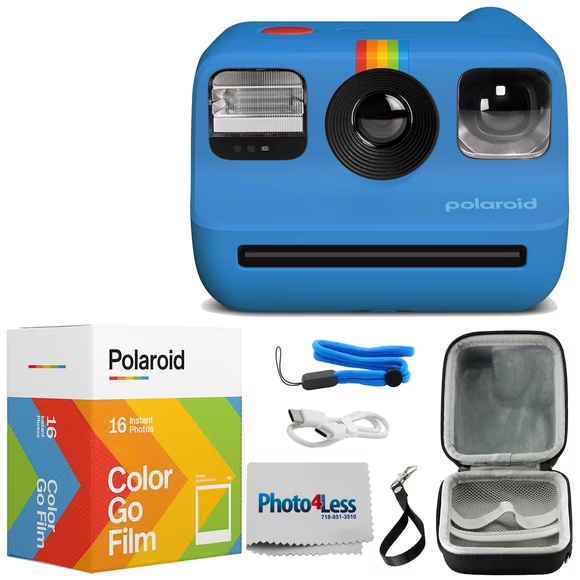
Full review
Design and Portability
The Polaroid Go stands as the world's smallest instant camera, measuring just 105mm × 84mm × 62mm or 4.1" × 3.3" × 2.4", making it pocketable in the truest sense. According to analog.cafe's Dmitri, the camera weighs 273g with film and accessories, or 242g without, which is remarkably lightweight for a camera with a built-in rechargeable battery. The Gen 2 model features a polycarbonate resin lens with a 65° diagonal field of view, equivalent to a 50mm lens on full frame. The build quality is solid, with 30% recycled plastic content, though analog.cafe's Dmitri noted it lacks the precision of higher-end cameras like the Voigtländer Vito C.
Image Quality and Film Performance
Image quality in the Polaroid Go presents a mixed bag of opinions. According to analog.cafe's Dmitri, the Go film is the tiniest instant film frame, measuring 67 × 54mm with a 47 × 46mm image area, smaller than Instax Mini but still offering square 1:1 aspect ratio. The film produces muted, dreamy colors with contrasted dark shadows, though some reviewers noted it's more challenging to get right than Instax film. PCMag's Jim Fisher criticized tiny prints with poor color and detail, while Amateur Photographer found it mostly gives bright, detailed images. The camera's fixed-focus lens with aperture range of f/9-f/42 and shutter speeds from 1s to 1/300s provides automatic exposure, though some reviewers found the flash insufficient for outdoor use.
Camera Features and Operation
The Polaroid Go's operation is designed for simplicity, with all controls grouped on the right side of the camera. The flash button serves multiple functions: single press toggles flash on/off, double press activates double exposure mode, and holding it activates the self-timer. The camera features an integrated rechargeable battery good for 15 packs of film, though charging takes less than 30 minutes via USB-C. The front viewfinder works as a selfie mirror with reflective coating. The camera includes a digital display showing remaining shots, with a tiny orange warning light indicating when recharging is needed. Unlike some competitors, it lacks a tripod mount, though it does include a wrist strap for easy handling. The film loading mechanism is simple, requiring alignment of arrows on the cartridge with those on the camera, though the film hatch is located at the bottom rather than the front.
Real-World Performance Testing
Testing in real-world scenarios revealed mixed results across different reviewers. Amateur Photographer found the Go Generation 2 mostly gives bright, detailed images but performs poorly in low light even with the flash on, while PCMag's Jim Fisher reported tiny prints with poor color and detail and inaccurate exposure metering. The camera's flash has a maximum range of 2 meters, according to analog.cafe.
Prints shrink to 47 by 46 millimeters
Despite its cute design and portability, the Polaroid Go has several notable shortcomings. PCMag's Jim Fisher criticized its tiny prints, poor color and detail, and inaccurate exposure metering, and Amateur Photographer found low-light performance weak even with the flash on. The fixed-focus lens has no macro or close-up mode, as Amateur Photographer noted, and the tiny image size of 47 × 46mm (1.85 × 1.8 inches) means that even with improved details, the prints remain quite small. The double exposure feature, while fun, was described as 'confusing' by some reviewers.
Small enough to be called the cutest camera
The Polaroid Go is best suited for shoppers who prioritize portability, design aesthetics, and the nostalgic appeal of instant photography over image quality. According to analog.cafe's Dmitri, it's ideal for those who want 'the world's smallest instant camera' and are willing to accept smaller prints but still enjoy the 'cute factor' and 'charming' nature of the device. The camera appeals to collectors and those who appreciate the 'cute' factor. However, those who need high-quality images or are serious about photography should look elsewhere, as PCMag's Jim Fisher found its prints tiny, with poor color and detail. It's also not ideal for users who require professional-level features or have difficulty with small controls, as some reviewers noted that 'the diminutive size of this camera could be a major point of frustration.' The camera is best for casual users who want to capture moments on the go and enjoy the fun factor of instant photography.
Film costs 40% more than Instax Mini
The Polaroid Go film costs around $20 for a pack of 16 mini square photos, working out to about $1.25 per print, which is roughly 1.4x more expensive than Instax Mini film at $12.99 for 10 frames. However, Amateur Photographer counted its self-timer and double-exposure modes among its strengths. The camera's built-in rechargeable battery is a premium feature that costs more than the basic AA-powered Instax models, though it provides convenience for users who don't want to carry extra batteries. The value proposition is strongest for those who appreciate the design and portability features over cost efficiency.
242 grams of recycled plastic, still feels solid
The build quality of the Polaroid Go is described as solid despite its small size, with reviewers noting it's 'well-made' and 'reliable' despite being made of plastic. According to analog.cafe's Dmitri, the camera's shell is made of plastic with 30% recycled content, and while it may not have the precision of higher-end cameras like the Voigtländer Vito C, it feels 'reliable.' Analog.cafe weighed it at 242 grams without film, and it comes with a wrist strap. The camera's design includes a digital display showing remaining shots and a tiny orange warning light for charging reminders, which reviewers found useful. The camera's plastic construction is durable enough for casual use but may not withstand heavy abuse.
Strengths
- +World's smallest instant camera with compact 105mm × 84mm × 62mm dimensions
- +Built-in rechargeable battery lasts for approximately 15 packs of film
- +Includes wrist strap and comes in attractive cerulean blue color option
- +Supports double-exposure mode and 9-second delay timer for creative photography
- +Encourages selfies with oversized front viewfinder mirror
Watch-outs
- −Film is more expensive than competing Instax brand at 1.4x the cost
- −Charging cable is described as uncomfortably short
- −Camera is not quite pocketable due to its size
How it compares
The Polaroid Go is the smallest camera in the lineup, but it's more expensive than the Instax Mini 12 and lacks the automatic exposure system. Compared to the Evo, it's less feature-rich and doesn't offer digital connectivity, though it's more portable. Unlike the SQ1, it's less user-friendly and more expensive for similar functionality.
Rating sources
“The new Polaroid Go comes with a 51mm polycarbonate resin lens which has a 65° diagonal field of view on film — a little wider than 50mm on full frame (which is 47°). This fixed-focus lens has an aperture range of 𝒇9-𝒇42 . The electronically-controlled shutter fires between 1s and 1/300s.”
Our 3.5 score is the average of these published ratings. Ratings marked * were derived from the reviewer’s written analysis or video transcript — the publisher didn’t print an explicit numeric score, so we inferred one from their own words. Click through to verify. More about methodology.