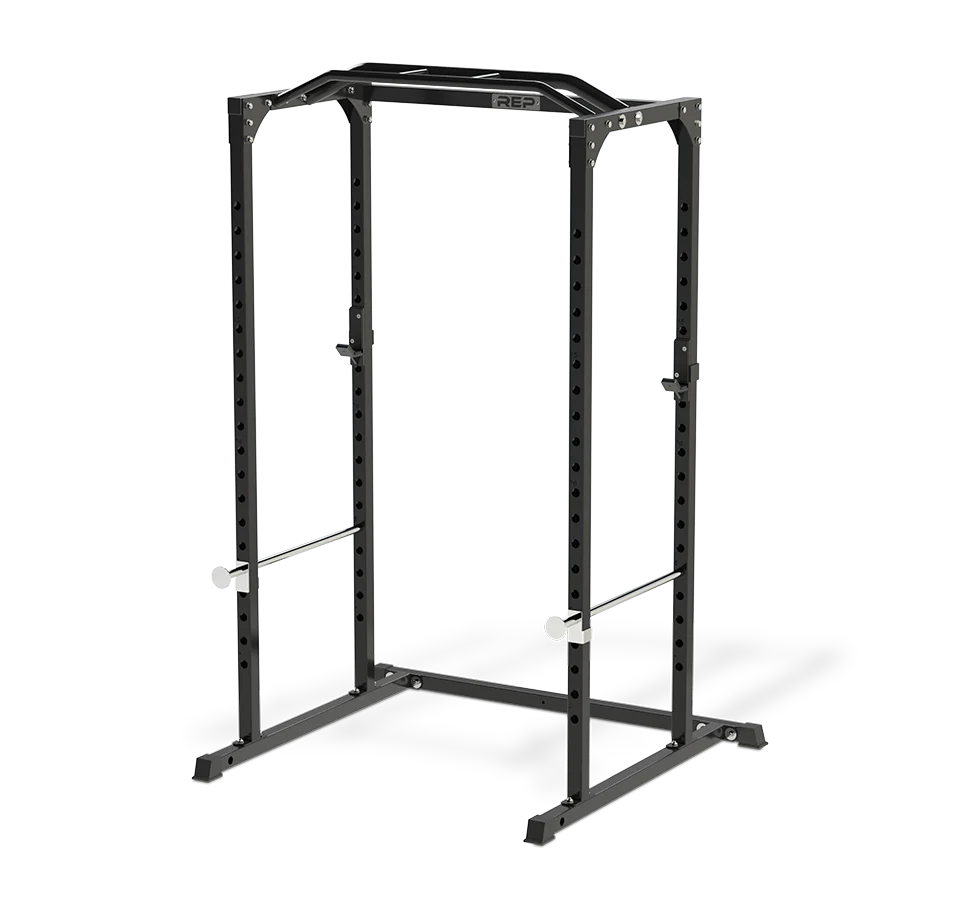
The REP Fitness PR-1100 is the best-value entry-level power rack: 2x2-inch 14-gauge steel, a 700-pound capacity, an included multi-grip pull-up bar, and a rear stabilizer that lets it stand without bolting down, all for around $379. Reviewers call it one of the best budget racks on the market while noting a slight wobble at heavy loads and 3-inch hole spacing that lacks the precision of pricier racks. For beginners and recreational lifters, it is hard to beat.
Full review
The Best Budget Entry Point
The REP Fitness PR-1100 is REP's most economical rack and one of the most recommended entry points into home barbell training. BarBend called it sturdy, compact, and a great choice for adding multiple kinds of pull-ups, summarizing it as one of the best value racks on the market. Garage Gym Lab echoed that, describing it as a solid, no-frills squat rack at a great price that is great for the budget-minded, beginner, or recreational lifter.
At around $379, the PR-1100 includes a multi-grip pull-up bar, pin-pipe safeties, and J-cups in the box, which is more than many budget racks bundle. It is the rack to buy when you want to start training seriously at home without committing to a 3x3 commercial platform.
Build and Capacity
The PR-1100 is built from 2x2-inch 14-gauge steel, which BarBend and Garage Gym Lab both note results in lower rigidity and capacity than the 2x3 and 3x3 racks higher in this list. Its rated capacity is 700 pounds, which Garage Gym Lab points out is more than enough for anyone short of an elite powerlifter.
Crucially, the rack uses a rear stabilizer so it does not need to be bolted to the floor, a major convenience for renters or anyone who does not want to drill into a concrete slab. The trade-off is that the lighter steel and free-standing design produce a slight wobble under the heaviest loads, which reviewers consistently mention but do not consider a safety issue within the rack's rated capacity.
Features and Attachments
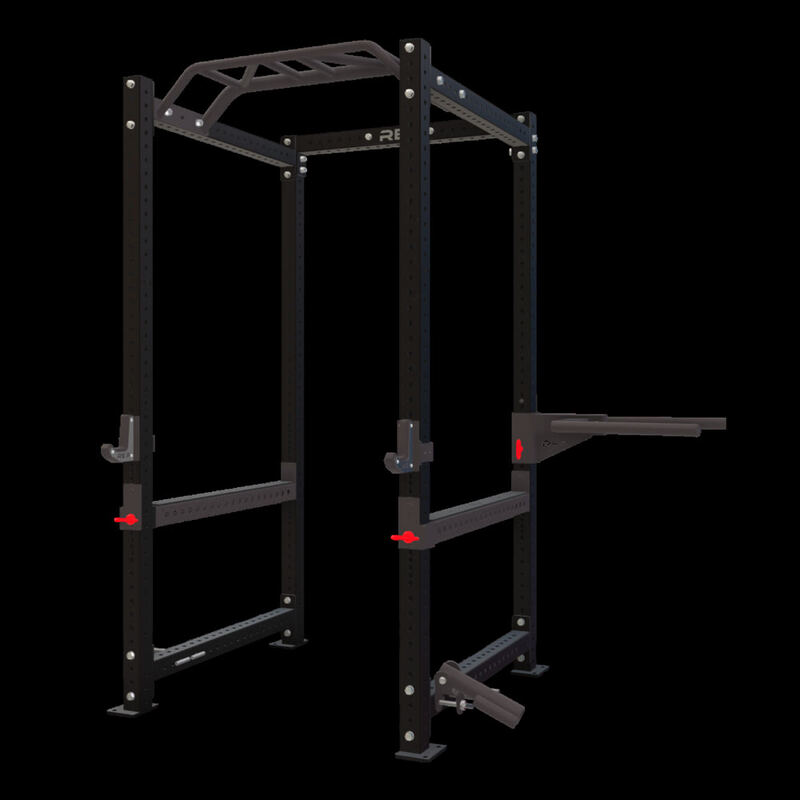
Despite the budget positioning, the PR-1100 ships with a multi-grip pull-up arch offering traditional, neutral, close, and wide grips, plus a standard 1.25-inch bar in front and a 2-inch bar in back. That variety is unusual at this price and a big part of the rack's appeal for anyone who values pull-up options.
REP also offers add-on attachments such as a landmine and a lat pulldown, so the rack can grow modestly with the user. It will never expand into a full training station the way the PR-4000 does, but it covers the fundamentals and a bit more, which is all most beginners need.
Can be moved by a single person
In practice the PR-1100 performs well within its intended use. Reviewers report it handles squats, presses, and pull-ups reliably for recreational lifters, and its compact 84-by-48-by-47.5-inch footprint fits in most garages and basements. BarBend noted it can be moved by a single person, a rare convenience among power racks.
The 3-inch hole spacing is the main functional compromise: it lacks the 1-inch bench-zone precision of the Westside-spaced PR-4000 and R-3, so finding the perfect liftoff or safety height for bench press takes some compromise. For most users at this level, that is an acceptable trade for the price.
Needs roughly 9 feet of ceiling height
The PR-1100's limitations are inherent to its budget tier. The 2x2 14-gauge steel produces the wobble reviewers mention, the 700-pound capacity rules it out for elite-level powerlifting, and the 3-inch hole spacing reduces setup precision. BarBend also flagged that the rack needs roughly 9-foot ceilings, which can be an issue in low basements.
None of these are surprising at the price, and none compromise safe use within the rated capacity. But they do define the ceiling of the rack: a lifter who keeps progressing will eventually want the thicker steel and finer spacing of a 3x3 rack.
Roughly half the price of the PR-4000
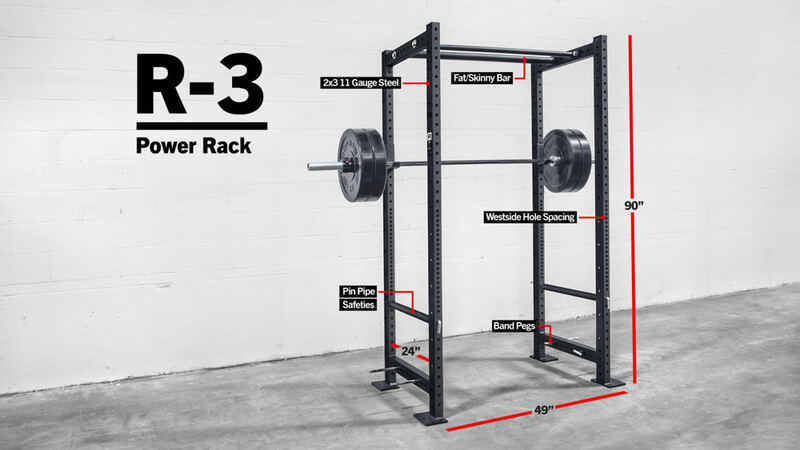
The PR-1100 sits a clear tier below the REP PR-4000 and Rogue R-3, trading their 3x3 and 2x3 11-gauge steel and 1,000-pound capacities for a lighter 2x2 14-gauge frame at roughly half the price. That is the intended trade-off, not a flaw.
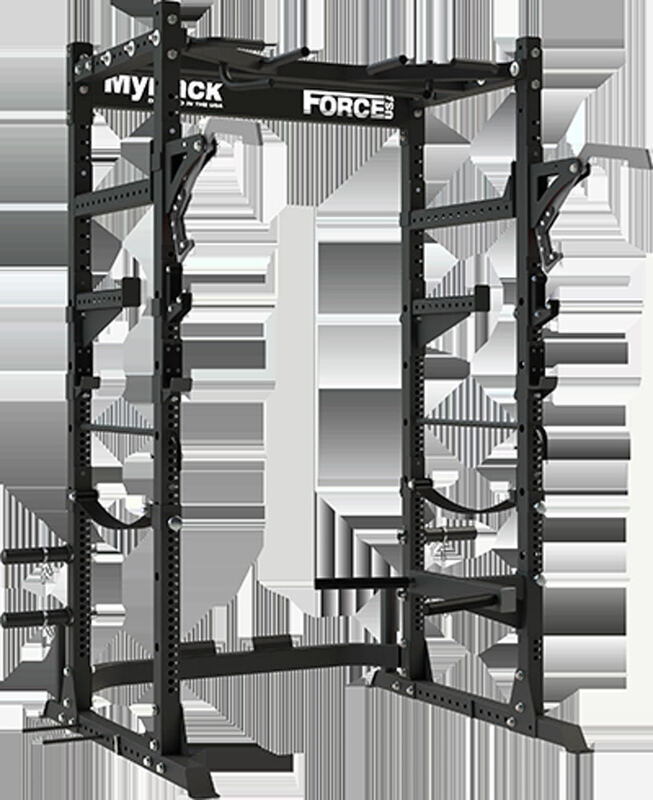
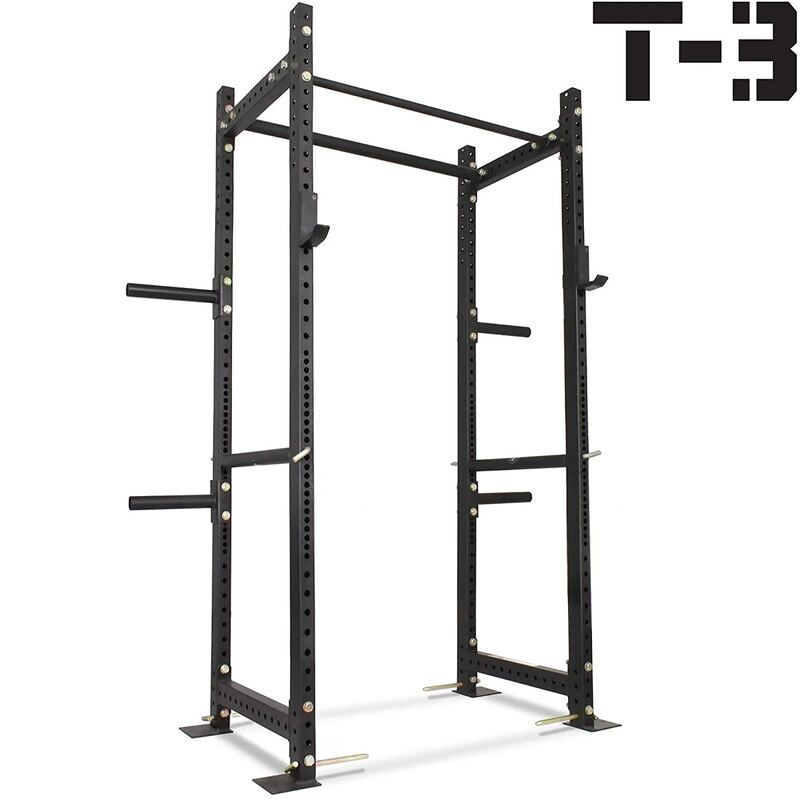
Against the Titan T-3, the PR-1100 is simpler and cheaper but uses thinner 2x2 steel versus the Titan's 2x3 11-gauge bolt-together design. The Force USA MyRack costs a bit more but adds a built-in cable system, appealing to buyers who want more than barbell work. For pure barbell training on the tightest budget, the PR-1100 remains the cleanest pick.
A first rack for renters still finding their limits
The PR-1100 is the right rack for beginners, recreational lifters, and renters who want a dependable, free-standing rack with a pull-up bar at the lowest reasonable price. It is ideal for someone setting up a first home gym who is not yet sure how far their training will go.
It is the wrong rack for serious or competitive powerlifters who will exceed its 700-pound capacity or want finer hole spacing, who should step up to the REP PR-4000 or Rogue R-3, and for buyers who specifically want a cable station, who are better served by the Force USA MyRack.
Strengths
- +Excellent value — $379.99 for the rack direct from REP
- +Multi-grip pull-up bar included as standard
- +Rear stabilizer means no bolting to the floor required
- +700 lb capacity covers the vast majority of lifters
- +Compact 84" x 48" x 47.5" footprint and easy to move
Watch-outs
- −2x2 14-gauge steel has a slight wobble at heavy loads
- −3-inch hole spacing lacks bench-zone precision
- −700 lb capacity is too low for elite powerlifters
- −Requires roughly 9-foot ceilings
How it compares
A lighter-duty 2x2 14-gauge rack with a 700 lb capacity, well below the 3x3 11-gauge, 1,000 lb REP PR-4000 and Rogue R-3. Cheaper and simpler than the Titan T-3 and the cable-equipped Force USA MyRack, and aimed squarely at beginners.
Rating sources
“This power rack is sturdy, compact, and a great choice for adding multiple kinds of pull-ups. One of the best value racks on the market.”
“A solid, no-frills squat rack at a great price.”
Our 4.4 score is the average of these published ratings. Ratings marked * were derived from the reviewer’s written analysis or video transcript — the publisher didn’t print an explicit numeric score, so we inferred one from their own words. Click through to verify. More about methodology.