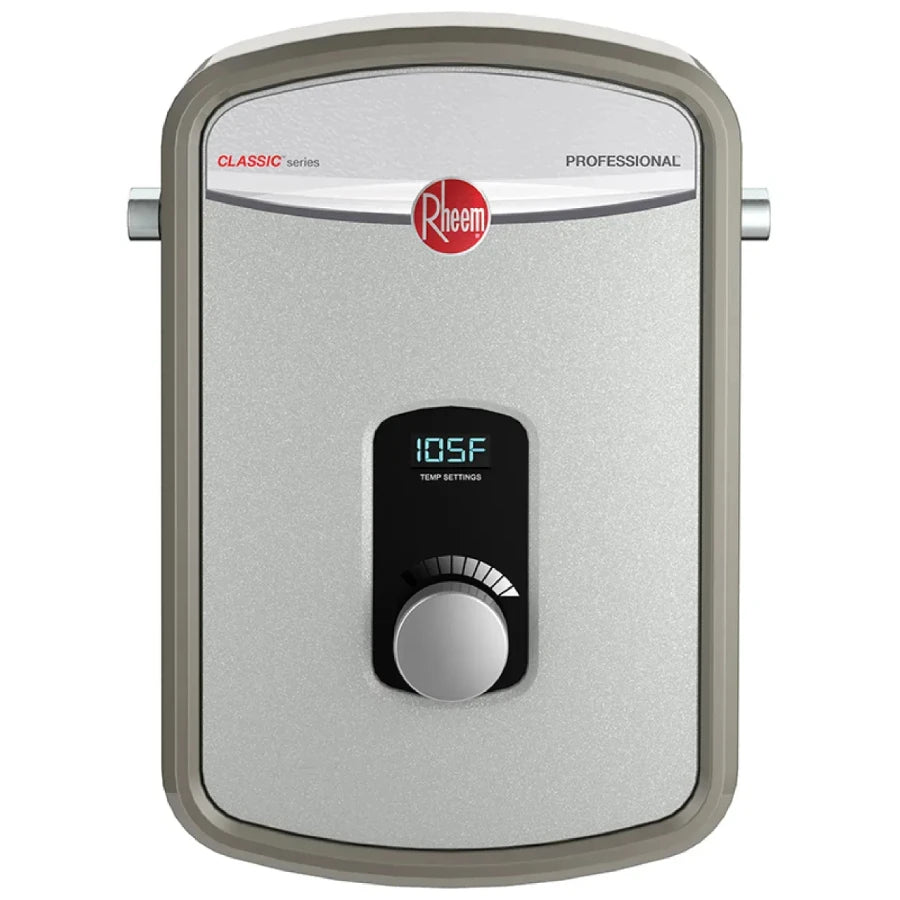
The Rheem RTEX-13 is the best bang for the buck, Bob Vila's value choice and Reviewed's budget electric unit, praised for a '99 percent efficiency rating' at the lowest price in this group. At about 3.17 GPM it's a point-of-use heater designed, as Reviewed notes, 'to support one to two appliances in a single location, such as a shower in the bathroom.' It won't run a whole house. For a remote bathroom, an addition, or a booster, its compact size, efficiency, and low cost make it the obvious affordable choice.
Full review
Maximum Value, Minimum Footprint
The Rheem RTEX-13 is the budget hero of this roundup. Bob Vila named it best bang for the buck, citing its '99 percent efficiency rating,' and it carries the lowest price of any unit here. It's a compact 13 kW electric heater designed to mount near the fixture it serves, heating water on demand with self-modulating control and a digital temperature readout. For a buyer who wants tankless efficiency without the cost and complexity of a whole-home unit, it's the easy entry point.
Point-of-Use by Design
It's important to understand what the RTEX-13 is for. With roughly 3.17 GPM of flow, it is not a whole-home heater — Reviewed is explicit that 'with a 3.17GPM flow rate, it's designed to support one to two appliances in a single location, such as a shower in the bathroom.' That makes it ideal for a remote bathroom far from the main heater, a garage or shop sink, an addition, or as a booster on a long hot-water run. Try to run a whole house off it and you'll be disappointed; use it for the job it's built for and it excels.
Like all electric units, its effective flow drops further when inlet water is cold, so even within its point-of-use role, climate matters.
Efficiency and Simplicity
The RTEX-13's self-modulating power control means it only uses the energy needed to reach the target temperature, contributing to its near-99% efficiency. There's no tank holding water hot all day, no venting, no gas, and no carbon-monoxide risk. As Reviewed notes, installation is relatively simple for an electric unit of its size, though it still requires proper 240V wiring. The external digital temperature adjustment makes dialing in the output straightforward.
The value pick from Bob Vila and Reviewed
Bob Vila and Reviewed both single it out as the value pick, praising the efficiency and the low price. The self-modulating power control and digital temperature display are practical touches at the price. The consensus is that, within its point-of-use lane, it delivers excellent efficiency and reliability for remarkably little money.
Only 3.17 GPM, not a whole-home fit
The RTEX-13's limitation is simply capacity. At about 3.17 GPM it can't serve a whole home, and buyers who mistake it for a primary heater will run out of hot water under simultaneous demand. Its flow also drops with cold inlet water, and despite being small it still needs a 240V circuit. It is a specialist, not a generalist — the wrong tool if you need to supply multiple bathrooms, where the Stiebel Eltron Tempra 36 Plus or a gas Rinnai RU199iN are the right answers.
Built for a single remote fixture
Buy the Rheem RTEX-13 for single-fixture, point-of-use duty — a remote bathroom, a shop sink, an addition, or a booster — where its low price, compact size, and high efficiency shine. It's the smart budget choice for a focused job. For whole-home hot water, look to the EcoSmart ECO 27 or Stiebel Eltron Tempra 36 Plus on electric, or the gas Rinnai RU199iN and Takagi T-H3-DV-N for the highest capacity.
Nearly 99 percent efficient at the lowest price
Within its intended role, the RTEX-13 is unbeatable on value — it's the cheapest unit in this roundup by a wide margin, and for putting endless hot water at a single fixture it does the job at a fraction of any whole-home unit's cost. The trap to avoid is judging it against units several times its price: it isn't trying to run a house, so comparing its 3.17 GPM to the Rinnai's 11 misses the point. Bought for what it is — a focused, near-99%-efficient point-of-use heater — it delivers exactly the value Bob Vila's best-bang-for-the-buck nod implies. Pair it with a main heater for a far-flung fixture, or use it solo in a tiny space, and the low price plus tankless efficiency make it the easy economical call.
Strengths
- +Lowest price of the group — excellent point-of-use value
- +Roughly 99% energy efficiency with self-modulating control
- +Compact 13 kW unit easy to install near a single fixture
- +Digital temperature readout and external adjustment, per Reviewed
- +No venting, gas, or carbon-monoxide risk
Watch-outs
- −Only ~3.17 GPM — supports one to two fixtures, not a whole home
- −Not suitable as a primary whole-house heater in most homes, as Bob Vila notes
- −Flow drops further with cold inlet water
- −240V wiring still required
How it compares
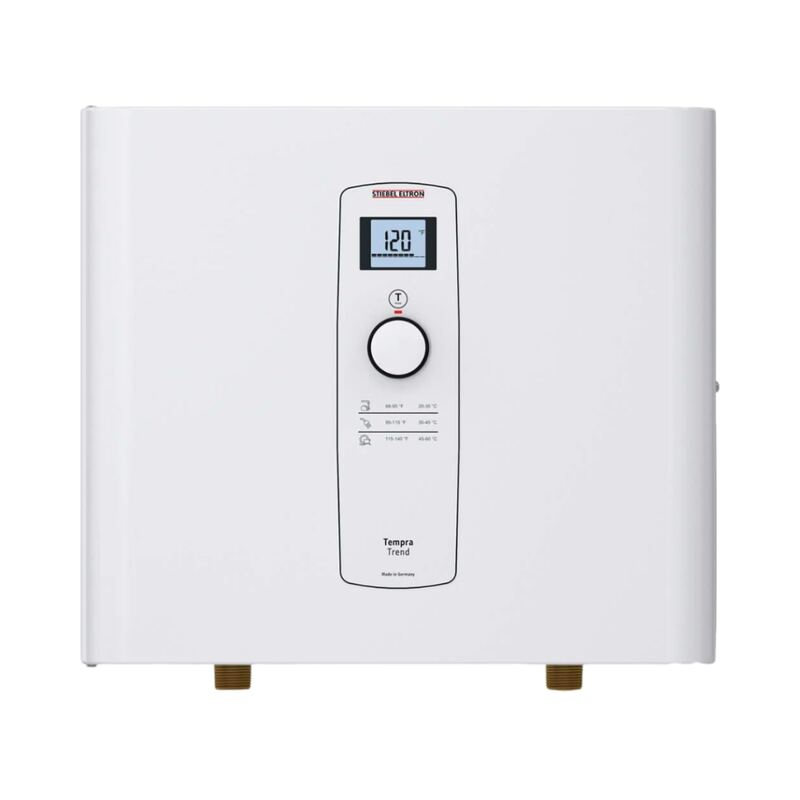
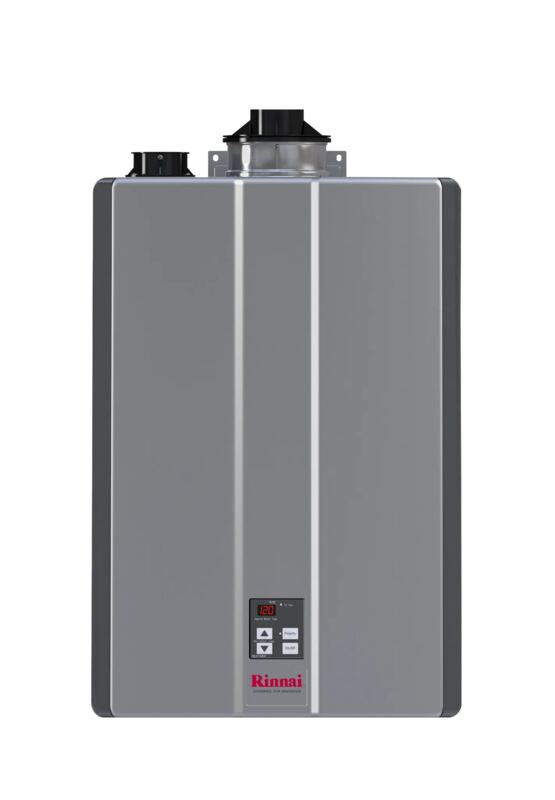
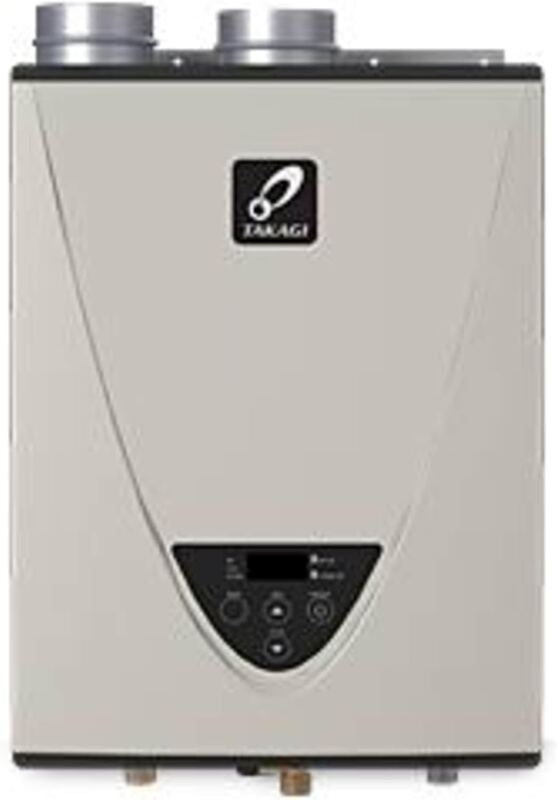
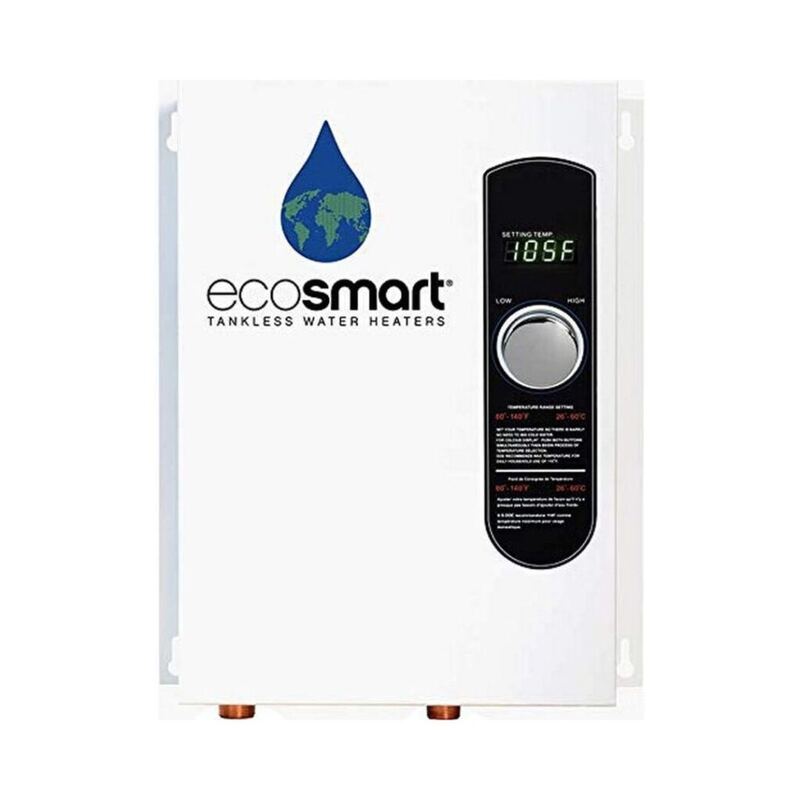
The Rheem RTEX-13 is the smallest and cheapest unit here, a point-of-use heater at about 3.17 GPM versus the whole-home flow of the Stiebel Eltron Tempra 36 Plus and EcoSmart ECO 27, and far below the gas Rinnai RU199iN and Takagi T-H3-DV-N. It's not a whole-home replacement, but it's the value leader for single-fixture jobs.
Rating sources
“99 percent efficiency rating”
“With a 3.17GPM flow rate, it's designed to support one to two appliances in a single location, such as a shower in the bathroom.”
Our 4.1 score is the average of these published ratings. Ratings marked * were derived from the reviewer’s written analysis or video transcript — the publisher didn’t print an explicit numeric score, so we inferred one from their own words. Click through to verify. More about methodology.