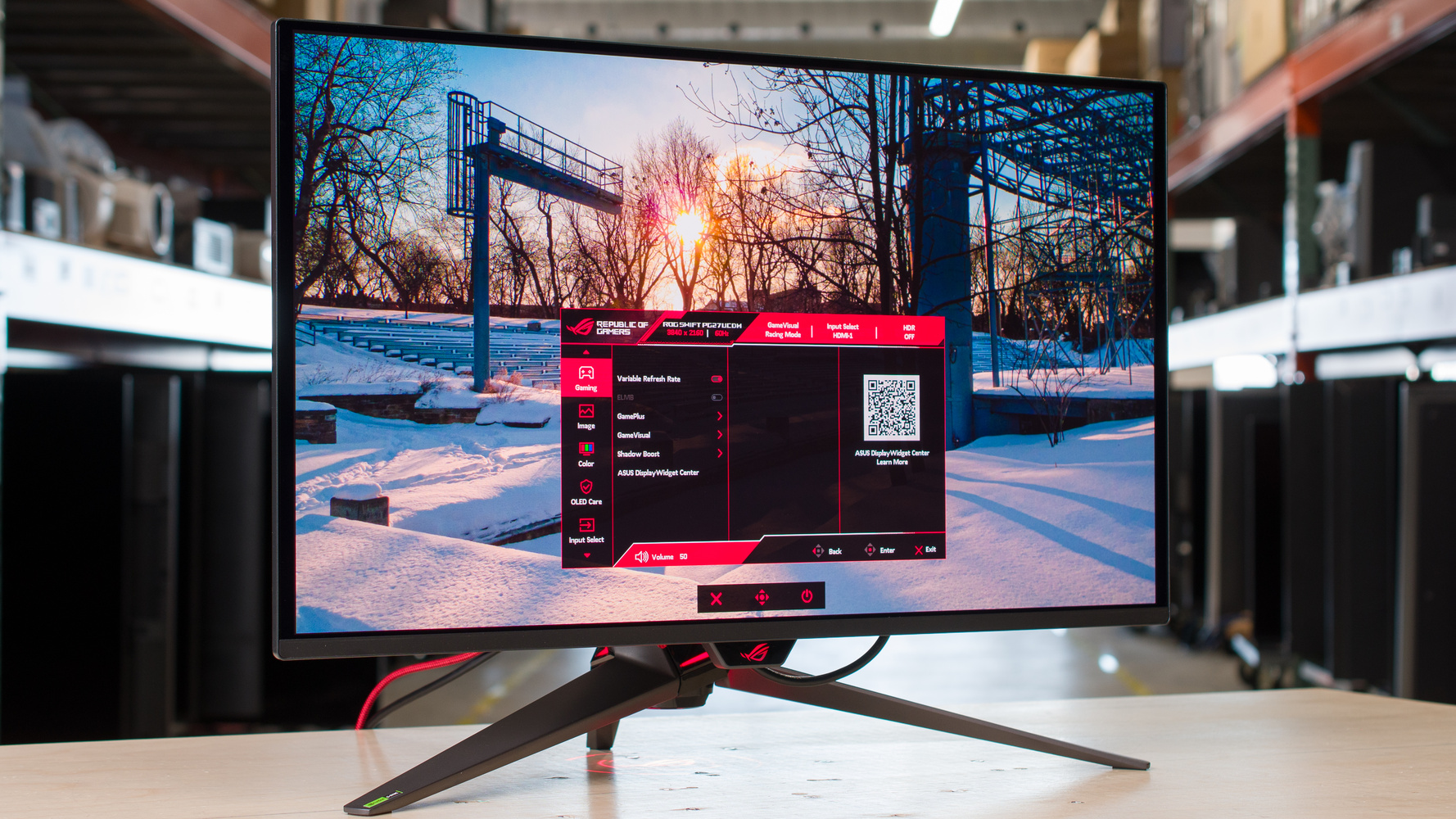
The ASUS ROG Swift OLED PG27UCDM is a 27-inch QD-OLED panel built for 4K gaming, with 166 PPI resolution. Reviewers pointed to the 240Hz refresh rate, ultra-fast response time, and premium connectivity that includes DisplayPort 2.1 and USB-C 90W charging. Price is the sticking point: at $1099 it costs significantly more than comparable models like the Alienware AW2725Q, which sells for $899. TweakTown scored it 91%, calling it an excellent choice if bought on sale while noting the premium relative to competitors offering similar specs.
Full review
166 pixels per inch on a 27-inch QD-OLED
Putting 3840 x 2160 on a 27-inch QD-OLED gives 166 pixels per inch, the highest density any OLED monitor had managed when this one shipped and the reason it exists at all, since 4K OLED had previously meant a 32-inch panel and visibly larger pixels. Tom's Hardware scored it 5 out of 5 and measured contrast at 1,500,000:1, the number an OLED reaches because its black level is genuinely off rather than dimmed. TweakTown put it at 91 out of 100.
240Hz at 4K with a 0.03ms response
The panel runs at 240Hz with a 0.03ms grey-to-grey response, which is the combination competitive players actually buy: no smearing behind a fast pan and no perceptible transition. PCMag, scoring it 4.5 out of 5, credits the OLED panel with holding colour and black level through fast motion rather than washing out the way a backlit IPS does. IGN's 9 out of 10 lands in the same place. An Extreme Low Motion Blur mode adds black-frame insertion on top for anyone who wants it.
DisplayPort 2.1 and a 90-watt USB-C
Connectivity is the other reason this monitor turns up in a USB-C roundup: DisplayPort 2.1 at UHBR20, two HDMI 2.1 inputs, and a USB-C port carrying both video and 90 watts of power delivery, enough to run and charge most laptops down one cable. There are three USB 3.2 Gen 1 downstream ports and a KVM switch, per Tom's Hardware. There are no speakers, as PCMag notes, which on a monitor at this price is a conspicuous omission.
$200 more than the Alienware using the same panel
The recurring criticism is price. The Alienware AW2725Q uses the same Samsung QD-OLED panel and sells for $200 less, and none of the reviews manages to argue the gap away. DisplayNinja's 4.1 out of 5 is the lowest score here and pricing is why. TweakTown's verdict amounts to buying it on sale. What the premium covers is the OLED Care tooling, the proximity sensor and the port selection, all real and none of them worth $200 on their own.
Burn-in mitigation you have to live with
Every OLED carries burn-in risk with static elements, and ASUS answers it with a set of OLED Care routines, pixel shifting and logo dimming and periodic compensation cycles, that interrupt whatever you were doing. Reviewers find them intrusive enough to complain about. The semi-glossy coating is the other thing to check against your room: it holds contrast better than a matte finish but it will show a window or a lamp behind you, a placement caution Tom's Hardware also raises.
Strengths
- +4K resolution (3840 x 2160) with 166 PPI pixel density on a 27-inch screen
- +240Hz refresh rate with 0.03ms G2G response time for gaming
- +DisplayPort 2.1 support with UHBR20 80Gbps bandwidth
- +Includes USB-C 90W power delivery and multiple HDMI 2.1 ports
Watch-outs
- −MSRP of $1099 is $200 higher than competing models like the Alienware AW2725Q
- −OLED Care feature can be annoying according to reviewers
How it compares
The ASUS ROG Swift OLED PG27UCDM is the gaming-leaning pick of the lineup — its QD-OLED panel and 240Hz refresh rate outclass the IPS productivity-focused Dell UltraSharp U2725QE and U3225QE on motion clarity. It costs more than every other monitor here but pairs USB-C connectivity with gaming features none of the others offer.
Rating sources
Our 4.5 score is the average of these published ratings. More about methodology.