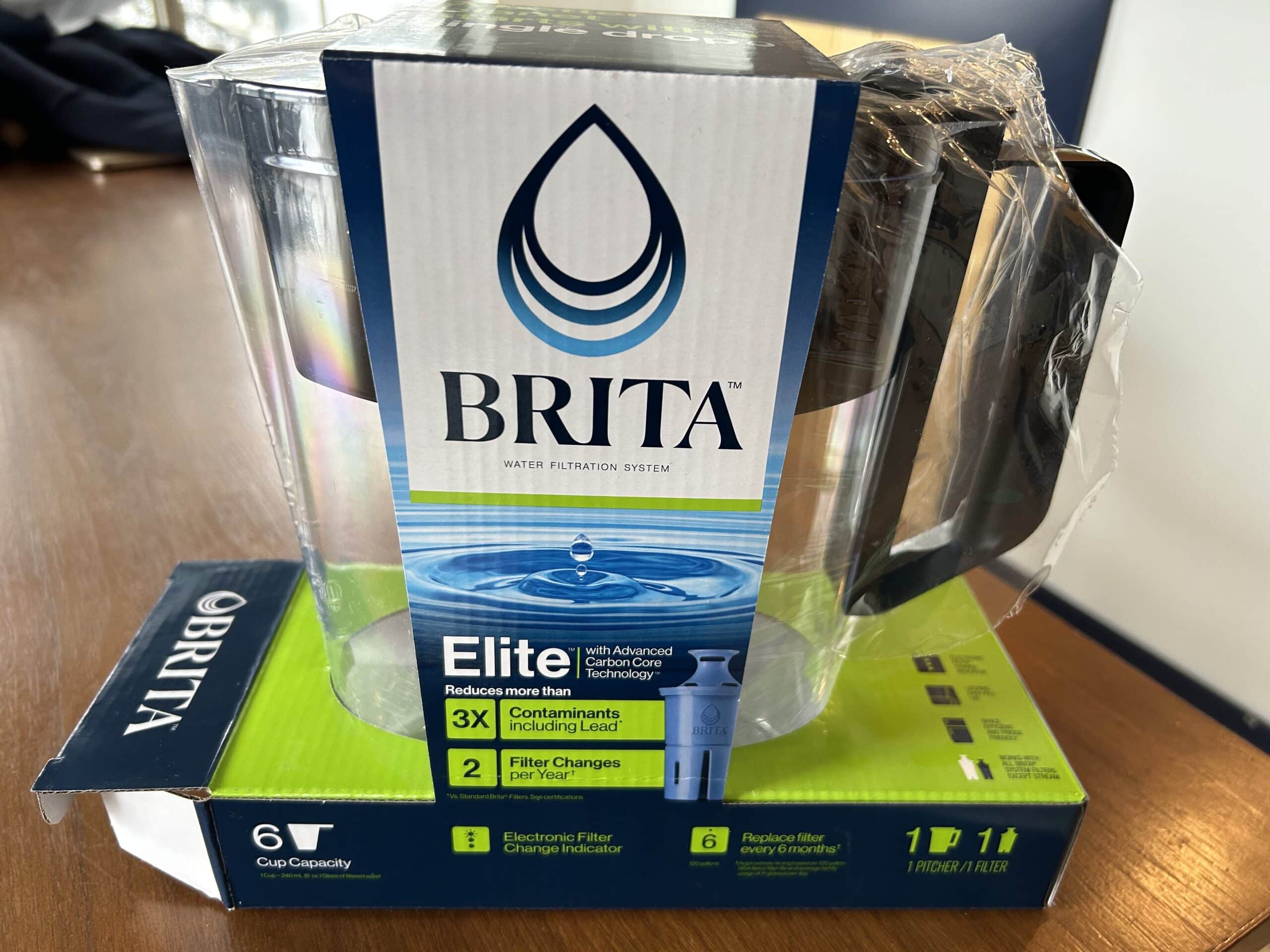
The Brita Everyday Elite offers rapid filtration and extended filter life rated for 120 gallons, making it a convenient option for on-demand hydration without frequent replacements. waterfilterguru found that while the pitcher effectively reduces barium, copper, strontium, and nitrate, its performance on health-related contaminants like fluoride is poor. A significant design flaw involves an unstable flip-top lid that allows unfiltered water to leak near the spout during pouring, compromising filtration integrity. This product fits users prioritizing speed and low maintenance costs, but those concerned with heavy contaminant removal or structural durability should look elsewhere.
Full review
Filtration performance on heavy metals and organics
waterfilterguru recorded a mixed bag of results when they sent water samples through the Brita Elite filter, finding that it successfully removed barium, copper, strontium, and nitrate from their groundwater supply. The outlet gave the pitcher an overall score of 6.59 out of 10, with a particularly low Health Related Contaminants score of just 3.50. While the removal of these specific heavy metals is notable for a budget pitcher, waterfilterguru noted that the filter did not address fluoride at all and only slightly reduced uranium levels in their testing environment.
The discrepancy between certified claims and real-world lab results becomes even more apparent when looking at independent laboratory analysis from YouTube reviewers. One channel sent unfiltered tap water and filtered samples to an independent lab, discovering a 100 percent reduction for chlorine and three disinfection byproducts: bromodichloromethane, bromoform, and dibromochloromethane. However, the same lab found that performance on harder-to-remove analytes was subpar, showing only a 25 percent reduction in boron, no reduction at all in lithium, a 56 percent reduction in strontium, and just a 21 percent drop in nitrates.
LeafScore highlighted the mechanical reason behind these filtration gaps, explaining that Brita filters rely on coconut-based activated carbon acting like an ultra-fine sieve to catch particles. The Elite filter adds ion-exchange resin intended to filter trace amounts of zinc, copper, and cadmium. LeafScore pointed out that while this combination effectively neutralizes chlorine taste and odor, the range of contaminants these specific media can tackle remains limited compared to more advanced multi-stage systems, leaving many potentially toxic compounds entirely unaffected.
Speed versus contact time trade-offs
The filtration speed of the Brita Everyday Elite is frequently cited as its most defining characteristic. Waterfilterguru clocked a Filtration Rate score of 9.50 out of 10, praising the quick rate at which water passes through the cartridge. This rapid flow means users do not need to plan their hydration far in advance; bos-water recorded that the pitcher can filter one cup of water in under forty-five seconds, making it highly suitable for on-demand filtering when someone is thirsty right now rather than hours later.
However, this speed creates a direct trade-off with contaminant reduction efficacy. The YouTube reviewer who conducted the independent lab test noted that their top recommendation required almost thirty minutes to filter four cups of water, whereas the Brita pitcher accomplished the same task in two and a half minutes. Because the contact time between the water and the activated carbon media is so brief during this rapid pass-through process, fewer impurities are trapped before the water reaches the reservoir below.
This dynamic means that shoppers who prioritize immediate availability of filtered water will find the Brita Elite to be an excellent fit for their daily routine. Those who care more about maximizing the removal of difficult contaminants like nitrates and boron should look elsewhere, as slower-flowing pitchers allow the water to dwell longer in the filter media, resulting in significantly higher reduction rates on those specific health-related analytes.
Flip-top lid stability and spout leakage
bos-water identified a significant design flaw regarding the pitcher's pouring mechanism, specifically noting that the flip-top lid does not seem very sturdy. During their hands-on evaluation, they observed that unfiltered water leaked through a gap near the spout when users attempted to pour quickly. This leakage allows raw tap water to bypass the filter entirely and mix directly with the already filtered water in the main reservoir.
This structural weakness is compounded by the pitcher's internal flow dynamics. The YouTube reviewer who tested the standard version of the Everyday pitcher warned that users should not attempt to pour water when the upper reservoir is still half full because unfiltered water will push through the lid and fall off into the filtered section below. This means that even with a high-quality Elite filter installed, improper pouring technique can immediately degrade the quality of the final output.
Third-party customer complaints cited by bos-water include cracked plastic around this area, suggesting that the durability of the flip-top mechanism is a recurring issue over time. While the pitcher is made from BPA-free materials and generally fits comfortably on refrigerator shelves, the lack of a secure seal during active pouring represents a notable compromise in an otherwise straightforward design.
Filter lifespan and replacement costs
The most compelling argument for choosing the Brita Everyday Elite over basic pitcher models is the extended service life of its filter cartridge. waterfilterguru gave the maintenance category a perfect score of 10.00 out of 10, highlighting that the Elite filter is rated for up to one hundred and twenty gallons of use. This capacity allows users to replace the filter only twice per year, compared to the standard filters which typically require replacement every forty gallons or roughly two months.
bos-water confirmed this longevity in their cost analysis, awarding the pitcher a perfect 5.00 out of 5.00 for costs because it sits below average in both upfront price and annual filter replacement expenses. The combination of a low initial purchase price and infrequent cartridge changes makes the long-term ownership cost significantly lower than many competing pitchers that demand monthly or bi-monthly filter swaps.
mytapscore reinforced this value proposition by noting that the Brita Elite Filter is certified to reduce three times more contaminants than the Standard filter while lasting three times longer. For budget-conscious households, this means paying a slightly higher upfront cost for the pitcher and Elite filters yields a much lower cost per gallon of filtered water over the course of a year compared to buying cheaper pitchers with shorter-life cartridges.
Taste improvement versus chemical reduction
Despite its limitations in removing heavy metals and nitrates, the Brita Elite consistently earns praise for improving the sensory experience of tap water. bos-water reported that filtered water produced by the pitcher had a much better taste and was completely odor-free during their 2025 lab testing rounds. This aligns with findings from reviewed.com, where testers described water filtered through Brita pitchers as tasting pure, clean, and neutral, often preferring it over competing brands for basic chlorine removal.
The YouTube reviewer who tested the standard filter version also noted that while the chlorine concentration dropped significantly, the resulting water had great improvements in both taste and smell. This suggests that even if the Elite filter does not eliminate every trace of chemical impurities like lithium or uranium, it successfully masks the unpleasant flavors associated with municipal chlorination.
However, bos-water also pointed out a caveat from their 2024 testing round where filtered water was odor-free but still retained some residual taste. This variability indicates that while the activated carbon media is highly effective at tackling volatile organic compounds and chlorine, it may not provide a perfectly consistent sensory experience across all municipal water supplies depending on local treatment methods.
Certification scope versus actual contaminant list
waterfilterguru found that the Brita Elite is certified by WQA and IAPMO for thirty-three contaminants, yet they noted a disconnect between this high certification count and its actual performance. The outlet observed that while the filter achieved solid results in their 2025 lab testing, it was mainly limited to easier-to-remove organics like chlorine and basic heavy metals. The certifications cover a broad range of aesthetic impurities but do not guarantee effective reduction for more complex health-related threats.
mytapscore clarified that while the filter is certified by third parties to reduce three times more contaminants than the standard version, users must verify their specific water quality issues against this list. They emphasized that there is no one-size-fits-all approach and that determining whether a Brita pitcher is effective depends entirely on testing local tap water first. If a household's primary concern is fluoride or high levels of nitrates, the certified contaminant list may not provide sufficient protection.
LeafScore added context by explaining that filters only lose effectiveness once they reach their saturation point for specific materials. They warned that leaving an Elite filter in place beyond its rated capacity can actually lead to worse water overall, as the saturated media might start filtering back into the pitcher or act as a breeding space for bacteria. This makes adhering strictly to the twice-yearly replacement schedule critical for maintaining both safety and taste.
Strengths
- +Certified by WQA and IAPMO to reduce a high count of contaminants, including lead, barium, copper, strontium, nitrate, and uranium.
- +Features an extended filter life rated for up to 120 gallons, requiring replacement only twice per year compared to standard filters.
- +Constructed from BPA-free materials and designed with a compact footprint that fits comfortably on refrigerator shelves.
Watch-outs
- −Lab analysis indicates poor reduction of health-related contaminants such as fluoride, lithium, and molybdenum compared to other pitcher filters.
- −The flip-top lid is described by reviewers as not very sturdy, with some users reporting unfiltered water leakage near the spout when pouring.
How it compares
The Brita Everyday Elite provides a wider range of certified contaminant reductions, including lead and uranium, whereas the Aquagear Water Filter Pitcher fails to remove salt or total dissolved solids. However, it shares the same 120-gallon filter life as the Aquagear but suffers from an unstable flip-top lid that risks leaking unfiltered water near the spout.
Rating sources
“That said, it's fairly bulky and can crowd an already tight sink space.”
Our 3.7 score is the average of the 2 scored reviews above; 4 more reviewed it without printing a score and are not in the average. Ratings marked * were derived from the reviewer’s written analysis or video transcript — the publisher didn’t print an explicit numeric score, so we inferred one from their own words. Click through to verify. More about methodology.