The Framework Desktop puts AMD's Strix Halo silicon into an open, repairable chassis aimed squarely at local AI. PCWorld awarded it 4.5/5 and an Editors' Choice, writing that 'it's not just for tinkering, this machine can legitimately run the latest AI models locally, something few desktops this size can do.' Of its 128 GB of LPDDR5X-8000 unified memory, AMD's driver can assign up to 96 GB as VRAM, enough to run GPT-OSS 120B, which AMD says runs about ten times faster than Llama 3 70B on this chip. ServeTheHome called it 'our third-favorite AMD Strix Halo mini PC so far,' and Tom's Hardware noted 'the mix of powerful graphics and plentiful RAM is why Framework is pushing this as an AI system.' Windows and Linux both run on it, so the full open-source AI stack is available in a way it isn't on the Mac Studio. Bandwidth and price are the limits.
Full review
96 GB of the 128 GB pool can be VRAM
The enabling trick is AMD's driver: of the 128 GB of LPDDR5X-8000, up to 96 GB can be assigned as VRAM, leaving 32 GB for the operating system. That is enough to hold GPT-OSS 120B. PCWorld, which made it an Editors' Choice at 4.5/5, wrote that 'it's not just for tinkering, this machine can legitimately run the latest AI models locally, something few desktops this size can do.'
256 GB/s is the ceiling on token speed
Bandwidth is the honest limit. At 256 GB/s the Framework sits alongside the GMKtec EVO-X2 and Beelink GTR9 Pro on the same Strix Halo silicon, and far behind the Mac Studio M4 Max's 546 GB/s. Dense 70B models run in the 6-8 tokens-per-second range. This machine is for fitting large models cheaply, not for generating tokens fastest.
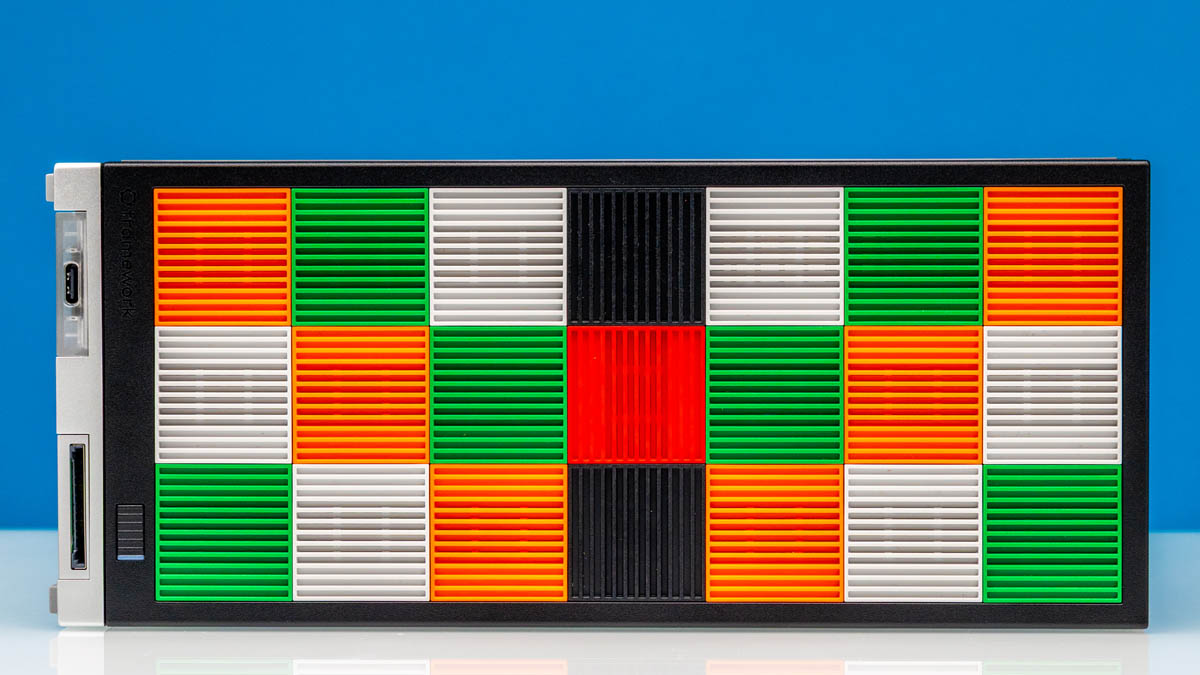
Manuals, etched hints and a customizable tile front
PCWorld observed that 'Framework obsesses over details, from manuals to helpful hints etched into the materials themselves,' which is not a sentence anyone writes about a mini PC. The 4.5-liter chassis takes swappable front tiles, storage and the cooler are serviceable, and the machine ships as a part-assembly project rather than a sealed appliance.
Soldered RAM in a Framework product
The exception to the repairability story is memory. Tom's Hardware put it plainly: 'the soldered RAM is effectively required for the bandwidth this system needs.' It is a defensible engineering call, and it still means the memory decision is permanent on a machine from the company that made upgradeability its identity.
Windows or Linux, and the whole open toolchain
Platform freedom is what it has over the Apple machines in this group. Ollama, llama.cpp, vLLM and ROCm-targeted builds all run, and the setup can be scripted, containerized and clustered with ordinary Linux tooling, which macOS and Metal will not do. Expect the AMD path to be less turnkey than MLX in exchange for that control.
Judged against DDR5 prices, the base config holds up
ServeTheHome framed the value directly: 'a few weeks ago, many would consider $1999 for the base price of a 128GB memory system to be high. Now given the spike in DDR5 pricing that feels quite reasonable.' Tom's Hardware's counterpoint stands as well, that 'if you don't use all of the RAM, you might be better off with a cheaper system,' and against the GMKtec EVO-X2 on identical silicon the Framework asks a premium for openness.
Strengths
- +128 GB LPDDR5X-8000 unified memory lets you assign up to 96 GB as VRAM for local models
- +Explicitly built and marketed for local LLM work; runs GPT-OSS 120B at usable speeds
- +Framework's hallmark repairability and documentation, including a customizable front tile panel
- +Runs Windows or Linux, opening up the full open-source AI toolchain the Mac Studio cannot
- +Compact 4.5-liter chassis that doubles as a capable productivity and 1080p gaming PC
Watch-outs
- −Soldered LPDDR5X means no future memory upgrades despite Framework's repairable reputation
- −256 GB/s bandwidth trails the Mac Studio M4 Max badly, so token speed is mid-pack
- −Expensive versus a gaming PC with discrete graphics if you don't use the full 128 GB
- −Requires some self-assembly, more involved than the plug-and-play mini PCs here
How it compares
It differentiates on platform and ethos: an open, repairable chassis running Windows or Linux, which the macOS-only Mac mini M4 Pro and Mac Studio M4 Max cannot match. Choose it for the most open 128 GB local-LLM box.
Rating sources
“It's not just for tinkering, this machine can legitimately run the latest AI models locally, something few desktops this size can do”
“A few weeks ago, many would consider $1999 for the base price of a 128GB memory system to be high. Now given the spike in DDR5 pricing that feels quite reasonable”
“The soldered RAM is effectively required for the bandwidth this system needs, and the mix of powerful graphics and plentiful RAM is why Framework is pushing this as an AI system”
Our 4.2 score is the average of these published ratings. Ratings marked * were derived from the reviewer’s written analysis or video transcript — the publisher didn’t print an explicit numeric score, so we inferred one from their own words. Click through to verify. More about methodology.