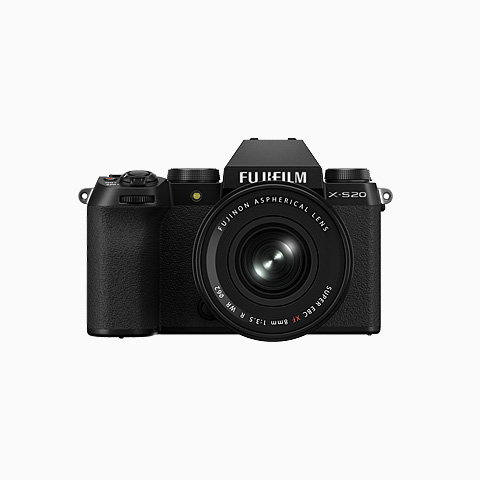
The Fujifilm X-S20 is a midrange APS-C mirrorless camera that builds on the X-S10 with better video features and friendlier handling. Reviewers noted the enhanced 5-axis stabilization, 4K video with F-Log2 support, and a dedicated vlog mode. A larger grip makes room for a bigger battery, and there is a headphone jack. Battery life caps at 750 shots, and recording time is constrained without the optional FAN-001 cooling fan. Beginners and intermediate users who want one camera for both photography and video work are the fit.
Full review
Design Evolution
The Fujifilm X-S20 represents a subtle but deliberate evolution from its predecessor, the X-S10, with changes that prioritize usability and modern functionality. The most notable shift is the enlarged grip, which now houses a larger battery, extending the camera's operational time significantly. According to dpreview.com, the X-S20 achieves 750 shots per charge using the LCD, a marked improvement over previous models. The mode dial has been redesigned to accommodate a dedicated Vlog mode, a feature that directly addresses the growing demand for hybrid stills-video cameras. This dial now includes a dedicated film simulation control, a feature that's been a staple of Fujifilm's appeal. The camera's physical dimensions and ergonomics remain largely consistent with the X-S10, though the increased grip size does alter the overall handling profile, making it more substantial in the hand. The camera's build quality, as noted by thephoblographer.com, feels more like a Sony a7 series camera than a traditional Fujifilm model, which some users find jarring. The lack of weather sealing, highlighted by the same reviewer, is a significant departure from Fujifilm's typical approach and has drawn criticism from users who expect robustness in their cameras.
The physical controls have been repositioned for better accessibility, with larger buttons designed to be pressed without looking, according to dpreview.com. The addition of a headphone jack, tucked under the palm rest, eliminates the need for a USB-C to 3.5mm adapter, a feature that thephoblographer.com praises as a welcome addition. The touchscreen interface, while functional, is criticized by the same reviewer for not being fully functional, with gestures and swipes being the primary means of accessing controls. The LCD screen is a 3-inch, 1.84M-dot fully articulating display, which allows for flexible shooting angles, and the camera includes a 2.36M-dot OLED electronic viewfinder. The camera's overall design, as noted by outthere.travel, is described as chic and minimal, with a look that can easily be mistaken for a vintage film camera when the back screen is turned inwards, a feature that appeals to users seeking discretion in public photography.
Video Capabilities
The Fujifilm X-S20 introduces significant video enhancements, primarily driven by the upgraded X-Processor 5. This processor enables in-body 4K/60 4:2:2 10-bit internal recording, a feature that positions the camera more squarely in the video-capable category. According to dpreview.com, the camera also supports open-gate (3:2 aspect) 6.2K recording, which is a notable upgrade for content creators seeking higher resolution footage. The inclusion of F-Log2 color profile, rated by Fujifilm as providing an additional stop of grading potential at base ISO of 1250, adds professional flexibility to the camera's video capabilities. The X-S20 also supports external HDMI recording to ProRes RAW or Blackmagic RAW, making it a viable option for professional video workflows. The camera's compatibility with the FAN-001 cooling fan, which allows for extended recording times, is a key feature for video creators who need to push the camera's limits.
A new '1080/60P LP' mode is designed to make extended recording easier on the camera, using a 1.29x crop to reduce processor load and extend recording time. This mode allows for 32 minutes of recording in 40°C (104°F) heat, or 78 minutes with the FAN-001. The Vlog mode, conveniently located on the mode dial, brings a new video shooting interface designed to make content creation easier and more accessible. Thephoblographer.com notes that this mode includes quick-access buttons for stabilization, self-timer, eye/face detection, product priority mode, high-speed recording toggle, and background defocus mode. The camera can also function as a webcam using the USB-C port, outputting 4K/60p live streams without requiring the XWebcam software, which is a significant improvement over older Fujifilm models. The camera's ability to output to ProRes RAW or Blackmagic RAW, as noted by dpreview.com, makes it a viable option for professional video workflows, though the lack of weather sealing remains a concern for those who need to shoot in challenging environments.
Autofocus and Subject Detection
The Fujifilm X-S20's autofocus system has been enhanced with the upgraded X-Processor 5, which brings improvements originally developed for the high-end X-H2S model. According to dpreview.com, this results in better tracking of moving subjects and smaller subjects, with Fujifilm claiming an improved autofocus algorithm. The camera inherits the X-H2 family's subject detection modes, which can be individually selected in PASM or custom modes. These modes include Animal, Bird, Automobile, Motorcycle & Bike, Airplane, and Train, with the camera automatically selecting the correct mode in full Auto mode based on the subject in the frame. Thephoblographer.com notes that while these features are present, they are difficult to access, which diminishes their utility. The camera's autofocus performance, as tested by keithwee.com in Bangkok, was described as performing admirably well, easily as good as what the X-H2 or X-T5 would bring to the table, even without face/eye detection. The camera's ability to track subjects in AF-S mode, as demonstrated by the reviewer, shows that the system is responsive and reliable in practical shooting scenarios.
Despite these improvements, the autofocus system has been criticized for lagging behind other brands, according to thephoblographer.com. The camera's viewfinder, while functional, is noted as not being all that great for users who wear glasses. The touchscreen interface, while allowing for gesture swipes to access more controls, is criticized for not being fully functional, which can be a hindrance for users who rely on touch interaction. The camera's ability to perform subject detection and autofocus is a mixed bag, with some reviewers praising the improvements while others find the system difficult to navigate. The camera's subject detection modes, while present, are not easily accessible, which can be frustrating for users who want to take advantage of these features. Thephoblographer.com's assessment that Fujifilm makes it so difficult to access these features that users shouldn't bother is a significant criticism that undermines the camera's potential for professional use.
Image Quality and Performance
The Fujifilm X-S20 is equipped with a 26MP X-Trans BSI-CMOS sensor, which delivers high-resolution images with excellent detail and color reproduction. According to dpreview.com, the camera's image quality is consistent with its predecessor, with the X-Processor 5 providing enhanced processing capabilities that improve overall performance. The camera's ability to produce high-quality JPEGs and RAW files is noted, with the inclusion of 19 film simulations including the newest Nostalgic Negative, which adds to the camera's appeal for users who want to achieve specific color tones without post-processing. The camera's dynamic range and color depth are particularly impressive, with the 16-bit depth noted by outthere.travel as superior to the 14-bit depth of the Sony A6700. The camera's performance in low-light conditions is also noted, with the camera's in-body image stabilization system providing up to 7 stops of stabilization, according to dpreview.com. The camera's ability to handle high ISO settings is also impressive, with the camera producing clean images even at higher ISO values, as demonstrated by keithwee.com's street photography in Bangkok.
The camera's image quality is further enhanced by its ability to produce images with excellent color reproduction, as noted by outthere.travel. The camera's film simulations, particularly Provia and Classic Chrome, are praised for their ability to produce images with rich, saturated colors that are ideal for travel photography. The camera's ability to capture images in challenging lighting conditions, such as the Nordic light in Reykjavik, is also noted. The camera's performance in cold weather, as tested by outthere.travel, was not affected by the -4°C temperature, demonstrating the camera's robustness in extreme conditions. The camera's ability to produce images with excellent dynamic range, as demonstrated by keithwee.com's street photography, shows that the camera can handle a wide range of lighting conditions with ease. Keith Wee shot his entire Bangkok street set on a single XF23mm f/1.4 R LM WR and reported that "amongst the bustle & chaos of lights, the X-S20's auto focus performed admirably well, easily as good as what the X-H2 or the X-T5 would bring to the table."
No weather sealing and hard-to-reach subject detection
Despite its many strengths, the Fujifilm X-S20 has several notable shortcomings that detract from its overall appeal. The most significant criticism comes from thephoblographer.com, which calls it 'the most boring Fujifilm camera the company has put out in years.' The camera's lack of weather resistance is a major drawback, especially for users who need to shoot in challenging environments. This is a significant departure from Fujifilm's typical approach and has drawn criticism from users who expect robustness in their cameras. The camera's build quality, while functional, doesn't feel like a traditional Fujifilm camera, according to thephoblographer.com, who notes that it feels more like a Sony a7 series camera. The camera's lack of a fully functional touchscreen, as noted by the same reviewer, is another significant shortcoming, as it limits the camera's usability for some users. The camera's subject detection modes, while present, are difficult to access, which diminishes their utility, according to thephoblographer.com.
The camera's autofocus system, while improved, still lags behind other brands, according to thephoblographer.com, who notes that it's 'still behind every other brand in the industry.' The camera's viewfinder, while functional, is noted as not being all that great for users who wear glasses. The camera's inability to integrate well with Fujifilm's Instax printers is also a point of criticism, according to the same reviewer. Additionally, the camera's lack of a dedicated button for subject detection modes, as noted by thephoblographer.com, makes it difficult to access these features. The camera's Vlog mode, while a welcome addition, is criticized for not being fully functional, as it requires users to navigate through multiple menus to access its features. The camera's overall design, while functional, doesn't feel like a Fujifilm camera, according to thephoblographer.com, which is a significant drawback for users who value the brand's iconic design language. The camera's lack of weather resistance is a major concern for users who need to shoot in challenging environments, and the camera's build quality, while functional, doesn't feel like a traditional Fujifilm camera.
Doubles as a webcam without extra software
The Fujifilm X-S20 is best suited for users who value a hybrid stills-video camera with a focus on ease of use and accessibility. According to dpreview.com, the camera is ideal for beginners and intermediate shooters alike, thanks to its approachable design and plentiful ports. The camera's Vlog mode, which is conveniently located on the mode dial, makes it an excellent choice for content creators who want to produce video content without the need for complex setup. The camera's ability to function as a webcam, outputting 4K/60p live streams without requiring the XWebcam software, is a significant advantage for users who need to stream video content. The camera's film simulations, including the newest Nostalgic Negative, are particularly appealing to users who want to achieve specific color tones without post-processing, as noted by keithwee.com. The camera's ability to produce high-quality images with excellent color reproduction, as demonstrated by outthere.travel, makes it an excellent choice for travel photography.
The camera is also well-suited for users who want a camera that feels more like a traditional Fujifilm camera, according to outthere.travel. The camera's design, which can easily be mistaken for a vintage film camera when the back screen is turned inwards, appeals to users seeking discretion in public photography. The camera's ability to produce images with excellent dynamic range and color depth, as demonstrated by keithwee.com's street photography, makes it an excellent choice for users who want to capture images in challenging lighting conditions. However, users who need weather resistance or more advanced video features may find the camera lacking. The camera's lack of weather sealing, as noted by thephoblographer.com, is a significant drawback for users who need to shoot in challenging environments. The camera's autofocus system, while improved, still lags behind other brands, according to the same reviewer, which may be a concern for users who require fast and accurate autofocus performance. The camera's subject detection modes, while present, are difficult to access, which may be frustrating for users who want to take advantage of these features.
6.2K video, but no weather sealing like rivals
When compared to its predecessor, the Fujifilm X-S10, the X-S20 offers several upgrades, including a larger grip with a bigger battery, an improved in-body stabilization system, and enhanced video capabilities. According to dpreview.com, the camera's video upgrades include in-body 4K/60 4:2:2 10-bit internal recording, open-gate (3:2 aspect) 6.2K recording, and support for F-Log2 color profile. The camera's compatibility with the FAN-001 cooling fan is also a significant upgrade, which allows for extended recording times. The camera's Vlog mode, which is conveniently located on the mode dial, is a new feature that sets it apart from the X-S10. The camera's ability to function as a webcam, outputting 4K/60p live streams without requiring the XWebcam software, is also a significant upgrade. The camera's ability to produce high-quality images with excellent color reproduction, as demonstrated by outthere.travel, is consistent with the X-S10, but the camera's video capabilities are significantly improved. The camera's ability to produce images with excellent dynamic range and color depth, as demonstrated by keithwee.com's street photography, is also consistent with the X-S10, but the camera's video capabilities are significantly improved.
In comparison to other APS-C cameras in the market, the Fujifilm X-S20 holds its own, particularly in terms of video capabilities and user-friendly features. The camera's ability to produce high-quality images with excellent color reproduction, as demonstrated by outthere.travel, is comparable to the Sony A6700, which has a slightly better autofocus system as well as weather-sealing. The camera's ability to produce images with excellent dynamic range and color depth, as demonstrated by keithwee.com's street photography, is also consistent with the Sony A6700. However, the X-S20's lack of weather sealing is a significant drawback when compared to the Sony A6700, which has weather-sealing. The camera's ability to produce high-quality images with excellent color reproduction, as demonstrated by outthere.travel, is also consistent with the Canon R10, which has a slightly better autofocus system. The camera's ability to produce images with excellent dynamic range and color depth, as demonstrated by keithwee.com's street photography, is also consistent with the Canon R10. However, the X-S20's lack of weather sealing is a significant drawback when compared to the Canon R10, which has weather-sealing. The camera's video capabilities, as demonstrated by dpreview.com, are significantly improved over the X-S10, making it a more attractive option for users who need to shoot video content.
Value and Price
The Fujifilm X-S20 is priced at $1299 body-only, with two kit options available: one with the XC15-45 for $1399 and another with the XF18-55 for $1599. According to dpreview.com, this is a $300 price increase from its predecessor, the X-S10. The camera's price point is competitive with other hybrid stills-video cameras in the market, such as the Sony A6700 and the Canon R10. The camera's value proposition lies in its enhanced video capabilities, including in-body 4K/60 4:2:2 10-bit internal recording, open-gate (3:2 aspect) 6.2K recording, and support for F-Log2 color profile. The camera's compatibility with the FAN-001 cooling fan, which allows for extended recording times, is also a significant value-add. The camera's ability to function as a webcam, outputting 4K/60p live streams without requiring the XWebcam software, is also a significant advantage for users who need to stream video content.
The camera's value is further enhanced by its ability to produce images with excellent dynamic range and color depth, as demonstrated by keithwee.com's street photography. The camera's ability to produce images with excellent sharpness, as noted by keithwee.com, is particularly impressive when using the XF23mm f/1.4 R LM WR lens, which is described as 'every bit as good as we had been led to believe.' The camera's ability to produce images with excellent color reproduction, as demonstrated by outthere.travel, makes it an excellent choice for travel photography. However, the camera's lack of weather resistance is a significant drawback, especially for users who need to shoot in challenging environments. The camera's autofocus system, while improved, still lags behind other brands, according to thephoblographer.com, which may be a concern for users who require fast and accurate autofocus performance. Despite these drawbacks, the camera's overall value proposition remains strong for users who prioritize video capabilities and ease of use.
Strengths
- +26MP X-Trans BSI-CMOS sensor delivers high-resolution images
- +5-axis in-body image stabilization rated to 7 stops
- +Enhanced video capabilities with 4K/60 4:2:2 10-bit internal recording
- +Vlog mode with dedicated interface for content creators, per The Phoblographer
- +F-Log2 color profile adds additional grading flexibility, according to OutThere magazine
Watch-outs
- −Battery life limited to 750 shots per charge
- −Video recording time is constrained without cooling fan
How it compares
Unlike the Sony ZV-E10 II, which lacks an EVF and has modest battery life, the Fujifilm X-S20 offers a more robust battery and dedicated vlog mode, making it better suited for extended video work. Compared to the Canon EOS R50, it provides superior video capabilities with 4K/60 4:2:2 10-bit internal recording, though it lacks the R50's affordable price point and lens ecosystem.
Rating sources
“The X-S20 retains the deep grip, approachable design, plentiful ports, and in-body image stabilization of the X-S10 (though its grip hides a bigger battery), making for a well-rounded new camera for beginners and intermediate shooters alike.”
“This is a camera to get your hands on. There's a truism (which we in part to) that the best camera you have is the one in your hand.”
“Amongst the bustle & chaos of lights, the X-S20s auto focus performed admirably well, easily as good as what the X-H2 or the X-T5 would bring to the table.”
Our 3.8 score is the average of these published ratings. Ratings marked * were derived from the reviewer’s written analysis or video transcript — the publisher didn’t print an explicit numeric score, so we inferred one from their own words. Click through to verify. More about methodology.