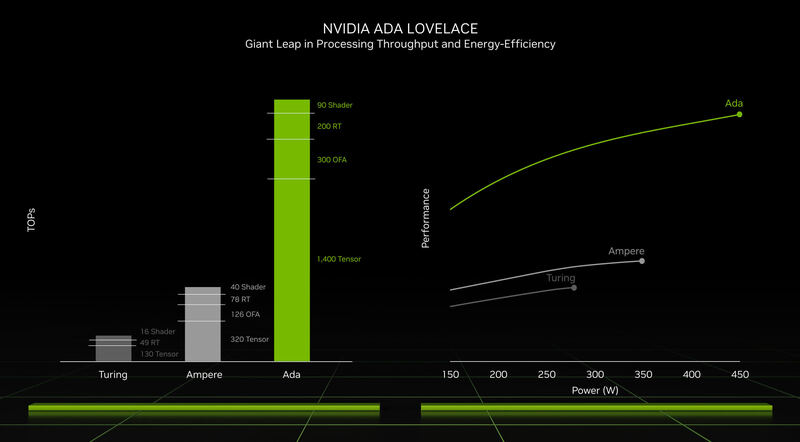
The NVIDIA RTX 4500 Ada Generation delivers substantial performance gains over its Ampere predecessor, particularly in rendering and AI workloads. It features 7,680 CUDA cores, 240 tensor cores, and 24 GB of GDDR6 memory with ECC, making it well-suited for demanding content creation tasks. While it offers significant improvements in graphics and rendering capabilities, the price premium may be a consideration for users seeking more modest performance increases.
Full review
Architecture and core specifications
It includes 7,680 CUDA cores, 60 RT cores, and 240 Tensor cores, delivering 39.9 TFLOPS of single-precision performance and 637.8 TFLOPS of tensor performance using FP8 sparsity. The card comes with 24GB of GDDR6 memory running at 432 GB/s bandwidth, with a 192-bit memory interface. The card supports four DisplayPort 1.4a outputs, is frame lock compatible with Quadro Sync II, and does not support NVLink. The maximum power consumption is rated at 210W, and it connects via PCIe 4.0 x16 interface.
Performance benchmarks and value
In PassMark benchmarks, the RTX 4500 Ada Generation achieved an average G3D Mark of 28,026, placing it at rank 31 among 10 common video cards tested. The value for money metric, measured as G3D Mark per dollar, was not available for this card in the PassMark database. However, the card's performance is indicative of its positioning in the professional GPU market, where it competes with other Ada generation cards like the RTX 5000 Ada and RTX 6000 Ada, which offer better performance at higher price points.
AI and machine learning capabilities
The card's 24GB of VRAM allows for handling larger datasets and models compared to consumer cards, making it suitable for professional applications that require substantial memory for AI computations. The card's performance in AI tasks would be more pronounced when compared to previous-generation professional GPUs, such as the RTX A6000, which was based on the Ampere architecture.
Content creation workload performance
In content creation workloads, the RTX 4500 Ada Generation is positioned as a mid-range professional GPU, offering performance improvements over previous-generation cards but not reaching the high-end capabilities of the RTX 6000 Ada or RTX 5000 Ada. The card's performance in applications like video editing, 3D rendering, and AI-assisted workflows is expected to be solid for professional use cases, particularly in scenarios where the workload does not require the highest performance levels. The card's 24GB of VRAM and support for NVENC/NVDEC encode/decode engines make it suitable for video editing and streaming applications, though it may not match the throughput of higher-tier Ada generation cards. The card's performance in content creation tasks is likely to be most beneficial when paired with other professional-grade hardware and software optimized for the Ada architecture.
Use cases and market positioning
The RTX 4500 Ada Generation is designed for professional use cases in industries such as manufacturing, media and entertainment, architecture, engineering, and construction (AECO), and visual simulation. In manufacturing, the card supports sophisticated visualization systems for collaborative design and real-time ray tracing, enabling photorealistic design reviews and optimization. PNY notes that for media and entertainment, it facilitates video editing, color grading, and ray-traced rendering with AI assistance, supporting workflows like broadcast graphics and virtual sets. In AECO, it enables real-time ray tracing and AI-enhanced design reviews, supporting collaborative workflows through tools like NVIDIA Omniverse Enterprise. According to PNY, for visual simulation it supports flight, mission, and training simulations with high detail and seamless projection across multiple displays. The card's positioning in the professional market is as a mid-tier option, offering a balance of performance, memory capacity, and power efficiency for professional workflows that do not require the highest-end capabilities.
Power consumption and thermal performance
The RTX 4500 Ada Generation is rated at a maximum power consumption of 210W, which is a moderate power draw for a professional GPU. This power rating is consistent with its mid-range positioning in the Ada architecture lineup, offering a balance between performance and energy efficiency. The card uses a blower-style active cooling system, which is designed to manage heat effectively within professional workstations. The dual-slot form factor and the card's thermal solution are optimized for use in high-performance desktop systems where adequate airflow and cooling are available. The card's power efficiency is particularly relevant for users who need to manage power consumption in their workstations while still achieving professional-grade performance.
Strengths
- +7,680 CUDA cores for high processing power
- +240 4th generation tensor cores for advanced AI capabilities
- +24 GB GDDR6 memory with ECC for data integrity
Watch-outs
- −Higher price premium over previous-generation cards
- −Limited performance improvement in lower-end models
How it compares
The NVIDIA RTX 4500 Ada Generation offers 24 GB of GDDR6 memory with ECC and 7,680 CUDA cores, making it a mid-range option between the A5000 and the higher-end 6000 Ada Generation. While it provides significant performance gains over previous-generation cards, it falls short of the 48 GB memory capacity of the RTX 6000 Ada Generation and lacks the advanced ray tracing and AI compute capabilities. Compared to the RTX A6000, it offers less memory but is more affordable and doesn't require a specialized power connector.
Rating sources
“The RTX PRO 4500 is newer, with 33% more memory and 2.1x the bandwidth. The RTX 4500 Ada is cheaper right now.”
Our 3.0 score is the average of the 1 scored review above; 4 more reviewed it without printing a score and are not in the average. Ratings marked * were derived from the reviewer’s written analysis or video transcript — the publisher didn’t print an explicit numeric score, so we inferred one from their own words. Click through to verify. More about methodology.