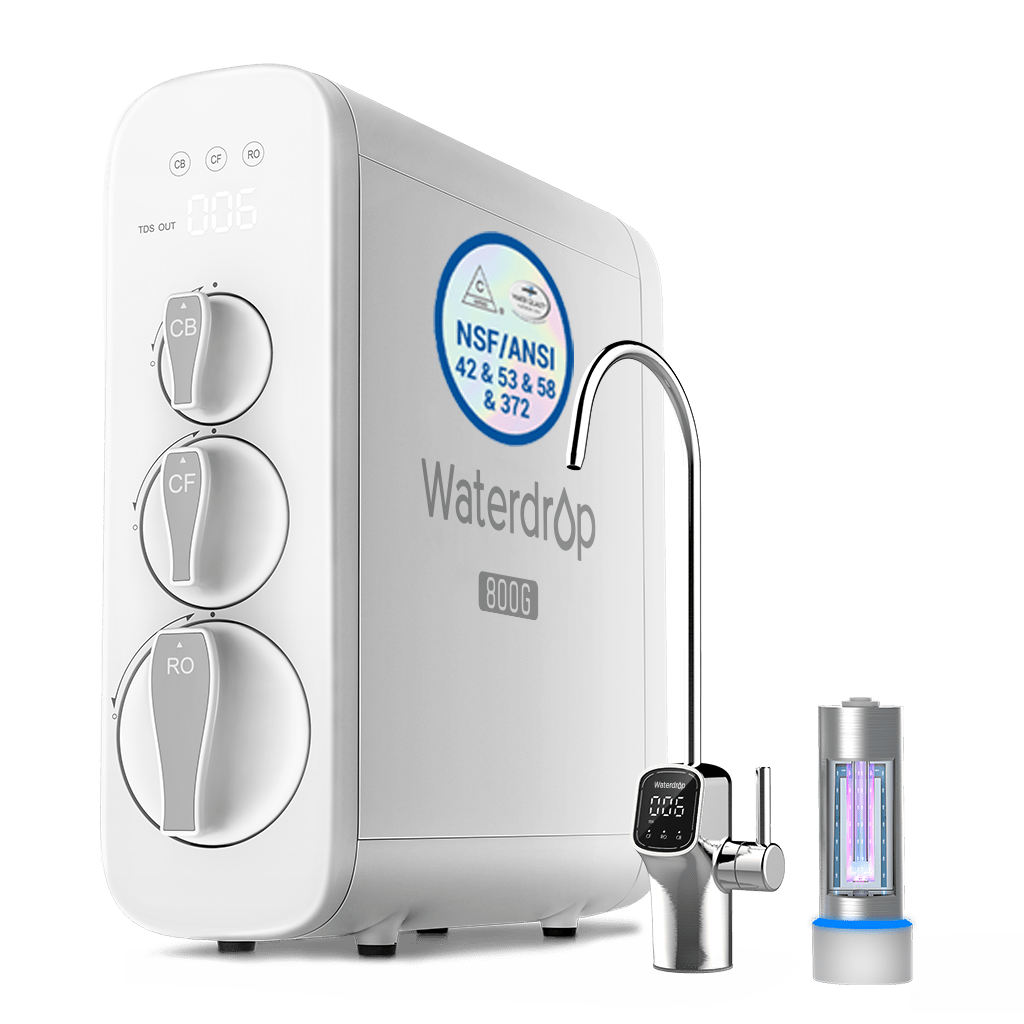
The Waterdrop G3P800 is the best overall reverse osmosis system, a tankless 800 GPD unit that's NSF/ANSI 42, 53, 58 and 372 certified and dispenses fast with no storage tank. It posted one of the best efficiency ratios of any tankless RO tested at 3:1 pure-to-drain, and lab testing confirmed 93-95% TDS reduction. Its only real gaps are price and the missing built-in remineralization, which Waterdrop sells separately.
Full review
Filtration and Certification
The Waterdrop G3P800 leads the reverse osmosis category on the strength of its certifications and lab-verified performance. It carries NSF/ANSI 42, 53, 58 and 372 certification, a comprehensive set covering taste and odor (42), health contaminants (53), TDS reduction via reverse osmosis (58), and lead-free materials (372). That four-standard coverage is broader than most competitors and gives buyers independent verification across the full range of what an RO system should address.
Independent lab testing backs up the certifications. The 0.0001-micron RO membrane reduces over 1,000 contaminants, and the G3P800 removed selenium by 100%, fluoride by 78-100%, hexavalent chromium by 88-100%, and cut TDS by 93-95%. Quality Water Lab and Water Filter Guru both ranked it among the top tankless systems, with Water Filter Guru describing it as 'a compact, space-saving under-sink unit with excellent contaminant reduction performance.'
Tankless Design and Flow
The G3P800's defining feature is its tankless architecture. Traditional RO systems store purified water in a bulky pressurized tank that dominates the under-sink cabinet and dispenses slowly; the G3P800 instead produces water on demand through a built-in pump at a rated 800 GPD. Lab testing actually clocked it at roughly 886 GPD, the fastest flow of any RO system tested, fast enough to fill a glass in about five seconds.
As Popular Science summarized, the system 'provides clean, filtered water without a wait,' which is the everyday payoff of the tankless design. Eliminating the tank also frees up significant under-sink space, as Quality Water Lab notes, a real benefit in cabinets already crowded with plumbing and cleaning supplies. A smart faucet rounds out the package, displaying real-time TDS readings and remaining filter life so you always know the water quality and when service is due.
Efficiency and Water Waste
Water waste is the traditional knock against reverse osmosis, and the G3P800 addresses it better than most. It carries a 3:1 pure-to-drain ratio, meaning only one gallon goes to drain for every three gallons purified. Quality Water Lab confirmed this is 'one of the best efficiency ratios among under-sink tankless systems tested,' a meaningful advantage over older RO designs that waste three or four gallons for every gallon produced.
That efficiency matters both for water bills and for environmental conscience, and it's a key reason the G3P800 edges out otherwise-excellent tank systems in overall ranking. Combined with the fast tankless flow, it delivers the purity of reverse osmosis without the two biggest historical drawbacks, slow dispensing and heavy water waste.
Flat taste unless you add the $30 remineralization kit
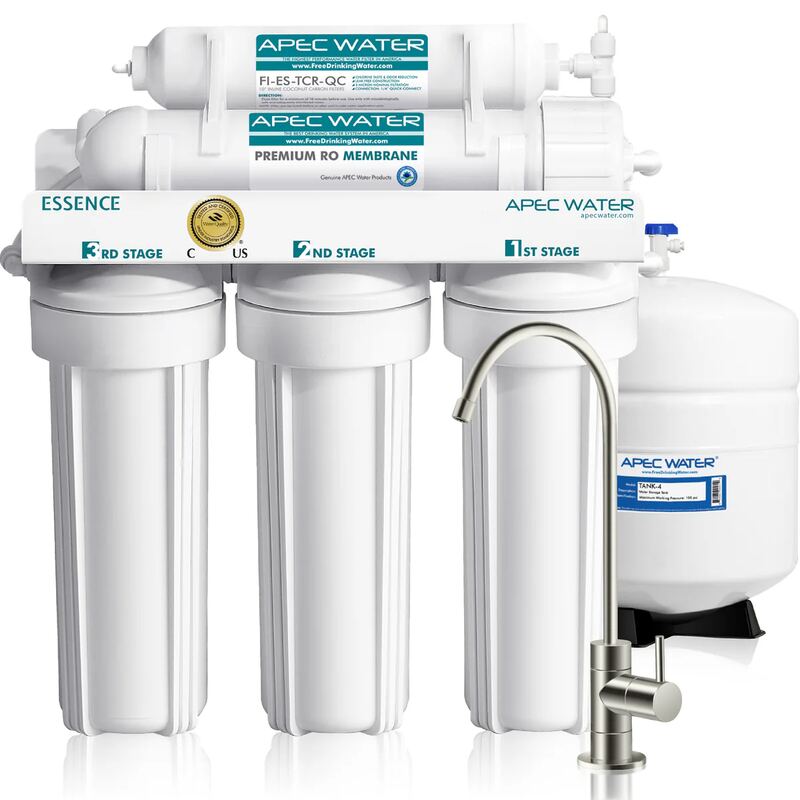
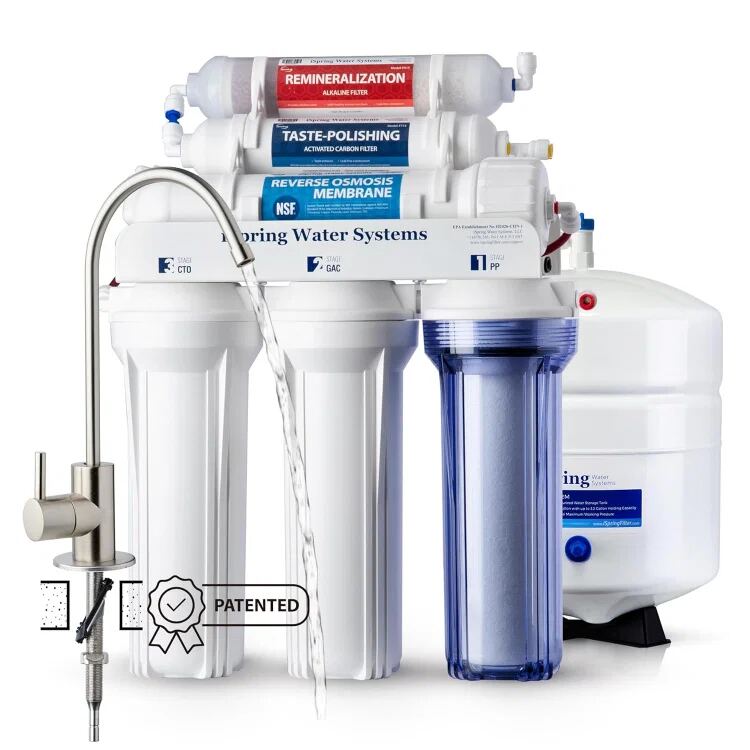
The most notable gap is remineralization. As Quality Water Lab notes, like most pure-RO systems the G3P800 strips minerals along with contaminants, leaving ultra-pure water that some find tastes flat or slightly acidic. Waterdrop sells a remineralization add-on for about $30, but buyers who want naturally mineral-balanced water out of the box may prefer the iSpring RCC7AK or APEC ROES-PH75, which include an alkaline remineralization stage.
It's also a premium-priced system, costing more than traditional tank-based RO units, and it requires both electricity for the pump and a drain connection. Some owners have noted it runs a touch louder than simpler Waterdrop models. None of these undercut its top ranking, but they mean it's a higher-investment choice aimed at buyers who value speed, efficiency and certification over the lowest price.
800 GPD beats every tank system in speed
Against the tank-based iSpring RCC7AK and APEC ROES-50, the G3P800 dispenses far faster, wastes less water and saves cabinet space, though it costs more and lacks their remineralization (RCC7AK) or simplicity. Against the Waterdrop D6, it offers higher 800 GPD output, more certifications and better efficiency, justifying its higher price for heavier users.
Compared with the remineralizing APEC ROES-PH75, the G3P800 trades the alkaline stage for tankless speed, more certified standards and a smart faucet. For buyers who prioritize fast, efficient, heavily certified RO water and are willing to add remineralization separately if desired, it's the standout pick of the group.
$699 buys the broadest certification set here
At around $699 the G3P800 is a premium purchase, but the value lies in what it consolidates: the broadest certification set in this roundup, the fastest flow, the best efficiency, and a smart faucet, all in a tank-free package that reclaims cabinet space. For a household that uses a lot of filtered water, the speed and efficiency pay dividends daily.
The ongoing cost is reasonable thanks to long-life filters and the efficient 3:1 ratio that keeps water-bill impact low. Buyers can save meaningfully by choosing a tank-based system like the APEC ROES-50 if they don't need the speed, but for those who want the best tankless RO experience and certified peace of mind, the G3P800 earns its price.
Fits crowded cabinets that can't fit a tank
The Waterdrop G3P800 is best for households that want the fastest, most space-efficient certified reverse osmosis water and are willing to pay a premium for a smart, tankless system with top-tier efficiency. It suits heavy filtered-water users and anyone with a crowded under-sink cabinet who can't fit a bulky tank.
It's less ideal for budget shoppers, who'd be better served by the APEC ROES-50 or Waterdrop D6, or for buyers who specifically want mineral-balanced water without buying an add-on, where the iSpring RCC7AK or APEC ROES-PH75 fit better. For the premium tankless experience, though, it's the top recommendation.
Strengths
- +NSF/ANSI 42, 53, 58 and 372 certified, covering taste, health contaminants, TDS and lead-free materials
- +Tankless 800 GPD design dispenses fast and saves under-sink space
- +Excellent 3:1 pure-to-drain efficiency, among the best of any tankless RO tested
- +Lab-verified 93-95% TDS reduction plus strong fluoride and chromium removal
- +Smart faucet displays real-time TDS and filter life
Watch-outs
- −Premium price versus traditional tank-based RO systems
- −No built-in remineralization; water can taste flat without the add-on
- −Requires electricity and a drain connection
- −Higher upfront cost than the value RO picks
How it compares
Unlike the iSpring RCC7AK and APEC ROES-PH75, it doesn't include remineralization, trading that for tankless speed and efficiency.
Rating sources
“The Waterdrop G3P800 provides clean, filtered water without a wait.”
Our 4.6 score is the average of these published ratings. Ratings marked * were derived from the reviewer’s written analysis or video transcript — the publisher didn’t print an explicit numeric score, so we inferred one from their own words. Click through to verify. More about methodology.