The Bose Smart Soundbar is a feature-packed, compact Dolby Atmos bar built around streaming smarts and balanced everyday sound. Its up-firing drivers and A.I. Dialogue Mode keep voices clear and effects tidy, and the deep streaming and voice-assistant integration make it a strong all-rounder. The trade-off is bass: with no subwoofer included it can't deliver the low-end weight movie enthusiasts crave, so it's best as a do-everything bar for smaller setups.
Full review
Rated 4.5 stars by TechRadar for consistency
The Bose Smart Soundbar's defining quality, per TechRadar, is that it is about as feature-filled as a compact Dolby Atmos bar gets, from Alexa and Chromecast built in to personal surround sound. That makes it an easy bar to live with day to day, switching from news to a film to a Spotify playlist without ever sounding obviously wrong. TechRadar rated it 4.5 stars, calling it "compact and feature-packed."
Atmos comes courtesy of genuine up-firing drivers, but from a cabinet just 27 inches long the height effect is more a subtle expansion of the soundstage than a precise overhead dome. Tom's Guide framed it as "a punchy yet compact soundbar that'll suit beginner setups" – a fair summary of a bar that prioritizes convenience and balance over raw cinematic scale. In a small room the effect is more than enough to lift movies above flat TV audio, even if it never approaches the enveloping ceiling that the LG SC9S manages with its triple up-firing array.
Lacks thumping bass without a subwoofer
Tom's Guide found the Smart Soundbar offered "mostly pleasant, balanced sound," with a tonal character that flatters dialogue and music. Bose's A.I. Dialogue Mode keeps speech clear and forward, which is a recurring strength of Bose bars and useful for late-night TV at low volume.
The headline weakness is bass. Tom's Guide was blunt: "It lacks proper thumping bass – a lack of subwoofer will do that." Without a dedicated low-frequency module the bar simply can't move air the way the subwoofer-equipped Samsung HW-Q800D does, so explosions and bass drops feel polite rather than physical. Bose sells an add-on bass module to address this, but it's an extra purchase.
Casing described as quite plasticky by Tom's Guide
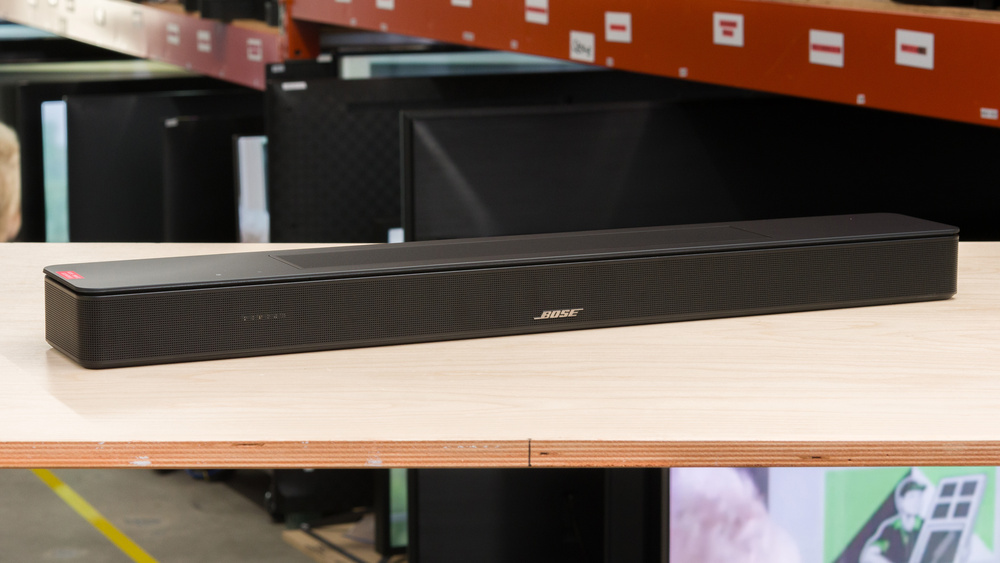
At roughly 27 inches the bar fits comfortably on tight TV stands – Tom's Guide placed it on a compact stand "with no sliding around or stability issues." That said, the same review judged the casing "quite plasticky," noting the mesh top "isn't the most appealing design," and singled out rivals like the Polk Signa S4 as better-looking. It's tidy and unobtrusive, just not a showpiece.
The wrap-around metal grille and low profile mean it disappears under most TVs, and the up-firing drivers sit beneath a perforated top panel. Bose keeps the footprint deliberately small so it suits apartments and bedrooms as readily as a main living room. There's no front display, with status conveyed by a small LED and the Bose app, which reinforces the clean look even if it sacrifices a little at-a-glance feedback.
Links directly to Bose Ultra Open Earbuds
Streaming is where the Bose pulls ahead. It includes built-in Amazon Alexa for voice control plus AirPlay 2, Spotify Connect and Chromecast, so it slots neatly into a smart home and can be driven from a phone with no remote. A standout extra is Bose Personal Surround sound, which links the bar directly to Bose Ultra Open Earbuds for a private, immersive listening session – a feature no rival here offers. Setup runs through the Bose app and is straightforward.
The Bose Music app handles initial pairing, room-aware ADAPTiQ-style tuning and EQ, and once configured the bar remembers its settings across inputs. A.I. Dialogue Mode can be toggled per-source so you keep voices forward for TV but flat for music. Because Alexa is on board, you can also control playback and smart-home devices hands-free without a separate smart speaker, which reinforces the Bose's pitch as a do-it-all hub for a compact living space.
Needs an optional bass module to hit its potential
The missing subwoofer is the recurring theme: this is not the bar for someone who wants their movies to rumble. The compact cabinet also caps how convincing its Atmos height layer can be, so dedicated home-cinema fans will get more from the Samsung HW-Q800D or LG SC9S. And while the feature set is rich, the plasticky styling and the need to buy a separate bass module to reach full potential keep it from outscoring the Sonos Beam Gen 2 on sound.
The spread of review scores tells the story: TechRadar's enthusiastic 4.5 stars rewards the features and balance, while Tom's Guide's 3.5 stars docks it for sound that's pleasant but not class-leading. That gap means expectations matter – buy it for the smart features and tidy footprint and you'll be happy; buy it expecting the most impactful audio in the price band and you'll wish you'd chosen the Samsung HW-Q800D.
Loses to the Sonos Beam on sound quality at $499
The Bose's natural rival here is the Sonos Beam Gen 2 at the identical $499. The Bose counters Sonos's virtualization with real up-firing Atmos drivers and a deeper multi-protocol streaming stack, but the Sonos earns higher sound-quality marks and a tighter multiroom ecosystem, so the Beam edges it on the ranking. Both cede bass to the subwoofer-equipped Samsung HW-Q800D and LG SC9S. The Sony HT-A3000 undercuts the Bose on price and adds built-in bass, though it lacks the Bose's smart-home breadth.
Within Bose's own range, the larger Smart Ultra Soundbar adds more drivers and a more expansive sound for more money, while this Smart Soundbar is the compact, value-oriented entry. For a small room where features and tidiness matter more than slam, it makes a strong case; for a dedicated home cinema it's outclassed by the bigger systems here.
Splits reviewers between 4.5 and 3.5 stars
At $499 the Bose lands at the same price as the Sonos Beam Gen 2, and the comparison is instructive: the Bose adds real up-firing Atmos drivers and a deeper streaming stack, while the Sonos counters with higher-rated sound quality and a stronger multiroom ecosystem. TechRadar's 4.5-star score signals that the Bose justifies its price on features and balance; Tom's Guide's more reserved 3.5 stars reflects the missing bass.
Where the Bose earns its keep is the breadth of what's built in – Alexa, AirPlay 2, Spotify Connect, Chromecast and the unique Ultra Open Earbuds pairing – without nickel-and-diming you for core streaming. The asterisk is that reaching its full potential means buying the optional bass module, which pushes the real-world cost up and narrows the gap to a sub-equipped system like the Samsung HW-Q800D.
For buyers already inside the Bose ecosystem – existing Bose earbuds, speakers or a Bose account – the value climbs because the Smart Soundbar groups with other Bose products and unlocks the Personal Surround trick. Standalone, it's a fairly priced compact bar with class-leading features; as part of a Bose setup, it's the glue that ties the rest together, which is a real consideration if you've already invested in the brand.
Suited to a first apartment or bedroom setup
Choose the Bose Smart Soundbar if you want a single compact bar that does a bit of everything – TV, music, voice assistant, multi-source streaming – in a small or beginner setup, and you're not chasing cinema-grade bass. Its balanced sound and deep smart-home integration make it a genuine Sonos alternative. Movie enthusiasts who want real low-end slam should pick the Samsung HW-Q800D, and listeners after the best one-box sound quality and Sonos ecosystem should look at the Beam Gen 2.
It's a particularly good match for someone furnishing a first apartment or a bedroom secondary system, where the compact size, hands-free Alexa control and clear dialogue matter more than reference-grade home cinema. If you own Bose Ultra Open Earbuds, the Personal Surround feature is a genuine reason to pick this bar over the Sonos. For a dedicated movie room, though, the budget is better spent on one of the sub-equipped systems here.
Strengths
- +Genuinely compact 27-inch cabinet with up-firing Atmos drivers that fits tight TV stands
- +Balanced, consistent sound that handles music, dialogue and movies evenly
- +Built-in Alexa voice control plus AirPlay 2, Spotify Connect and Chromecast streaming
- +Bose Personal Surround pairing with Ultra Open Earbuds for private immersive listening
- +Clear, well-projected dialogue with A.I. Dialogue Mode
Watch-outs
- −No subwoofer in the box means bass lacks real thump and depth
- −Casing looks somewhat plasticky compared with rivals
- −Atmos height effect is modest from such a small cabinet
- −Better suited to TV and music than demanding home-cinema movie fans
How it compares
Like the Sonos Beam Gen 2, the Bose Smart Soundbar is a one-box bar with no included subwoofer, so both give up the deep bass of the Samsung HW-Q800D. The Bose actually adds real up-firing Atmos drivers the Beam Gen 2 omits, but its small cabinet limits how much height it produces, and reviewers rate the Sonos higher for outright sound quality. Against the Sony HT-A3000 it offers richer streaming and voice features but similarly modest low-end.
Rating sources
“The Smart Soundbar makes up for it with its mostly pleasant, balanced sound. It lacks proper thumping bass – a lack of subwoofer will do that – but it's still a punchy yet compact soundbar that'll suit beginner setups.”
Our 4.0 score is the average of these published ratings. More about methodology.