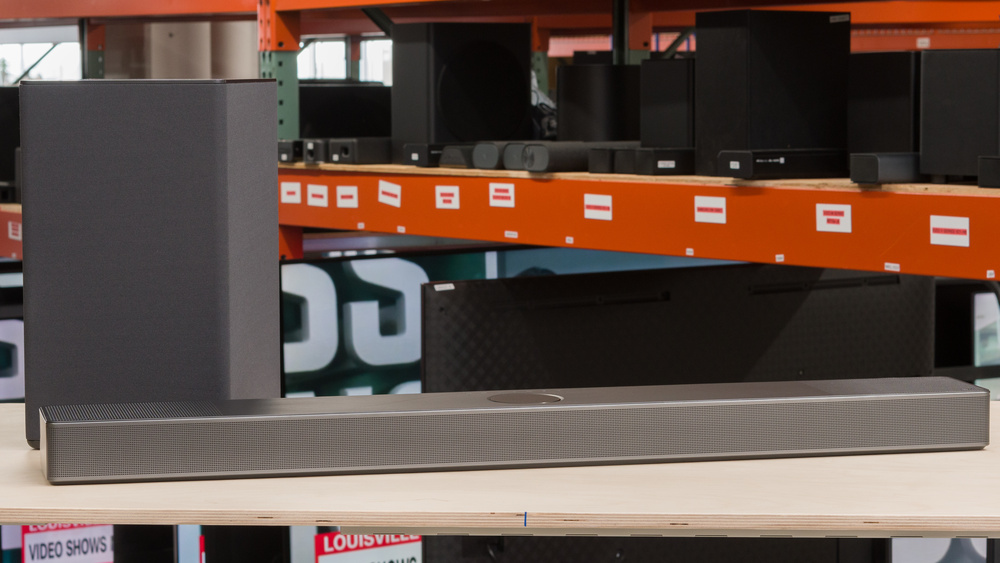
The LG SC9S is a feature-rich 3.1.3 Atmos bar whose triple up-firing drivers and punchy subwoofer create a tall, exciting, effects-driven soundstage – especially next to an LG OLED TV. Reviewers love its scale and feature set but flag that outright sound quality lacks subtlety and refinement, and its surround imaging needs the optional rears. It's a strong pick for LG TV owners who prize immersion and integration over audiophile nuance.
Full review
First soundbar with triple up-firing channels
The SC9S's calling card is its 3.1.3 channel layout – LG marketed it as the world's first Dolby Atmos soundbar with triple up-firing channels. RTINGS described it as a 3.1.3 bar with two center channels and a focus on height, designed to pair with LG TVs for a more immersive experience. That extra up-firing driver pays off on effects-heavy content: Reviewed found that "lightsaber battles packed incredible detail, dogfights between Rebel and Empire forces had all kinds of height and dimension to them, and moments when the force was used reverberated throughout my living room thanks to that punchy woofer."
Paired with an LG OLED via WOW Orchestra, the bar and TV speakers play together for an even bigger sound. The overall presentation is large and exciting, clearly trading on scale and impact rather than precision – it's a bar built to impress during a blockbuster.
Sound quality rated only 3 out of 5
Here the SC9S divides reviewers. Reviewed enjoyed its dynamic, dimensional sound, but What Hi-Fi was firm that "the feature set and LG TV symbiosis elements are impressive, but they don't make up for the SC9S's mediocre sound quality," rating its sound 3 out of 5. What Hi-Fi elaborated that "the presentation still lacks low-level dynamic subtlety, fine detail and clarity" and "it will deliver big explosions and a large soundstage, but it lacks the sort of subtlety required to deliver emotional engagement."
The wireless subwoofer is a genuine strength, adding the kind of low-end punch the subwoofer-less bars in this guide can't, but the satellites and overall tuning prioritize spectacle over nuance. For action and gaming that's a fun trade; for delicate music or dialogue-driven drama it's less convincing than the Samsung HW-Q800D or Sonos Beam Gen 2.
Styled to match LG's OLED TV lineup
The SC9S is designed to physically and aesthetically complement LG's OLED TVs, with a matching finish and a form factor meant to sit cleanly beneath them. It ships with a wireless subwoofer and supports optional rear speakers to build out a full surround system later. Build quality is solid and the included wall-mount bracket makes placement flexible.
Despite cramming three up-firing drivers and a 3.1.3 array into the cabinet, LG keeps the bar relatively compact – it's pitched specifically to sit in front of the matching OLED without overwhelming it. The wireless subwoofer is a conventional ported box that you can tuck to the side of the room. As Reviewed noted, it's "a powerful bar with tons of features that should feel right at home under most TVs," so even outside an LG setup the physical design slots in fine.
WOW Orchestra works only with LG TVs
The bar supports both Dolby Atmos and DTS:X, giving it broader format coverage than the Samsung HW-Q800D, and connects via HDMI eARC with an additional HDMI input. Its software story is built around LG TVs: WOW Orchestra and the tightest control integration are reserved for LG OLED and QNED owners, mirroring the Samsung-and-Sonos pattern of bars that reward staying inside their maker's ecosystem. With a non-LG TV it still works fully but loses the headline synergy features.
WOW Orchestra is the marquee trick – it plays the bar and a compatible LG TV's speakers together rather than muting the set, which broadens the soundstage further. WOWCAST enables a wireless connection to recent LG TVs to cut down on cabling, and the LG Sound Bar app exposes EQ presets and AI Sound Pro auto-modes. The catch is consistency: pair it with the right LG OLED and the experience is seamless and impressive; pair it with anything else and you're left with a capable but unremarkable standalone bar.
Can't do real surround without extra rear speakers
The core caveat is refinement: as What Hi-Fi put it, the SC9S "lacks the sort of subtlety required to deliver emotional engagement." Reviewed also cautioned that "the LG SC9S is not able to natively deliver convincing surround sound in any meaningful way" without adding the optional rear speakers, so the rounded surround experience costs extra. And because so much of its appeal is LG-TV integration, buyers on other TV platforms get less out of it than the price suggests.
Value is the other sticking point. What Hi-Fi flagged the SC9S as carrying "a significant price tag" for the sound on offer, and at its typical street price you're paying a premium for height hardware and feature count rather than tuning. Spend similar money on the Samsung HW-Q800D and you get a more refined, better-controlled 5.1.2 system; the SC9S only pulls ahead if the triple up-firing spectacle and LG synergy specifically matter to you.
Three up-firing drivers beat the Samsung's two
The SC9S stakes out the height-hardware extreme of this guide. Its three up-firing drivers outnumber the two in the Samsung HW-Q800D and Bose Smart Soundbar and dwarf the virtualized approach of the Sonos Beam Gen 2 and Sony HT-A3000. But that hardware advantage doesn't translate into a sound-quality win: the Samsung's better-controlled 5.1.2 system and the Sonos's refined one-box presentation both score higher with reviewers despite simpler height arrays.
The deciding factor is your TV. With an LG OLED and WOW Orchestra, the SC9S delivers a taller, bigger sound than anything else here and integrates beautifully. Without one, the same money buys a more refined experience from the Samsung HW-Q800D, which is why the SC9S sits mid-pack rather than higher.
Priced between the Sony HT-A3000 and Samsung
The SC9S typically trades around $599, putting it between the Sony HT-A3000 and the Samsung HW-Q800D. Its value proposition is unusual: you're paying for the most ambitious height hardware in the guide – three up-firing drivers and a wireless subwoofer – rather than for the most refined sound. Reviewed concluded it "sounds great and offers plenty of value thanks to a bunch of features," while What Hi-Fi's 3-star sound score is the counterweight reminding you the tuning isn't this bar's strong suit.
That value depends heavily on context. For an LG OLED owner who'll use WOW Orchestra and wants maximum spectacle, it's a compelling package; for a buyer on a different TV who cares most about sound-per-dollar, the more refined Samsung HW-Q800D or the cheaper, richer-sounding Sony HT-A3000 are easier to recommend. The optional rear speakers also add cost if you want true surround.
It's also a bar that tends to see meaningful discounts, and at a reduced price its value equation improves markedly – the triple up-firing array and included subwoofer become a lot more compelling when the premium for them shrinks. If you can find the SC9S on sale and you own a compatible LG TV, it shifts from a niche pick to a genuinely strong one.
Built for LG OLED owners chasing scale
The SC9S makes the most sense for LG OLED owners who want the tallest, most dimensional Atmos presentation in this guide and care more about cinematic scale than audiophile finesse. Its triple up-firing drivers and punchy subwoofer make action films genuinely thrilling. Buyers who want more refined, balanced sound should pick the Samsung HW-Q800D, and those after a tidy one-box bar with the best music chops should choose the Sonos Beam Gen 2.
Think of it as the spectacle specialist of this list: if your priority is the biggest, tallest, most enveloping wall of sound for blockbusters and games, and you can pair it with the LG TV it's built for, the SC9S delivers that in a way the others don't. If you mostly watch dramas, listen to music, or own a non-LG TV, the trade in refinement is harder to justify, and one of the more balanced picks will serve you better.
Strengths
- +World-first 3.1.3 layout with three up-firing drivers for an unusually tall, dimensional soundstage
- +Punchy, capable wireless subwoofer that delivers genuine low-end impact
- +Deep integration and matching design with LG OLED TVs, including WOW Orchestra
- +Big, exciting presentation that thrills with action movies and effects
- +Supports both Dolby Atmos and DTS:X
Watch-outs
- −Sound quality lacks low-level detail, subtlety and refinement
- −Native surround imaging is weak without the optional rear speakers
- −Best value is really only unlocked when paired with an LG OLED TV
- −Pricey for the sonic refinement on offer versus rivals
How it compares
The LG SC9S goes further than any other pick on height hardware, with three up-firing drivers versus the two in the Samsung HW-Q800D and Bose Smart Soundbar, and none in the Sonos Beam Gen 2. But where the Samsung HW-Q800D pairs its height channels with better-controlled, more refined sound, the SC9S trades refinement for spectacle, and unlike the Sony HT-A3000 it includes a real subwoofer for proper bass impact.
Rating sources
“The feature set and LG TV symbiosis elements are impressive, but they don't make up for the SC9S's mediocre sound quality.”
“Lightsaber battles packed incredible detail, dogfights between Rebel and Empire forces had all kinds of height and dimension to them, and moments when the force was used reverberated throughout my living room thanks to that punchy woofer.”
Our 3.6 score is the average of these published ratings. Ratings marked * were derived from the reviewer’s written analysis or video transcript — the publisher didn’t print an explicit numeric score, so we inferred one from their own words. Click through to verify. More about methodology.