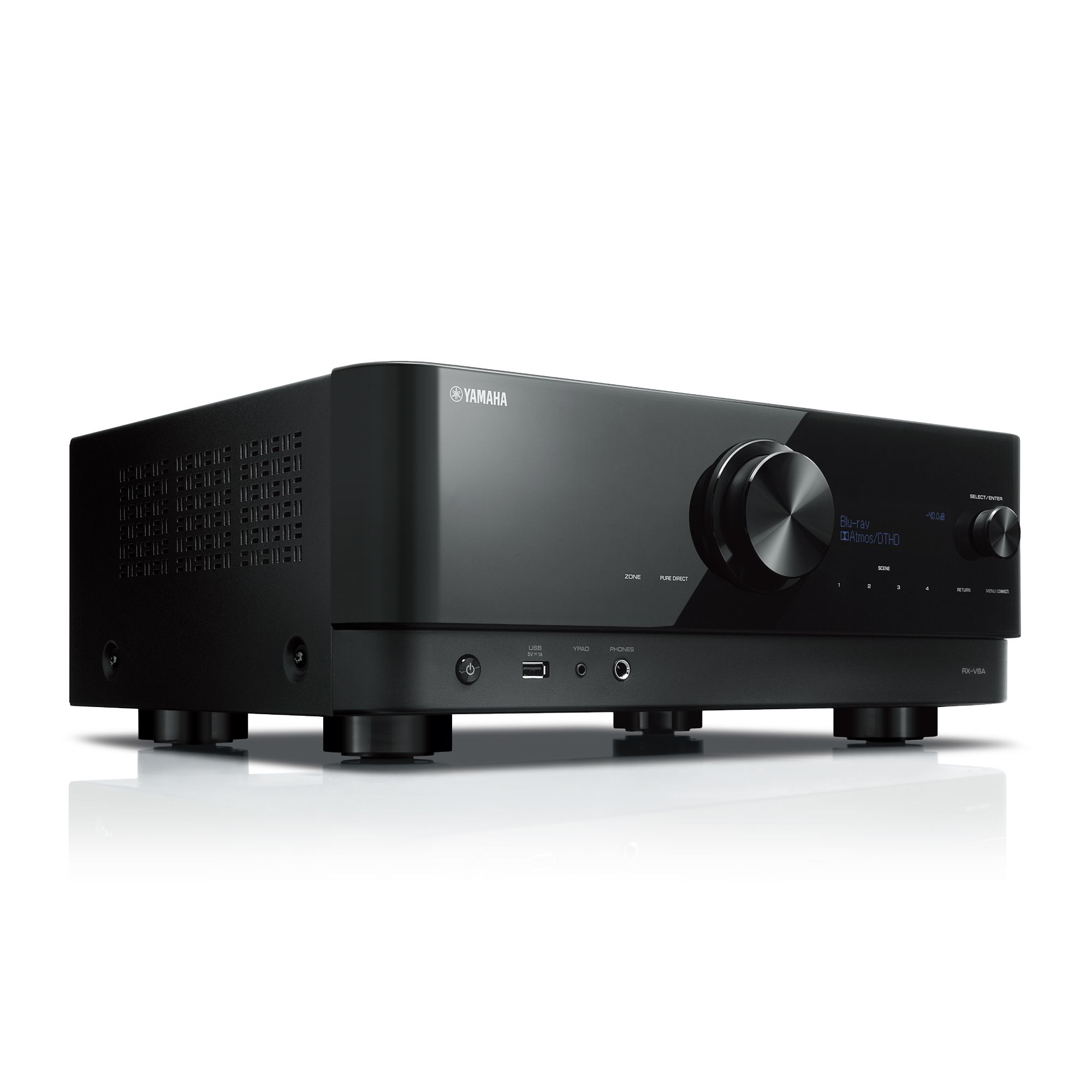
The RX-V6A is the value champion: a 7.2-channel, 8K-ready receiver that reviewers say sounds bigger than its price implies. What Hi-Fi called movie sound "simply wonderful," Sound & Vision made it "an easy recommendation for anyone who needs a sub-$600 AVR," and Z&K scored it 89/100. YPAO calibration across up to eight positions and Cinema DSP 3D round out a genuinely complete package for small-to-mid rooms.
Full review
100 watts and concert-hall DSP under 600
The recurring theme in RX-V6A reviews is scale. Sound & Vision wrote that "the RX-V6A has nice power for its price and a nice sense of space for a receiver at any price" — the at-any-price qualifier being the notable part for a sub-$600 unit. What Hi-Fi found the "sound quality with movies simply wonderful," describing dialogue that stays clear and a sense of cinematic scale that belies the budget. For someone turning a living room into a movie space, that spaciousness is exactly the right priority.
Power is rated at 100 watts per channel into 8 ohms with two channels driven, the same headline figure as the more expensive Onkyo, and Yamaha's Cinema DSP 3D processing adds a layer of acoustic-space modeling drawn from real concert halls. The result is a receiver that fills a room convincingly without needing a premium price tag.
Atmos and Surround
The RX-V6A supports Dolby Atmos and DTS:X in a 5.1.2 height configuration, plus Dolby Atmos Height Virtualization for owners who cannot fit ceiling or up-firing speakers. Reviewers found the height effects "subtle, but it is precisely what is needed to make the scene more believable and realistic," with "an excellent scale and vertical extension."
The ceiling here is that height is limited to two channels (5.1.2) rather than the 5.2.2 some rivals manage, and you trade some surround channels to enable Atmos. For most real-world living-room layouts that is a non-issue, but a buyer planning an elaborate height array should note it.
Setup and Room Correction
Yamaha's YPAO calibration is a genuine strength at this price. Sound & Vision highlighted that "the RX-V6A allows you to measure up to eight positions, which gives YPAO more data to work with in calculating its filters" — multi-point measurement that helps the receiver optimize for an actual seating area rather than a single sweet spot.
It is not as refined as Denon's Audyssey MultEQ XT and there is no Dirac Live option, but for the money the eight-position YPAO is more capable than the auto-calibration on several pricier rivals, and the MusicCast app makes managing inputs and multi-room straightforward.
Connectivity
The RX-V6A is generous on HDMI — seven inputs and one output, with the first three inputs supporting 8K/60Hz and 4K/120Hz, plus VRR and ALLM for gaming. That is more HDMI inputs than several rivals here, useful for households juggling consoles, streamers and a disc player.
Wireless covers MusicCast multi-room, Wi-Fi, AirPlay 2 and Bluetooth, though the Bluetooth is the older 4.2 standard rather than 5.x — a minor spec-sheet wrinkle that rarely matters in practice but is worth noting against newer competitors.
Compact chassis built around Cinema DSP 3D
Physically the RX-V6A is a compact, tidy unit — 435 x 171 x 377 mm and 9.8 kg — that slots neatly into a typical media cabinet without the bulk of higher-tier receivers. The redesigned chassis that arrived with Yamaha's home-cinema shake-up gives it a cleaner, more modern face than the models it replaced, and the build feels appropriately solid for the price bracket.
Yamaha's Cinema DSP 3D processing is the design centerpiece, using sound-field data captured from real concert halls and music clubs to recreate those acoustic spaces at home. Combined with the spacious base tuning reviewers praised, it is the main reason the RX-V6A produces such a convincing sense of scale despite its modest footprint and price.
Atmos capped at 5.1.2, no THX
The compromises are exactly what you would expect at the price. The interface and MusicCast app are functional but less slick than the Denon or Sony equivalents, Bluetooth is an older revision, and Atmos tops out at 5.1.2. There is no THX certification and no Dirac path.
None of these are deal-breakers for the target buyer, but they are the reasons the RX-V6A sits behind the pricier, more feature-complete receivers in this ranking rather than above them. You are buying sound-per-dollar, not the longest feature list.
Full 8K support at the lowest price here
The RX-V6A is the budget anchor of this group. It cannot match the Denon AVR-X2800H's polish and Audyssey MultEQ XT calibration, nor the Onkyo TX-NR6100's THX certification and raw power, nor the Sony STR-AN1000's 360 Spatial Sound Mapping. What it does is deliver a genuinely spacious, full-8K-capable receiver for meaningfully less money than any of them, which is why it earns a top-three spot purely on value.
Seven HDMI inputs despite the budget price
Value is the entire pitch for the RX-V6A. Sound & Vision's verdict that it is "absolutely an easy recommendation for anyone who needs a sub-$600 AVR for a small to mid-sized room" frames it as the obvious choice in its bracket, and What Hi-Fi positioned it as "a must-consider if you're seeking surround and music power at this price." The aggregate 89/100 from Z&K Electronics confirms a receiver that scores highly relative to cost rather than in absolute terms.
Crucially, Yamaha did not gut the connectivity to hit the price. Seven HDMI inputs, three of them 8K-capable, eight-position YPAO and MusicCast multi-room are features you would expect on pricier units. That is why the RX-V6A keeps appearing on best-value shortlists years after launch — the fundamentals were strong and the discount has only widened the gap.
Ideal first surround system on a budget
Buy the RX-V6A if you want the most home-theater capability for the least money and your room is small to medium. It is ideal for a first proper surround system or a secondary room, where its spacious sound, eight-position YPAO and full 8K connectivity punch well above the price. Step up to the Denon AVR-X2800H or Onkyo TX-NR6100 only if you specifically need better room correction, THX modes, or more power for a large space.
Strengths
- +Spacious, well-organized sound with an unusually wide sense of scale for the price
- +100W per channel with a large, confident sense of space reviewers praised at any price
- +YPAO room correction supports measuring up to eight listening positions
- +Cinema DSP 3D adds convincing virtual surround and height with limited speakers
- +Excellent value, frequently the cheapest fully 8K-capable receiver of this group
Watch-outs
- −Bluetooth is older 4.2 rather than 5.x
- −On-screen interface and app are less slick than Denon or Sony
- −Atmos is limited to 5.1.2 height configurations, not 5.2.2
- −No THX certification or Dirac Live option
How it compares
Its YPAO room correction is competent but less refined than the Audyssey MultEQ XT in the Denon AVR-X2800H, and it lacks the THX modes of the Onkyo TX-NR6100, but as a value pick it is the standout here.
Rating sources
“It is equipped with 7 channel amplifier with 100 W (8 Ohm, 20 Hz - 20 kHz, 2 channel driven) power per channel and is capable of 7.1 maximum channel processing.”
“A fine not-so-entry-level networked and nicely smart AV receiver and a must-consider if you're seeking surround and music power at this price.”
Our 4.3 score is the average of these published ratings. Ratings marked * were derived from the reviewer’s written analysis or video transcript — the publisher didn’t print an explicit numeric score, so we inferred one from their own words. Click through to verify. More about methodology.