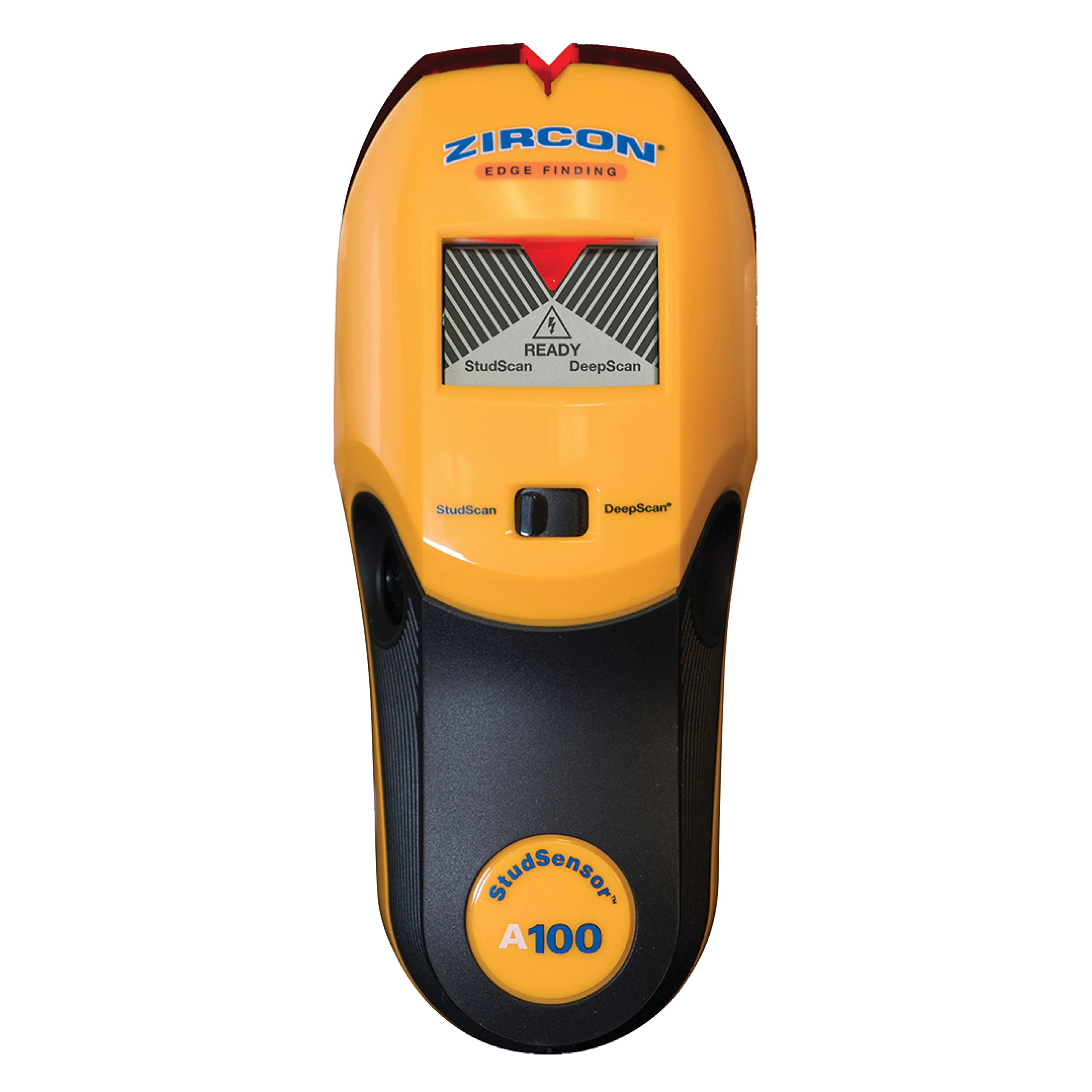
The StudSensor A100 is an edge finder, not a center finder: it marks where a stud begins and ends and leaves the midpoint to be worked out by hand. StudScan reads to ¾ in. (19 mm) and DeepScan doubles that to 1½ in. (38 mm), while WireWarning flags live unshielded AC wiring in either mode. A 9V alkaline battery is required and not included.
Full review
StudScan to ¾ in., DeepScan to 1½ in.
Two modes, one button. StudScan reads to ¾ in. (19 mm), which covers ordinary drywall, and DeepScan doubles the depth to 1½ in. (38 mm) for thicker sheathing or a doubled layer of board. Both find the edges of wood and metal studs; neither reports a center, so the honest workflow is to mark both edges and split the difference before drilling.
WireWarning covers live unshielded AC to 2 in.
The scanner watches for live unshielded AC wiring while it works and warns before a nail goes into it. Two limits are worth knowing: it sees only unshielded conductors, so wiring in metal conduit or armored cable is invisible to it, and anything deeper than about 2 in. (50 mm) is outside its range. Treat it as a second check rather than permission to drill blind.
A SpotLite arrow instead of a beep to chase
Rather than relying on a tone, the A100 projects an arrow-shaped light onto the wall at the stud edge and shows the same reading on its display. That matters on a job site, where an audio alert disappears under a compressor or a saw. The translucent base and marker groove let a pencil line go down without lifting the tool off the spot it found.
A 9V battery you have to supply
The tool weighs 4.80 oz. (136 g) without a battery and needs a 9V alkaline that is not in the box. That is a small annoyance at purchase and a larger one later, because 9V cells are the ones nobody keeps spares of, and a scanner running on a weak battery gives unreliable readings rather than no readings at all.
Lath and plaster is outside what it can read
The A100 is not recommended for lath and plaster, which rules out a great deal of pre-war housing. Textured, freshly painted or damp walls also degrade its readings, and starting a scan directly over a stud confuses the calibration until the tool is lifted, moved along the wall and started again.
Strengths
- +StudScan mode locates edges of wood and metal studs up to 3⁄4 in. (19 mm) deep
- +DeepScan Mode doubles scanning depth to locate edges up to 11⁄2 in. (38 mm) deep
- +WireWarning Detection indicates presence of live unshielded AC electrical wiring up to 2 in. (50 mm) deep
- +SpotLite Pointer shines an arrow-shaped light to clearly indicate stud edge location
Watch-outs
- −Marks stud edges only, so finding a center means marking both sides and measuring
- −Not recommended for lath and plaster walls
- −Requires a 9V alkaline battery that is not supplied
- −WireWarning only sees unshielded conductors, so conduit and armored cable are invisible to it
How it compares
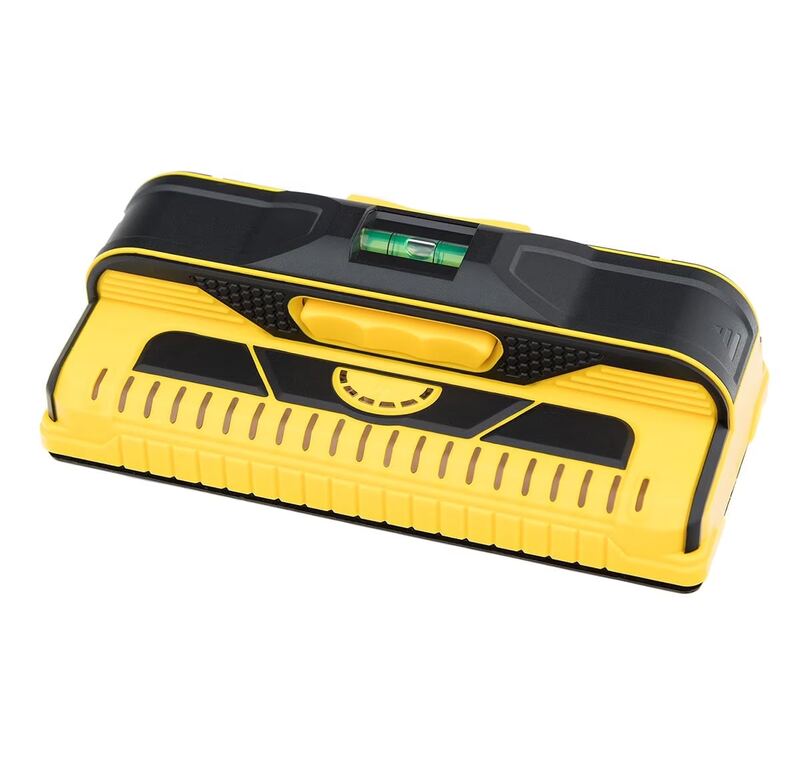
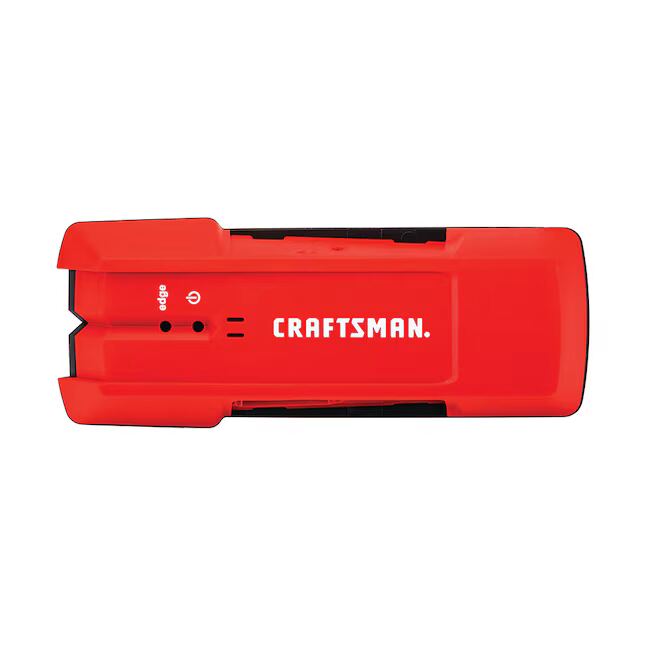
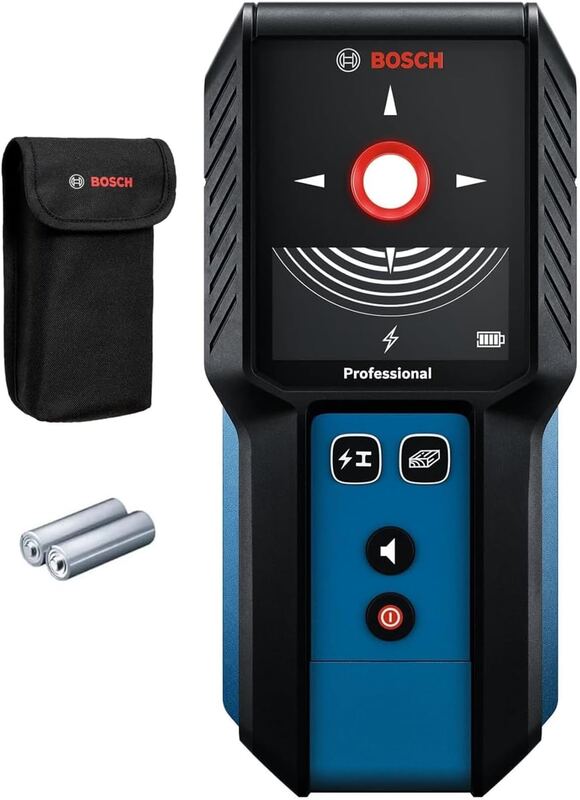
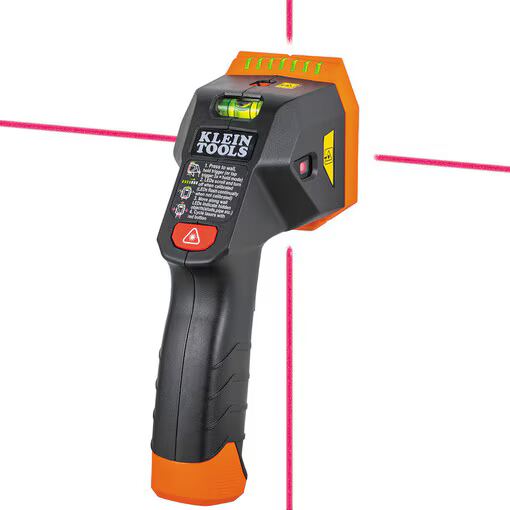
The Franklin Sensors ProSensor M210 lights up a whole stud at once and needs no calibration pass, which is the real upgrade over an edge finder. The battery-free C.H. Hanson 03040 is a magnet, cheaper and dumber. The A100's case for itself is scanning depth plus the wire warning at around $26.32.
Rating sources
Our 5.0 score is the average of these published ratings. Ratings marked * were derived from the reviewer’s written analysis or video transcript — the publisher didn’t print an explicit numeric score, so we inferred one from their own words. Click through to verify. More about methodology.