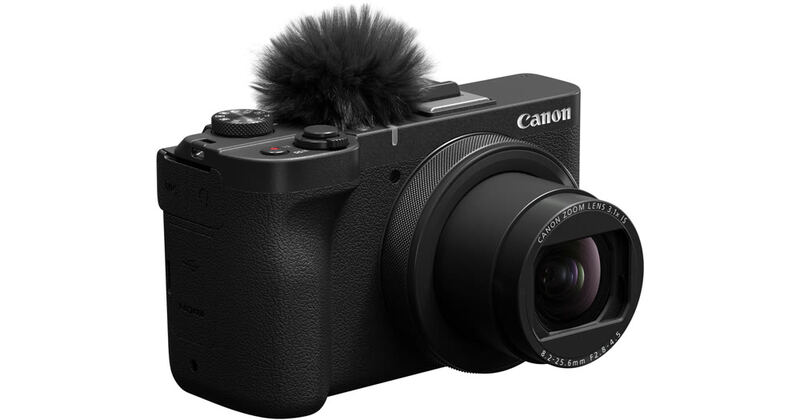
The Canon PowerShot G7 X Mark III remains the most pocketable pick here, a 1-inch compact with a bright zoom, crop-free 4K, and built-in YouTube live-streaming. It's a proven creator favorite, though it's a 2019 design that overheats in 4K and lacks modern stabilization, which puts it in casual vlogging and stills territory rather than long video takes.
Full review
First compact with built-in YouTube live-streaming
The G7 X Mark III earned its reputation as, in Amateur Photographer's words, TikTok's favourite camera, and a lot of that appeal still holds today. It is genuinely pocketable, has a bright and versatile zoom, and handles beautifully thanks to Canon's well-judged dials and touchscreen. TechRadar praised its longer-than-usual lens, great handling and a whole suite of niceties for videographers, and awarded it 4.5 stars. Canon added crop-free 4K so your framing does not change when you switch from stills to video, plus the headline party trick at launch of built-in live-streaming straight to YouTube, which was a first for any camera and remains genuinely useful for creators who go live.
DPReview, which scored it 81%, was clear about where it shines: as a stills camera, it is one of the best enthusiast compacts on the market, and a good value considering its feature set. For grabbing quick clips, vlogging short segments, and capturing high-quality photos in a camera that genuinely lives in a pocket, it remains a strong everyday companion years after launch, and its proven track record with creators means there is a deep well of accessories and community knowledge around it.
Zooms to 100mm equivalent, longer than most compacts
The 20.1MP 1-inch sensor and bright f/1.8-2.8 lens are the standout image-quality features. That fast aperture pulls in noticeably more light than the Canon PowerShot V1's f/2.8-4.5 lens, which helps in dim rooms and at night, and it produces pleasant background separation, especially at the longer end of the 24-100mm equivalent range. Stills are crisp with classic Canon JPEG color that needs little editing, and the 1080p/120fps mode delivers smooth slow motion for B-roll and transitions.
The lens reaches all the way to a 100mm equivalent, which is unusually long for a pocket compact and great for tighter framing, flattering portrait-style headshots, and reaching distant subjects. The trade-off is that the wide end starts at 24mm, which is tighter than the V1's 16mm, so arm's-length selfie vlogging is more cramped and you often cannot fit much background in the shot. In practice the G7 X Mark III leans slightly more toward stills and short clips than dedicated wide walk-and-talk video, and it is happiest as a do-everything carry camera.
Lightest camera in this roundup at 304 grams
At just 304g the G7 X Mark III is one of the lightest and most pocketable cameras in this roundup, and that portability is its whole reason for being. The metal-bodied compact slips into a jeans pocket, has a tilting touchscreen that flips up 180 degrees for self-framing, and offers the kind of refined control ring and dial layout Canon is known for. There is a 3.5mm microphone input for better audio than the built-in mic, which was a notable addition for vloggers when the camera launched and still matters for anyone serious about sound.
The design is fundamentally a 2019 enthusiast compact, so it predates the latest creator-focused refinements such as cooling vents and fully articulating screens. It is not weather sealed, the screen tilts rather than fully articulating to the side, and there is no viewfinder. None of that undermines its core appeal as a take-anywhere camera, but it does explain why the newer Canon PowerShot V1 exists, addressing the G7 X Mark III's chief shortcomings with a bigger body that adds venting and a wider lens.
Overheats and shuts down during 4K recording
The defining weakness is heat. As DPReview put it, the biggest drawback of this camera for video is that in 4K it overheats quickly and shuts down. For anyone planning long 4K takes, a full event, a long monologue, or a continuous tutorial, that thermal limit is disqualifying, and it is precisely the problem the newer Canon PowerShot V1 solved with active cooling vents. There is also no gimbal or in-body stabilization, so handheld 4K relies on the lens-based optical IS alone, which smooths static handholding but cannot tame walking footage the way the Osmo Pocket 3's gimbal does.
It is a 2019 design, so the autofocus system and sensor are a generation or two behind the Sony ZV-E10 II and Fujifilm X-M5, and the fixed lens offers no upgrade path whatsoever. Face tracking is decent but not class-leading, and the camera lacks the 10-bit capture and Log profiles that the mirrorless options provide. These are the inherent trade-offs of buying a proven older compact at a reduced price rather than the latest hardware, and they are why it sits at the bottom of an otherwise strong list rather than being a poor camera.
Gathers more light than the newer V1's lens
Within this group the G7 X Mark III is the pocketability champion, smaller and lighter than the Canon PowerShot V1 and far more compact than the interchangeable-lens Sony ZV-E10 II and Fujifilm X-M5. It shares the 1-inch sensor class with the DJI Osmo Pocket 3, and its bright f/1.8-2.8 lens actually gathers more light than the V1's slower zoom, giving it a low-light edge over its own larger sibling in some situations.
But it gives ground almost everywhere else that matters for serious video. The Osmo Pocket 3 has a gimbal and the same sensor class with newer processing; the V1 has a larger sensor, a wider lens, and unlimited 4K; and the two mirrorless cameras offer bigger sensors, 10-bit color, and lens flexibility. The G7 X Mark III's argument is simple: it is the one you will always have with you because it is the smallest, and for casual creators that convenience can outweigh the spec-sheet gaps.
Best for casual creators who prize pocketability
The G7 X Mark III is for the creator who values pocketability above all and shoots a mix of stills and short clips rather than long-form 4K video. If you want a camera that genuinely disappears into a pocket, has a bright versatile lens, and can live-stream to YouTube out of the box, it remains a delight to use and a proven performer for social content, travel, and everyday photography.
Look elsewhere if you record long continuous 4K segments, where the overheating will quickly frustrate you, or if you want modern autofocus, 10-bit color, and stabilization. The Canon PowerShot V1 is the natural step up within the Canon family and the DJI Osmo Pocket 3 wins for stabilized handheld video. But as a compact, do-everything, carry-anywhere camera with a bright lens and lovely Canon color, the G7 X Mark III still earns its place at the value end of this list.
Strengths
- +Genuinely pocketable 1-inch sensor compact that's easy to carry everywhere
- +Bright f/1.8-2.8 24-100mm equivalent zoom for low light and flattering compression
- +4K video with no crop, so framing stays consistent between modes
- +Built-in live-streaming to YouTube, a first for a camera, plus a mic input
- +Excellent controls and image quality for an enthusiast compact
Watch-outs
- −Overheats and shuts down quickly when recording 4K
- −No in-body or gimbal stabilization for video
- −Aging 2019 model that lacks the latest autofocus and sensor tech
- −Fixed lens with no upgrade path and a tighter wide end than dedicated vlogging compacts
How it compares
The most pocketable camera here, smaller than the Canon PowerShot V1 and the interchangeable-lens Sony ZV-E10 II and Fujifilm X-M5. It shares the 1-inch sensor class with the DJI Osmo Pocket 3 but lacks that camera's gimbal, and its bright f/1.8-2.8 lens gathers more light than the V1's, though the V1's larger sensor and unlimited 4K make it the better dedicated vlogger.
Rating sources
“As a stills camera, it's one of the best enthusiast compacts on the market, and a good value considering its feature set.”
“With a longer-than-usual lens, great handling and a whole suite of niceties for videographers, it succeeds in offering enough to warrant its place in a populated section of the market.”
“TikTok's favourite camera”
Our 4.2 score is the average of these published ratings. Ratings marked * were derived from the reviewer’s written analysis or video transcript — the publisher didn’t print an explicit numeric score, so we inferred one from their own words. Click through to verify. More about methodology.